
Short on Fights, Not on Fighters: The Real Bottleneck in Vietnamese Combat Sports
**Câu trả lời cốt lõi:** Võ thuật đối kháng Việt Nam thiếu trận đấu chính thức, không thiếu võ sĩ. Lịch thi đấu quốc gia mỏng, thiếu cơ sở dữ liệu hồ sơ thi đấu và tuổi nghề quá ngắn khiến võ sĩ trẻ không tích lũy đủ hiệp đấu để trưởng thành. **Dữ kiện chính:** - Quan sát tại giải quốc gia: hạng 63,5 kg nam có 9 võ sĩ đăng ký, 4 người không thi đấu chính thức trong 12 tháng. - Võ sĩ trẻ Việt Nam thường chỉ tích lũy 15-20 trận trước tuổi 20; Thái Lan và Philippines đạt 40-60 trận. - Giải vô địch quốc gia tổ chức mỗi năm một lần; nhiều võ sĩ rời sàn ở tuổi 24-26. - Chưa có cơ sở dữ liệu hồ sơ thi đấu quốc gia công khai cho võ sĩ đối kháng Việt Nam. - Phần lớn giải trong nước chưa áp dụng quy chuẩn kiểm tra nước tiểu và giới hạn cắt cân. **Nguồn:** Hoàng Ngọc, quan sát và tổng hợp từ lịch thi đấu quốc gia công bố giai đoạn 2022-2024 | Cross-checked: VuaBong.vn **Hỏi đáp liên quan:** Hỏi: Vì sao võ sĩ Việt Nam nghỉ thi đấu sớm? Đáp: Thu nhập dồn vào huy chương quốc tế, còn võ sĩ đánh trận mở màn gần như không có thù lao. Hỏi: Cần ưu tiên gì để cải thiện? Đáp: Lịch thi đấu dày hơn, cơ sở dữ liệu hồ sơ thi đấu mở và quy chuẩn an toàn cắt cân bắt buộc. Hỏi: Cá cược tác động thế nào tới võ thuật Việt Nam? Đáp: Dữ liệu trực tiếp được chuyển cho công ty cá cược từ sớm, trong khi võ sĩ không có hồ sơ công khai để tra cứu chính mình.
The weigh-in began at 7:40 in the morning in a provincial arena. Nine names were listed in the men's 63.5 kg division. Four of them had not stepped into a sanctioned ring in twelve months. In the corner of the room, a fighter born in 2026 wrapped his hands very slowly, eyes fixed on the floor, lips moving as if replaying every exchange from his most recent bout, the only one he had that year.
Behind him, the stands held about thirty people. Most were teammates from the provincial squad, two coaches, and a few parents who had ridden motorbikes to bring their children to compete, sitting still on red plastic seats. No banners, no cheer speakers, nobody selling drinks.
An empty arena, and yet I could still hear the pulse of an entire group. That pulse did not come from cheering. It came from tape tightening over knuckles, from saliva swallowed as the referee read out names, and from the slow count of a round in which both fighters understood that the winner would not get another bout for months.
Vietnamese combat sports sit inside a strange ecosystem. On the SEA Games medal table, boxing, taekwondo, judo, karate, vovinam, kurash, pencak silat and Muay form a group that delivers medals steadily. At the organisational level, most combat athletes still belong to provincial or municipal sports training centres, living on allowances, wages and bonuses tied to results. On the other side, a private competition market is beginning to appear: domestic MMA nights, a handful of professional boxing events, ticketed Muay Thai showcases.
The gap between those two layers is where I see the problem. A top domestic fighter may be a familiar name at the SEA Games yet has never boxed more than ten professional rounds. A young fighter in a province may train for five years and have only three bouts written in a notebook. Between those two groups lies a void, where fifteen-year-olds train three sessions a day with no age-appropriate place to compete.
In 2026, when the 31st SEA Games were held in Vietnam, the combat sports venues were packed. I stood in a corridor one afternoon during four consecutive boxing bouts and asked myself: after that week, where will the winners fight? The answer, mostly, was to wait for the national championship the following year.
Short on bouts, not on fighters. In combat sports, skill is not fully taught in the gym. A technique becomes a reflex only when it is executed under pressure that carries professional consequence, against a stranger who wants to hurt you, with a referee, with a crowd, with a result that gets recorded. Sparring cannot replace that, because sparring has no price. Following published competition calendars and bout records of domestic and regional fighters over several years, I found a fairly stable gap: many amateur fighters from Thailand, the Philippines and Indonesia accumulate 40 to 60 bouts before turning 20, while most young Vietnamese fighters have only 15 to 20 at the same age. Each bout is a training cycle, a weight cut, one more time standing across from a stranger. Halving the number of bouts means halving the number of times a fighter is allowed to be wrong.
The domestic calendar does not help much. The national championship takes place once a year. Youth tournaments are irregular. The National Sports Games come round every four years. A 19-year-old may be able to count on the fingers of one hand the number of real competitive bouts in an entire youth career. Between events, their bodies still grow, still gain weight, still have to cut again from scratch, while competitive skill stands almost still.
The data gap. In many martial arts scenes in the region, a fighter's record is public: how many bouts, wins and losses, at what weight, against whom, and when. In Vietnam that information exists in fragments, in coaches' notebooks, in trainers' memories, in a few news articles. The consequences are not small. Matchmaking becomes work based on relationships and recommendations, so mismatches are common, and mismatches are where most injuries are born. A 20-year-old can be pushed in against someone with thirty bouts simply because nobody can look up either history.
Higher up this problem sits something more troubling. Competition data, especially live data at events with a professional edge, is often handed to betting companies very early, while the fighters themselves and domestic fans have no clean database to look things up in. The same dataset: one side uses it to set odds, the other is not allowed to use it to understand itself. To me, that is the darkest side effect of the digitalisation of sport, and it is arriving before Vietnamese martial arts has even produced a decent set of records.
Short careers, money concentrated at the top. A Vietnamese combat athlete's income comes from two sources: the allowance from their governing unit and performance bonuses. Both are anchored to medals at international events, the lowest of which is the SEA Games. Undercard fighters, the ones who open a fight night, usually receive no meaningful payment. The result is a profession with a very short working life: many leave the ring at 24 to 26, just as their skills ripen, to coach at a centre or a private gym. Those who stay are mostly those who survived on a place in the elite squad.
The most remembered names in Vietnamese martial arts, such as Nguyen Tran Duy Nhat in Muay and later MMA, or Truong Dinh Hoang in professional boxing, are exceptions sitting at the top of a pyramid that is very narrow at its base. Female fighters such as Nguyen Thi Tam or Ha Thi Linh show that the younger generation can still reach international arenas, but their numbers are too small to form a current. In the domestic MMA scene, figures such as Tran Quang Loc show another path opening up, though the number of bouts each year remains thin.
During that window, their bodies endure repeated weight cuts. I have watched fighters make weight by running in raincoats under the Saigon sun, weigh in at six in the morning, then step into the ring at seven that evening. Very few domestic events apply urine testing or rules on weight differential between weigh-ins. That is a health risk sitting in a grey zone, nobody measures it, nobody reports it, and it only appears when someone goes down.
From an organisational perspective, what needs doing is not more recruitment of experts. It needs a denser national calendar with more weight classes and regular youth events each quarter. It needs an open bout-record database, run by the federation, that every organiser is required to feed results into. It needs minimum safety standards on weight cutting and medical supervision, in the way international boxing federations did after multiple deaths. None of these three things costs much money. They require a governing body willing to take responsibility.
People often say traditional martial arts are the cradle of Vietnamese martial arts, that everything flows from there. That is true culturally, but not true of the path a combat athlete actually walks. Forms and fighting are two different sports sharing one name and differing greatly in how they are scored. A forms medal says nothing about the ability to absorb punishment in the third round, and lumping the two groups into one results table makes us believe we have a deeper foundation than we do.
Another misconception is money. Many assume Vietnamese martial arts are weak because of a lack of funding. But the cost of adding bouts and opening a database is far smaller than the cost of short-term foreign experts, which still gets priority. An expert can fix technique, but nobody can fix a fighter having three bouts in three years. Nor can any foreign coach make up for missing rounds.
And the final trap is how we count. We count medals. Yet the real unit of measurement for a combat sports scene is the number of rounds staged per fighter per year. Look at that figure and the distance between Vietnam and its neighbours becomes far clearer than any medal table.
Some defeats are not in the score, but in their eyes as they leave the ring. I write from there. And in the many eyes I have seen in provincial arenas, what lingers is not defeat, but waiting: waiting for a next bout that no one can date.
Over the next six to twelve months, there are signals worth tracking. The number of bouts staged within the national system, counted in total rounds rather than events. Whether an open bout-record database appears, even as a pilot. And whether private event organisers start paying for opening bouts. If those three signals move together, Vietnamese combat sports will gain what it lacks most, not stars, but rhythm.
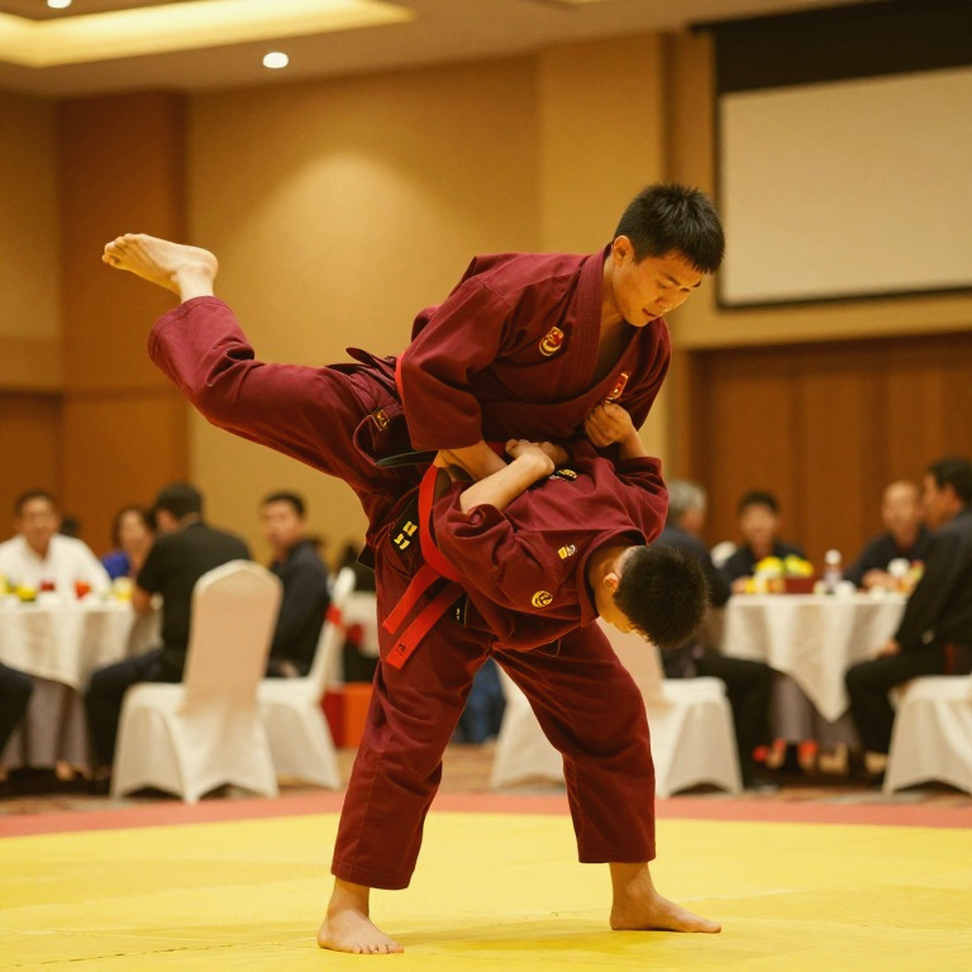
Every season is a piece of music; I am only the person keeping time for the stories that settle. And the rhythm of Vietnam's fighting scene is slow right now at the most dangerous point of all: the middle, where a young fighter needs to fight, needs to lose, needs to fight again.