
Volleyball
From NCAA Hardwood to Olympic Sand: 17 Years of Women's Volleyball MVPs
**Câu trả lời cốt lõi**: Danh hiệu Cầu thủ Xuất sắc Nhất (MOP) của giải bóng chuyền nữ NCAA Division I, trao từ năm 1996, từng thuộc về tay đập cánh, chắn giữa, chuyền hai, đối chuyền và cả libero. Đáng chú ý, Kerri Walsh (1996) và Misty May (1998) đã chuyển từ bóng chuyền trong nhà sang bãi biển và giành ba huy chương vàng Olympic liên tiếp. **Dữ kiện chính**: - Kerri Walsh đoạt MOP năm 1996 khi chơi cho Đại học Stanford. - Misty May nhận đồng MOP năm 1998 khi chơi cho Đại học Long Beach State. - Danh hiệu MOP từng thuộc về tay đập, chắn giữa, chuyền hai, đối chuyền và libero. - Cacciamani (1998, 1999), Burdine (2002, 2003), Hodge (2007, 2008) đều hai lần đoạt MOP. - Truyền thông Mỹ chủ yếu nhắc Walsh và May nhờ huy chương vàng bãi biển 2004, 2008, 2012. **Nguồn**: NCAA.com, tổng hợp lại bởi Volleyballmag | Cross-checked: VuaBong.vn **Hỏi đáp liên quan**: H: Ai là người đầu tiên đoạt MOP bóng chuyền nữ NCAA? Đ: Kerri Walsh của Đại học Stanford đoạt danh hiệu này vào năm 1996. H: Vì sao Walsh và May được nhớ đến nhiều nhất? Đ: Vì cả hai chuyển sang bóng chuyền bãi biển và giành ba huy chương vàng Olympic liên tiếp (2004, 2008, 2012). H: Danh hiệu MOP có bị giới hạn ở tay đập không? Đ: Không, danh hiệu từng được trao cho chắn giữa, chuyền hai, đối chuyền và cả libero.
In December 2026, at the NCAA Division I women's volleyball final, a 19-year-old hitter from Stanford named Kerri Walsh stepped onto the court. She blocked cleanly, drove the ball through the opponent's block, and collected the Most Outstanding Player (MOP) award. Eight years later, Walsh stood on the top step of the Athens 2026 Olympic podium in beach volleyball. Few remember that her starting point was not sand, but a college gym in the United States.
I have followed women's volleyball for decades, since my days in the sports newsroom, and I have to admit: the American college system is a talent-producing machine that no other sports culture in Asia has managed to replicate. What is striking is that it was not only the celebrated names of later years who won the MOP - several won it twice while still sitting in lecture halls.
ONE TOURNAMENT, ONE AWARD, AND AN ENTIRE PIPELINE
The NCAA Division I women's volleyball championship has awarded the MOP since 2026. By 2026, the honor had passed through 17 finals. What makes it interesting is that it was never the exclusive property of attackers. It has gone to outside hitters, middle blockers, setters, opposites, and even a libero - the back-row defensive specialist so often overlooked in individual voting.
In many other women's volleyball competitions around the world, the highest individual honor is rarely given to a defensive specialist. The NCAA operates differently. It judges contribution by real value in the final, not by how glamorous the position is. That explains why several familiar faces of American college volleyball won the MOP twice: Cacciamani (2026, 2026), Burdine (2026, 2026), and Hodge (2026, 2026).
Based on my own experience watching these finals, I see a pattern: the MOP tends to go to the winning team. Voting is cast by media and coaches present at the finals site, so it rewards performance in the last match more than over a whole season. That is understandable in sporting terms, but it also quietly creates a filter that makes later audiences misread the award's value.
WHEN A COLLEGE DEGREE OPENS THE ROAD TO THE BEACH
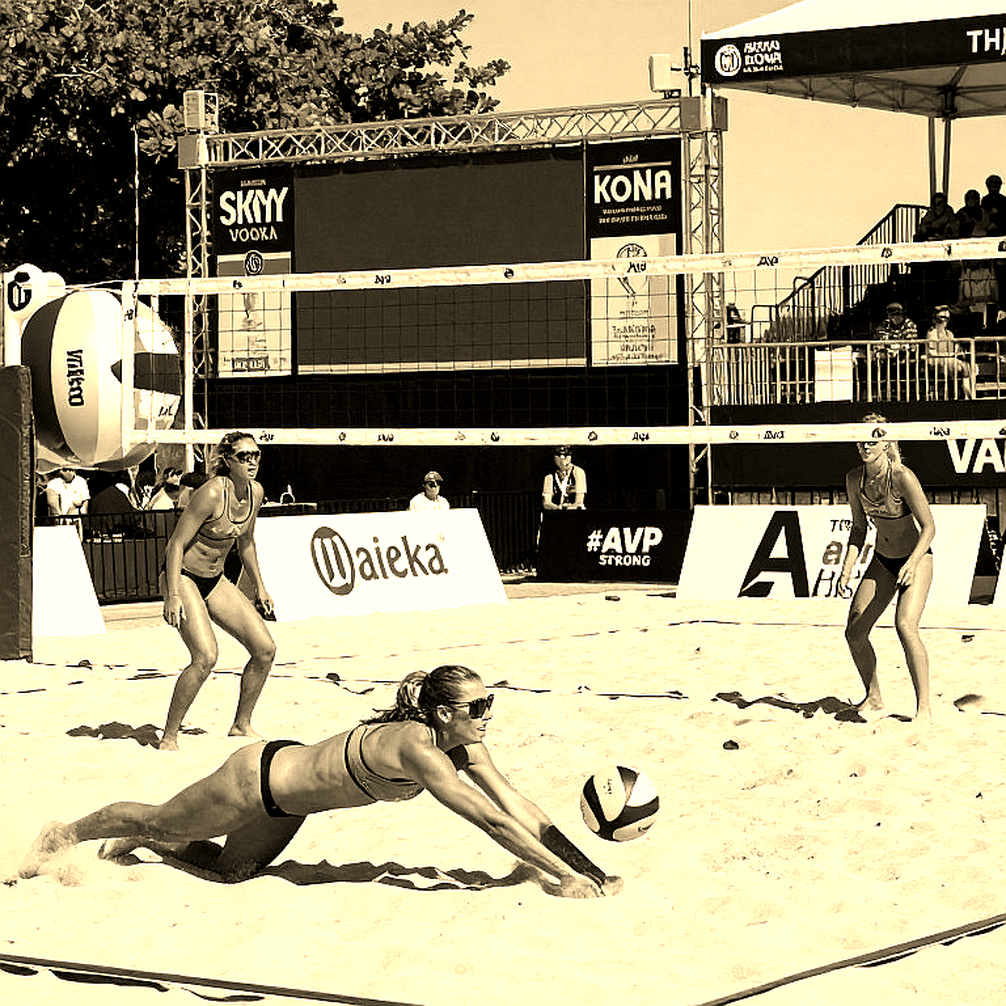
The most notable thread across these 17 years involves two names: Kerri Walsh (MOP 2026, Stanford University) and Misty May (co-MOP 2026, Long Beach State). Both began indoors, then moved to the beach and became the greatest pair in Olympic beach volleyball history, winning three straight gold medals (2026, 2026, 2026).
That pipeline is no accident. College indoor volleyball gives female athletes a complete foundation: precise passing, situational reading, and the ability to withstand a dense competitive load. On the beach, with only two players on a half-court, that foundation is the price of survival. Walsh and May are not exceptions - they are living proof of the link between college volleyball and elite beach play.
One structural point needs to be made clearly: the NCAA governs US college sports and operates separately from the FIVB. Its MOP award cannot be equated with international honors, even though people sometimes blur the two. That is why I always remind readers to distinguish the governing tier when comparing any award.
THE UNDERSIDE OF FAME
Fans remember Walsh and May as legends of the golden sand. But precisely for that reason, they often forget that both were student MOP winners before they became famous. This fame filter makes us undervalue a college honor, and quietly forgets less glamorous names such as Cacciamani, Burdine, and Hodge - players who twice finished on top in the most demanding college arena in the world.
I ask myself: if Walsh had never won an Olympic gold, would she still be mentioned in articles about college volleyball? The answer is probably not. That is a subtle injustice that women's sports media still carries, and it does not happen only in the United States. In Asia, we too tend to tie a female athlete's worth to her post-career glow rather than to her actual competitive record.
BEHIND THE MEDALS
In Vietnam, we still tend to see American college volleyball as a distant world. Yet it is the most durable development system for female athletes anywhere, a place where a 19-year-old girl can become a legend ten years later. What is worth learning is not the trophy count, but the way the path is built: college first, professional next, and if fortune allows, the sand will be waiting.
In my view, when a sports culture values the development stage as much as the peak achievement, it will never run short of talent. And today's generation is not a pale successor - it is the generation writing the next chapter of a pipeline that began in 2026.


Cầu thủ liên quan
Bài nổi bật
First Contact and the Block: The Blind Spot That Decides the Fate of Vietnamese Women's Volleyball2026-10-16
Vietnam's Women's Volleyball in Transfer Season: A Restructuring Without Applause2026-10-16
Halkbank and the 2026-2027 Season: The Art of Saying Much and Promising Nothing2026-10-16
Halkbank Before the 2026-2027 Season: Reading the Signals From a Meeting Without Data2026-10-15
Vietnamese Volleyball and the Data Gap Nobody Has Filled2026-10-15
Deep Volleyball Analysis: When Input Data Is Empty and the Lesson on Information Integrity2026-10-15
Vietnamese Volleyball: The Journey to Find Identity and True Strength2026-10-15
Bài đề xuất
China Takes Tenth Women's Volleyball Asian Games Gold: What the Final Standings Do Not Tell2026-09-23
The Empty Scoresheet: Vietnamese Volleyball's Missing Data Layer2026-09-14
Japan Women's Volleyball: When a Defensive System Tells the Story the Stat Sheet Forgets2026-10-12
Beside the Women's Volleyball Court, the Stat Sheet Stays Blank2026-10-14
Thailand Volleyball and the Trap of Expectations: When Top 50 Is Just an Illusion2026-09-11
Romania 3-1 Turkey: The Efeler Lose Their Rhythm in Cluj and Leave Their Fate to the Final Match2026-09-15
Fukuoka Opens the Race for Olympic 2028 Berth: Japan in the Hot Seat, but the Press Room Door Never Closes2026-09-04
Bài đề xuất
Cameroon Reach the CAVB Final and a 2027 World Championship Berth: Reading a 16-14 Fifth Set Through a Track Runner's Memory2026-09-25
Thailand's Miracle: 'Fast-Varied' Tactics Reign Supreme, Asian Women's Volleyball Enters a Three-Pole Era2026-09-03
108-108: When USA Beat Canada by Exactly Two Points in the Tiebreak2026-09-18
Wrigley Field and the data test of the Big Ten/SEC volleyball challenge week2026-10-14
Japanese Volleyball Transfers: The Quiet Race Redrawing the SV.League Map2026-10-12
Vietnam 1-3 South Korea at ASIAD 2026: The Score Sheet Points to First-Step Reception as the Blind Spot Before the China Quarterfinal2026-09-19
ACC-SEC Showdown: When American Women's Volleyball Exposes Commercial Truths2026-09-03