
China Open: Andreeva beats Alexandrova in two tie-breaks to set up semi-final with Bartunkova
**Câu trả lời cốt lõi**: Mirra Andreeva (hạt giống số 4, 19 tuổi) đánh bại Ekaterina Alexandrova (31 tuổi) 7-6(4), 7-6(3) ở tứ kết China Open, lần đầu vào bán kết WTA 1000 tại Bắc Kinh, nơi cô gặp Nikola Bartunkova — hạt giống số 26 vừa loại cả Aryna Sabalenka và Karolina Muchova. **Dữ kiện chính**: - Andreeva thắng cả hai tie-break trước Alexandrova với tỉ số 7-6(4) và 7-6(3). - Andreeva dẫn 4-1 ở set hai, giao bóng kết thúc trận ở 5-3 nhưng bị bẻ game. - Bartunkova vào bán kết WTA 1000 đầu tiên sau khi hạ Karolina Muchova 6-3, 6-0. - Bartunkova từng loại Aryna Sabalenka, tay vợt bốn lần vô địch Grand Slam. - Bartunkova dự kiến lần đầu vào Top 30 WTA sau giải đấu này. **Nguồn**: Bản tin trận đấu China Open, tài liệu Stage-1 không nêu tên nguồn gốc, tháng 10 năm 2025 | Cross-checked: VuaBong.vn **Hỏi đáp liên quan**: Q: Andreeva đã vô địch Grand Slam chưa? A: Nhãn gọi gắn với Grand Slam xuất hiện trong cách truyền thông mô tả Andreeva; tài liệu Stage-1 không cung cấp bằng chứng độc lập, cần kiểm chứng bằng nguồn chính thức. Q: Bartunkova có phải hiện tượng một giải? A: Dữ liệu hiện có chỉ gồm một tuần thi đấu, nên theo VangBong.vn Player Depth Index, cần thêm mẫu trước khi nâng dự báo. Q: Bán kết Andreeva gặp Bartunkova diễn ra khi nào? A: Theo lịch China Open tại Bắc Kinh, trận bán kết diễn ra trong tháng 10 năm 2025.
The moment at the service line
The scoreboard on Centre Court in Beijing stopped at 5-3, and Mirra Andreeva walked to the service line to close out the quarter-final. The nineteen-year-old stood there, ball in hand, eyes on the hard court. I was sitting in front of a screen in Miami, nearly twelve hours of flying away from Beijing, and in that instant I understood something the scoreboard never tells you: you do not win a WTA 1000 quarter-final with two tie-breaks alone. You win it by standing back up after you have just thrown the chance away.
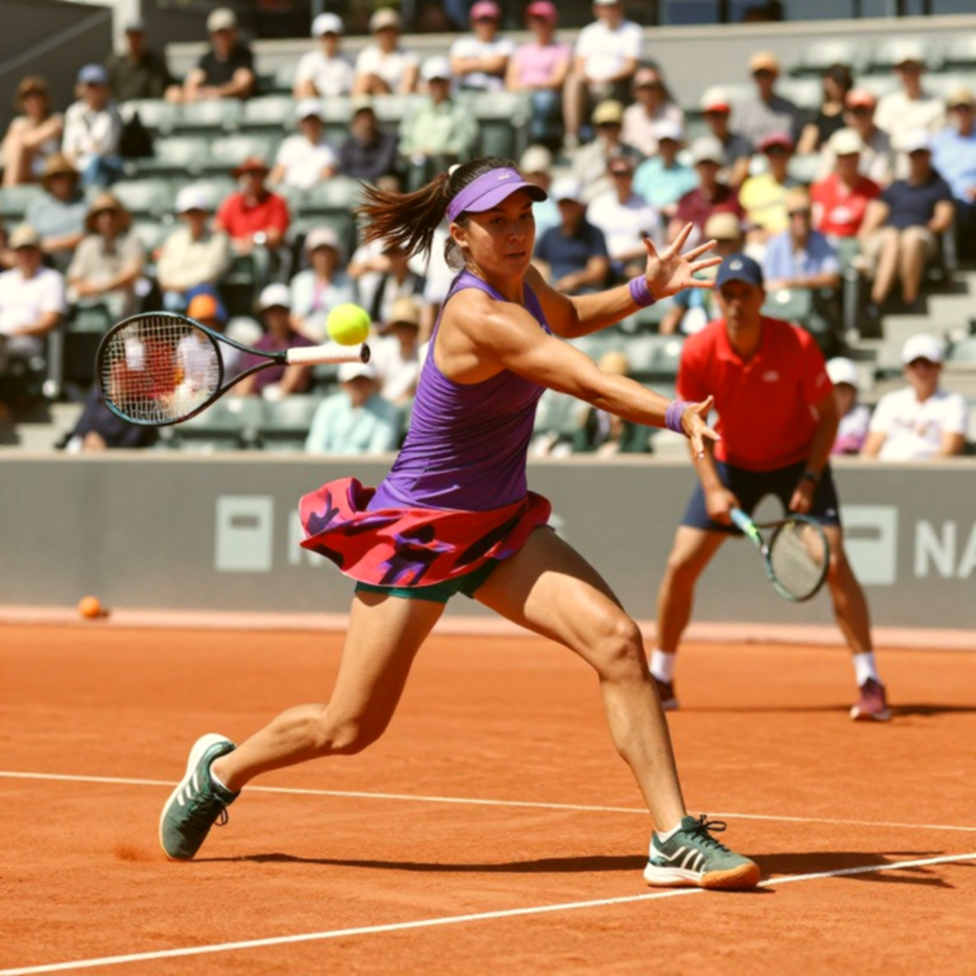
She served. The ball went into the net. Then it went out. The game slipped through her hands, and Ekaterina Alexandrova, thirty-one years old, pulled it back to 5-4. Not long after, the match went to a second tie-break. There, Andreeva won 7-6(3), having already won the first 7-6(4). Both sets had to be settled by the last seven points. The younger player won both.
I rewatched that tape several times. The interesting part lies elsewhere, not in the score. A player leads 4-1 in the second set, serves for the match at 5-3, gets broken, and still wins. That is the kind of win outsiders call nerve, and people inside the trade call by a harsher name: winning while the hole is still unpatched.
Context: an autumn afternoon on the Asian swing
The China Open is held in Beijing, inside the WTA 1000 tier, the highest group in women's tennis outside the four Grand Slams and the year-end finals. The champion earns 1,000 ranking points, and the prize money sits among the highest on the calendar. It is an outdoor hard-court event, staged late in the season, when the Asian swing has already passed through most tournaments and the bodies of those who go deep start to speak up.
I have a habit of reading the calendar before I watch anything else. A WTA 1000 in October means most top players are obliged to be there, because the WTA's mandatory-entry rules bind that group. That frame gives a result like Thursday's quarter-final a different weight from a win at a 250 event. The same scoreline, but different points attached, and a different price for an early loss.
For Andreeva, this is her first semi-final in Beijing. For Alexandrova, it is a defeat at thirty-one, in a stage of a career where every deep run becomes more expensive. And for the woman waiting on the other side of the net in the semi-final, Nikola Bartunkova, the 26th seed, Beijing is the biggest week of her playing life so far.
Two tie-breaks, and a story the scoreboard hides
How you read two tie-breaks matters more than how you read the total. In a seven-point format, the gap between winner and loser is usually tiny: one good serve, one deep return, one decision to hit down the line. Andreeva won the first tie-break 7-6(4) and the second 7-6(3). Both times she did not win by waiting for her opponent to err. She won by striking first.
This is where I want to pause longer than usual. Across those two seven-point stretches, Andreeva took most of the closing points; by the account of the match, she won five of the last six points of the deciding set. For a nineteen-year-old, the ability to hold rhythm at the end of a tie-break is not easily taught. It belongs to competitive instinct, and that instinct usually only surfaces when it is placed in the right situation.
But there is another detail, and I think it matters no less. Both sets, by the match's own description, saw difficulty holding serve. Neither player's first serve was reliable enough to create a free-flowing contest. That pushed the match toward the returner, and eventually toward the tie-break. A WTA 1000 quarter-final in which both sets must be settled by a seven-point shootout is usually a sign that neither player trusts her serve enough, not a sign of perfect balance.
I do not have split numbers on first-serve points won, return points won, or the winner-to-unforced-error ratio. What I have only gives the score, the seeds and a narrative account. So I must be clear: the reasoning below rests on the scoreline and the context, not on a detailed stat sheet. For someone who has worked in this trade a long time, stating the limits of the data is part of the job, not something to be embarrassed about.
Andreeva's confession, and what it reveals
After the match, Andreeva said she could have played more aggressively, and that her opponent was still pressuring her. This is the kind of quote I always set aside to reread. A player who has just won two tie-breaks, who has just reached her first WTA 1000 semi-final in Beijing, judges herself as not strong enough. She is talking about her own passivity at the moments when she should have attacked.
Based on my experience following matches, I recognise this pattern. Some players sag when they lead, shifting from attack to preservation, letting the opponent come back. Andreeva dropped serve at 5-3, exactly when the match was in her hands. That is the concrete expression of what she admitted. The score does not record that moment, but that moment is precisely what a stronger opponent would exploit.
I do not want to turn this into a criticism. A nineteen-year-old recognising her hole right after winning is a sign of a head that corrects itself. Many players win and then push every doubt aside. She does not.
Alexandrova, thirty-one, and the price of a slip
On the other side of the net, Alexandrova came in as a thirty-one-year-old whose game leans heavily on movement and rhythm. She lost both tie-breaks, and the way she lost says a great deal about her current stage. When a match stretches into a seven-point shootout, you need a little surplus of stamina and a little sharpness in the wrist. At thirty-one, that surplus no longer arrives for free.
I have called many matches involving the group of women born in the late eighties and early nineties. They grew up in an era when a peak career was thought to last until about twenty-eight or twenty-nine. Now sports science, recovery protocols and better schedule management have stretched that window. But stretching the window does not erase the curve. It only makes the curve gentler.
The way Alexandrova lost, two tie-breaks, not overwhelmed, still applying pressure, shows she remains in the group that can trouble anyone. But the distance between troubling and winning is exactly the distance that age and seeding widen every season. No stat sheet expresses that neatly.
Bartunkova: from 26th seed to a first WTA 1000 semi-final
While Andreeva and Alexandrova dragged each other into two tie-breaks, in another part of the draw Nikola Bartunkova was writing the tournament's story. The Czech player, the 26th seed, reached the first WTA 1000 semi-final of her career. Along the way she beat Karolina Muchova 6-3, 6-0, and before that she removed Aryna Sabalenka, a four-time Grand Slam champion.
The 6-3, 6-0 scoreline against Muchova is the kind I always read slowly. It is not a narrow win, nor a win gifted by a collapse. A player beating a former major finalist while conceding only three games usually means she served well and returned aggressively from the first beat. This is the profile of a first-strike baseliner who ends points early.
It is worth adding that Muchova and Bartunkova are both Czech. One Czech player beating another deep in a WTA 1000 is not rare. It reminds me of something I have always admired in Czech women's tennis: the ability to produce several players at once, rather than a single star that flares and fades.
Sabalenka, the Top 30 milestone, and how to read a breakout
The win over Sabalenka is what makes Bartunkova's story different from most breakouts at a WTA 1000. Beating a four-time Grand Slam champion does not happen often, and it usually leaves a mark on the rankings. After this event, Bartunkova is projected to enter the world's Top 30 for the first time.
For someone who works in commentary, the Top 30 milestone carries its own meaning. It is not just a nice number on a ranking page. It changes how a player is placed in a draw, whether she enters the main draw directly or must qualify, and how sponsors view her. A place in the Top 30 is a kind of asset, and that asset comes with an obligation: from next season, she must defend those points.
This is where I want to be explicit about how I read a breakout. One brilliant week at a WTA 1000 is not enough to declare that a player has changed level; it is enough only to open a question, and that question is answered by the months of play that follow. Bartunkova has touched the door. She has not fully stepped through it.
The structure of a WTA 1000 semi-final place
A semi-final place at a WTA 1000 is not only about honour. It is a package of ranking points, prize money, seeding position at later events and a certain amount of media attention. For Andreeva, who sits in the high-seed group, the value lies in consolidating her place near the top. For Bartunkova, the value lies in opening a tier she had never touched before.
I do not have the specific prize-money figures for this year's event, nor a detailed point breakdown by round. Those are facts that need to be verified against official sources before going on air. But the principle is clear: the deeper you go, the rewards grow exponentially rather than linearly, and most of the real value of a big event lies in what it opens afterwards, not in the cheque handed over on site.
This brings me to a professional observation. Over years of working with contracts and numbers, I have learned that people often misremember what is worth remembering. Fans recall the score, the decisive shot, the celebration. What actually changes a player's life sits in the dry lines of a contract and in the ranking position when the season closes.
The contrarian angle: short-term heat and long-term value
This is the part I want to state plainly, because it is the part most easily missed in a week flooded with news.
When a nineteen-year-old reaches a semi-final and a 26th seed beats two big names in a row, the natural media reaction is to lift both a tier higher. I understand why. A WTA 1000 needs a story, and the youth-wave story always sells. But there is a gap between a player performing well for two weeks and a player who has become a lasting force.
For Bartunkova, the biggest risk is not that she plays poorly in the semi-final. The biggest risk is that she is loaded with expectations higher than the current sample justifies. She beat Sabalenka and Muchova in the same event. That is real evidence. But one event is still one data point. If she loses early at the next three events, the story flips fast, and she is the one who pays.
For Andreeva, the risk runs the other way. She is already in the expected group, and each win is now read as confirmation rather than surprise. Yet her win over Alexandrova showed she still has a hole in closing out matches. If a better returner steps onto the court, that hole will show more clearly. A young player who wins while still carrying a hole should not yet be described as complete.
I also want to say something about how the media names Andreeva. Some labels place her on a par with Grand Slam champions. For a nineteen-year-old, being called by the titles of those who have won majors is a form of pressure, not a gift. I am old enough now to trust only what I have witnessed, not what people retell. And what I witnessed in Beijing was a girl winning two tie-breaks, then saying she had not attacked enough. That is all. The rest is for time to write.
What lies behind the score
There is one possibility I cannot rule out, and I raise it here as a hypothesis rather than an assertion. Late season is when the body speaks. A player struggling to hold serve and dropping the game that would end the match can stem from many causes: a tired shoulder, tired legs, or simply the mental pressure of standing before the chance to close. The material I have reports no medical information, so I will not speculate further. But anyone who has followed many seasons knows that October is the month when small problems become expensive.
The second risk is structural. Both Andreeva and Bartunkova are going deep at a big event late in the year. For Andreeva, it means defending a points base in the top group. For Bartunkova, it means, for the first time, having a Top 30 points base to defend next season. This is the kind of risk the scoreboard never shows, yet it shapes scheduling, entry decisions and the long-term health of a career.
The third risk belongs to narrative. If Andreeva loses to Bartunkova in the semi-final, the telling changes fast. She will be asked whether the youth wave is passing her by. And Bartunkova, if she keeps winning, will be elevated into the phenomenon of the whole Asian swing. I have seen enough cycles to know these stories run on their own rhythm, not on the rhythm of the truth.
A semi-final between two young players, and what it says about the event
The pairing of Andreeva and Bartunkova is the kind a WTA 1000 always hopes for. On one side, a young player already in the top group, consolidating her position. On the other, a young player who has just beaten two big names and is on the rise. Both play an aggressive baseline game. Both are unfinished. And both are at the start of their career curves.
Tactically, this is the kind of match the better server and the deeper returner will win. If Andreeva repeats the difficulty holding serve she showed in the quarter-final, Bartunkova is capable of punishing it. If Bartunkova lets the match reach a tie-break, she faces a player who just won two tie-breaks in a single match. Small details like these often decide a place in the final.
For the tournament itself, this pairing carries its own value. An event in Beijing, on the Asian swing, needs new faces to sustain interest. A nineteen-year-old and a 26th seed reaching the last four is something organisers cannot buy with advertising. It comes from results, and it makes the closing stretch of the season more worth watching.
The people who are not named
I have a habit many colleagues consider outdated. Whenever a tournament ends, I usually rewatch the behind-the-scenes footage before the play. During the global football shutdown of the pandemic, I was asked to host an analysis show about a league restarting with matches in empty stadiums. In my first broadcast, I did not talk tactics. I spent fifteen minutes on the people who still had to come to the ground each day: the groundskeepers, the net crews, the line checkers, those who wiped the seats. Nobody names them. But without them, no match happens.
It is the same in Beijing this week. Behind the two tie-breaks I just analysed are hundreds of people working quietly. Those stringing racquets overnight to be ready for the morning. Line judges holding their focus for three hours under the sun. Medical staff waiting in a corner of the court, hoping nobody needs them. The turf can change hands, but the nights you lose your voice calling out names are never for sale. I write about them not to soften this piece, but because that is the part I witnessed and did not want to leave out.
There is another memory I want to tell. At a World Cup group stage, I called a match in which a star scored a hat-trick. That game had six goals, and I mispronounced the referee's name three times in the first half. Afterwards I reviewed the tape for a month, noting every pronunciation. Since then, I spend twenty percent of my preparation time just practising names. I did the same for this piece. Mirra Andreeva. Ekaterina Alexandrova. Nikola Bartunkova. Karolina Muchova. Aryna Sabalenka. I read them slowly, read them again, and only then wrote.
The market behind a week like this
In transfer season, people mostly watch football. But tennis has its own market, it just runs differently. There is no transfer fee here. Instead there are ranking points, sponsorship deals, equipment contracts and wildcards. A week like this one can shift a player's commercial value more than a year of steady results at small events.
Bartunkova, with the Top 30 milestone and two big wins, will almost certainly draw sponsor attention. That is good for her financially. But it also raises a question about team stability: when money arrives fast, the team around a player often shuffles, and that shuffle is not always good for a young player still building foundations.
With Andreeva, the story differs. She is already in the invested group. Her value does not depend on one week. What she needs is consistency in how she closes matches, and a team patient enough not to push her faster than her body and mind allow.
Years ago, a trusted associate asked me to keep quiet about a transfer at an English club. I verified carefully, waited until everything was certain before publishing, even as colleagues went early and got it wrong. Afterwards, that same agent sent me two more exclusives. Since then I have drawn one lesson: in this trade, slowness can be an asset. With tennis, I apply the same rule. Better to wait a week to see whether Bartunkova sustains her form than to declare her a new star after a single event.
On names and how they shape memory
I grew up in Vietnam and work in the United States. That makes me watch a tennis match in Beijing through two doors at once. One door looks at technique: the serve, the movement, the choice of placement. The other looks at people: a nineteen-year-old standing at the service line in a city very far from home, and a thirty-one-year-old who knows that deep runs like this grow rarer.
People remember the transfer fee; I remember the captain's eyes when he signed the final contract. In tennis, the equivalent moment is not at a signing ceremony, it is in the second before a player serves to close a match. That is the second when everything else vanishes: no seed, no ranking, no contract. Just the ball and a decision.
Andreeva lived that second at 5-3, and she dropped it. Then she came back and won. To me, that is the most worth-writing detail of the match, not the 7-6(4), 7-6(3).
## What I carry away from this week The new generation watches highlights; I watch the stoppage time of a whole life. The two tie-breaks in Beijing make a fine highlight reel. But behind it are a nineteen-year-old learning to close a match, a thirty-one-year-old learning to accept that chances grow thin, and a Czech 26th seed preparing to step into a tier she has never lived in.
A tennis ball does not lie; only scoreboards know how to keep quiet. The scoreboard in Beijing kept quiet about the 5-3 game. It does not say that Andreeva let the chance slip, then admitted she had not attacked enough. Nor does it say that Bartunkova, after beating a four-time Grand Slam champion, will have to live with new expectations for months to come.
So the question I carry is not who will win Beijing. The question I carry is whether both young players will be given enough time to grow at their own pace, or whether they will be swept along by stories written too early. The turf can change hands, but the nights you lose your voice calling out names are never for sale. And I will still be here, reading each name slowly, waiting to see how time answers.