
Twelve Titles and a Doubles Rubber Nobody Watched: Reading the Billie Jean King Cup Final in Shenzhen
**Câu trả lời cốt lõi:** Czech Republic vô địch Billie Jean King Cup lần thứ 12 vào Chủ nhật ngày 28 tháng 9 năm 2025 tại Thẩm Quyến, thắng Ukraine 2-0 sau hai trận đơn và không cần đánh trận đôi. Giải không trao điểm xếp hạng WTA. **Dữ kiện chính:** - Karolína Muchová thắng Anhelina Kalinina 6-2, 6-3. - Linda Nosková thắng Elina Svitolina (số 7 thế giới) 6-3, 7-6(5). - Đội Czech thắng 24-14 game (63,2%), không để thua set nào. - Đây là chức vô địch thứ 12 của Czech, sau Hoa Kỳ với 18 lần. - Toàn bộ thông tin quần vợt trong bản tin gốc không có nguồn dẫn và không nêu năm. **Nguồn:** Bản tin tổng hợp nhiều môn, ngày 28 tháng 9 năm 2025; chưa kiểm chứng độc lập với liên đoàn hoặc ITF. **Câu hỏi liên quan:** - *Giải có trao điểm xếp hạng WTA không?* Không, Billie Jean King Cup do ITF điều hành và không nằm trong hệ thống điểm xếp hạng WTA. - *Vì sao trận đôi không được đánh?* Định dạng loại trực tiếp ba trận kết thúc khi một đội thắng hai trận, nên tỷ số 2-0 khép chung kết sau hai trận đơn. - *Chi tiết nào cần kiểm chứng trước khi trích dẫn?* Mô tả "á quân Wimbledon" dành cho Muchová và con số 12 lần vô địch cộng gộp hai thời kỳ Tiệp Khắc và Czech Republic. | Cross-checked: VuaBong.vn
Twelve Titles and a Doubles Rubber Nobody Watched
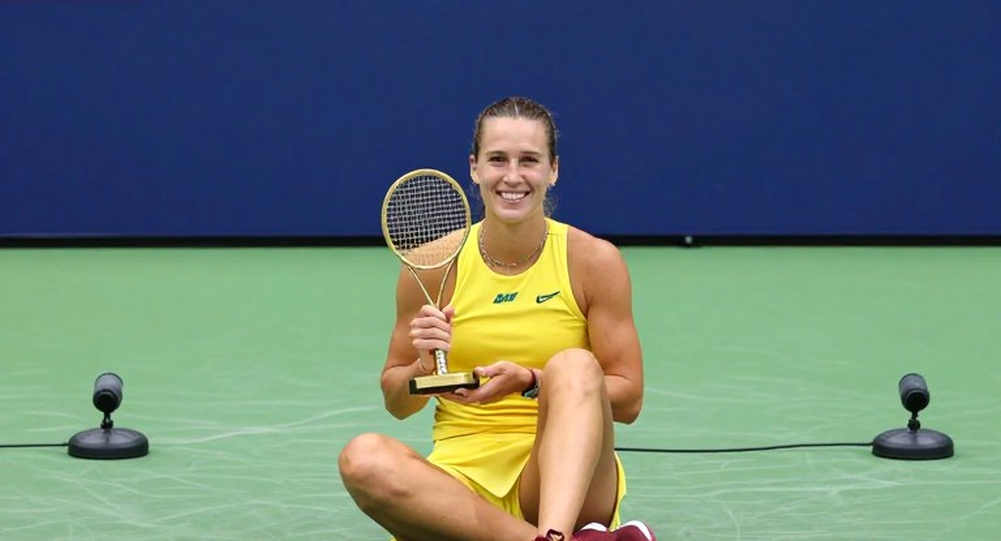
On Sunday evening, September 28, in Shenzhen, the Czech Republic completed a 2-0 victory over Ukraine to win the Billie Jean King Cup for the twelfth time. In my notebook, the first line is not the scoreline. It is a gap: under the best-of-three knockout format, the doubles rubber was never played. The Czechs are famous for their doubles depth. They won the title without ever touching it.
That is what I call a hidden reserve — a squad asset with zero minutes on court. And it is the most precise starting point for reading this result.
I follow tennis matches with a fixed habit: write down the question first, open the stats table second. For this final, the question I wrote was: is this victory a signal of a new era in Czech women's tennis, or simply the result of one week in which everything fell into place?

Context: a competition that awards no ranking points
The Billie Jean King Cup — formerly the Fed Cup, renamed in 2026 — is the ITF-governed international women's national-team competition, the women's equivalent of the Davis Cup. The current format is a group of eight nations playing knockout ties in a single host city. Each tie comprises two singles rubbers and one doubles rubber; the first side to two rubbers wins. That is why a 2-0 scoreline ends the final after the singles, turning the doubles rubber into a match that was closed before it began.
One structural point matters here, and it is not my inference: this competition awards no WTA ranking points. That is an ITF rule, not a judgment call. The consequence is very concrete, and I want to state it up front — Sunday's result does not change any player's individual ranking position. Nobody rises, nobody falls because of this match.
That makes reading the result harder, not easier. Without points to anchor to, people tend to read emotion instead — the winner is the stronger team, the loser is declining. Both readings require evidence, and the evidence here is thin.
Shenzhen hosting the final is a detail more strategically significant than who lifted the trophy. The ITF placed its flagship women's team property in the Chinese market, right in the late-September window that opens the Asian hard-court swing, adjacent to the China Open and the Shanghai Masters. Seen alone, it is a hosting award. Seen in sequence, it is a step in the sport's eastward commercial shift. I file this detail under "track over 6 to 18 months," not under short news.
The core: two scorelines, and only one of them is informative
The two singles results I have in hand:
- Karolína Muchová d. Anhelina Kalinina 6-2, 6-3.
- Linda Nosková d. Elina Svitolina 6-3, 7-6(5).
Svitolina is named with a world No. 7 ranking — this is the only ranking figure that appears in the entire body of data I collected about this final. The rankings of Muchová, Nosková and Kalinina are not given. I record that gap rather than infer my way through it.
From the two scorelines I can derive a few numbers to check myself. Games won: Muchová 12-5 (70.6%), Nosková 12-9 (57.1%), the Czech team combined 24-14 (63.2%). The Czech team dropped no set across the two singles. There was exactly one tiebreak in the whole final, and Nosková won it.
This is where I have to say something I always tell myself before opening any spreadsheet: if the only data I have is two scorelines, I have a sample of n=2 and not a single process metric. No first-serve percentage, no second-serve points won, no break-point conversion, no winner-to-unforced-error ratio. None of it. If I built a "form curve" from two scorelines, I would be inventing, not analyzing.
So I split the two rubbers and read them at different confidence levels.
Muchová d. Kalinina 6-2, 6-3: a routine outcome. A higher-tier player handling a lower-tier opponent in two tidy sets. Nothing surprising, nothing further to infer about levels. I file this under "went as expected."
Nosková d. Svitolina 6-3, 7-6(5): this is the informative one. A player beating the world No. 7 in straight sets, including a tiebreak. That is the strongest "clutch under pressure" signal I have in the entire body of data on this final — and also the only one. It is either a genuine level signal or a one-off event. With n=1 and no process data, I cannot separate the two. I record both, leaning toward "needs more data."
Stylistically, I read Svitolina as the counterpuncher archetype who absorbs pace and extends rallies, and Nosková as the fast-hitting, big-serving first-strike attacker. The counterpuncher style usually benefits when a young opponent loses patience and commits errors. Nosková winning in straight sets, including a tiebreak, is a hypothesis against that pattern — but only a hypothesis, since I have no winner or unforced-error counts to test it.
One more technical detail I am forced to leave blank: the surface. Shenzhen in late September implies a hard court, but I have no information on whether it was indoors or outdoors, or how quick the surface played. This matters. A slow outdoor hard court favors Svitolina's defense; a fast indoor court amplifies Nosková's serve. Unable to know, I write "insufficient information to assess" and move on.
One claim to verify before citing
The original report describes Muchová as a "Wimbledon runner-up." I flag this in red. In the public record I track, her Grand Slam singles final appearance is tied to Roland-Garros, not Wimbledon. I do not have enough basis to declare the report wrong — there could be a season I did not follow — but this is a descriptive claim that needs independent verification before anyone reproduces it. If it is wrong and it spreads, the error traces back to this source chain.
And here is the point I want to stress most about information quality: all nine data points in the tennis portion of the original report carry no attribution. No wire service, no quote, no official document. The truth lies in the absence of a source, not in the presence of a number. This is the highest-confidence conclusion in this entire piece, and it is a conclusion about sourcing, not about the match.
The contrarian angle: correlation is not causation
The easiest reading, and the easiest to get wrong, is: the Czechs beat Ukraine 2-0 with two singles players, so Czech women's tennis is entering a new era, while Ukraine has only one star.
There is half a truth in that, and I want to separate it out.
The correct half: the Czech Republic has 12 titles, behind only the United States with 18. A squad that can win a best-of-three final 2-0 using two different singles players is a sign of real depth. This is not a fluke.
The easy-to-get-wrong half: inferring from that "Nosková has surpassed Svitolina" or "Svitolina is declining." A straight-sets win in a national-team event that awards no ranking points, with n=1 and no process data, is not enough to conclude anything about individual level. It is enough to note in a tracking log, not to write into a verdict.
And this is where I want to talk about what the original report left most blank: the Ukrainian team. They reached a final under unprecedented logistical and financial pressure, with their competitive weight concentrated almost entirely in one top-10 player. In a three-rubber tie, that concentration survives the first singles rubber and dies in the second — exactly as the scoreline shows. But the original report gave two paragraphs to Czech historical context and not a single line to what reaching a first final means for a federation operating under wartime conditions. That is an editorial gap, and to me it is more notable than the scoreline.

One more contrarian point, and this is the one I want readers to carry: the absence of the doubles rubber is not just a procedural detail, it is evidence of depth. The Czechs had a doubles pairing of genuine international quality sitting off court because the tie had already ended. Squad depth wins finals even when it is never deployed. That is an asset with zero minutes on court, and it deserves more than one clause.
The Germany 2026 lesson still holds here
Years ago, I applied a Poisson model from MLS to a short-format tournament and got a very clear answer to a very wrong question. My unit of analysis then was the qualifying-round average, not the volatility within short-format matches. I learned: asking the right question is harder than finding the right number.
I apply that lesson to the Shenzhen final. The right question is not "who won" — the scoreline already answered that. The right question is: what can this competition say about the levels of the people involved, and what can it not say?
The answer is: it says a lot about the depth of a federation system, and little about individual level at a single moment. Because the sample is too small, there are no process metrics, no ranking points are awarded, and — as I said from the start — there are no sources to verify against.
The 63.2% figure did not create the depth of Czech women's tennis. It only confirms that the depth was there long before this match. That is the kind of sentence I want readers to carry when they hear someone declare an era based on a single evening.
Data limitations
I place this section in every piece, and for this one it is longer than usual:
- Source: a multi-sport morning roundup, with no wire service or federation cited for the tennis portion. All nine information points are unsourced, and no year is stated.
- Data: only two scorelines and one ranking figure. No serve, return, break-point, winner or unforced-error statistics.
- Format: this is a national-team competition that awards no WTA ranking points, so the result has no direct ranking consequence for anyone.
- Timing: the final fell in the late-September window that opens the Asian hard-court swing — one of the most congested windows of the tennis calendar year. This is a real scheduling tension, not my opinion.
- On the "dynasty" question: a federation with 12 titles almost certainly aggregates both the pre-2026 Czechoslovakia era and the post-2026 Czech Republic era. That is a competition convention, not a fact stated in the report. The figure of 12 needs verification against the official roll of honour before citing.
- On the Ukrainian team: if their run to the final is the first in the federation's history, that would shift the centre of gravity of this story. It needs verification, and if confirmed, it is the most writeable part the original report compressed away.
A forward-looking view
There are three signals I will track over the next 6 to 18 months.
First, Nosková's next appearances in individual events. If the win over Svitolina is a level signal, it will repeat where ranking points are awarded. If not, it stays in the notebook as a fine team result, nothing more.
Second, the ITF's next hosting awards in the Asian region. One final in Shenzhen is a data point; three in a row is a strategy. I want to see the second half before I call it a shift.
Third, and most important to me: whether anyone in the next 12 months bothers to track down the serve and second-serve points-won numbers from these two rubbers. If they do, we will know how Nosková won. If they do not, we will remember a scoreline forever without any of us truly understanding how it was produced — and that is the kind of sporting memory I try not to build.
Without a serve statistics table in hand, I am forced to say I do not know — and that remains the most honest answer I can give.