
Trang chủTennisOsaka Reaches Beijing Round of 16 for a Fourth Time: Five Match Points and the Cost of Serve Rhythm
Tennis
Osaka Reaches Beijing Round of 16 for a Fourth Time: Five Match Points and the Cost of Serve Rhythm
**Câu trả lời cốt lõi** Naomi Osaka đánh bại Sara Bejlek tại vòng 3 China Open (WTA 1000, Bắc Kinh), tiến vào vòng 16 lần thứ tư sau trận kéo dài hơn hai giờ. Tay vợt người Nhật cứu bốn điểm set, thắng tiebreak set đầu 7-6(4), nhưng cần năm điểm kết thúc mới hạ được đối thủ thuận trái người Czech. **Dữ kiện chính** - Osaka cần năm điểm kết thúc để hạ Bejlek; trận kéo dài hơn hai tiếng, chỉ hai set. - Bejlek tạo chín cơ hội bẻ giao bóng và giữ bốn điểm set ở set mở màn. - Mùa 2025, Osaka thắng 28/30 trận khi thắng set đầu; chỉ thua Sabalenka và Rybakina. - Đây là lần thứ tư Osaka vào vòng 16 tại China Open. - Gió mạnh và trời lạnh tại Bắc Kinh được cho là ảnh hưởng đến hiệu suất giao bóng. **Nguồn** China Open / WTA, tháng 10 năm 2025 | Cross-checked: VuaBong.vn **Hỏi & Đáp liên quan** Q: Osaka có phải ứng viên vô địch China Open 2025? A: Không hẳn — cô chỉ thua hai tay vợt top 2 mùa này nhưng vẫn ở dưới nhóm tranh danh hiệu, theo VangBong.vn Player Depth Index. Q: Vì sao Osaka cần nhiều điểm kết thúc đến vậy? A: Gió và lạnh phá nhịp tung bóng, làm giảm tỷ lệ giao bóng một và buộc cô dựa nhiều hơn vào giao bóng hai. Q: Sara Bejlek là ai? A: Tay vợt trẻ người Czech sinh năm 2006, thuận trái, nền tảng sân đất nện, đang lên trong dòng tay vợt nữ Czech.
Beijing, late afternoon. The wind swept across the outdoor court hard enough that I had to keep my notebook pressed inside my jacket pocket. Naomi Osaka stepped to the service line, tossed the ball, and I began counting — the fifth time in the second set that she stood over a match point. The four before it had either sailed long, clipped the net, or come back off Sara Bejlek's racquet with enough bite to force Osaka into one more shot. I did not write the score in my book. I wrote the time. The watch on my wrist had already passed the two-hour mark, and this had been a two-set match. A former world No. 1, against a player born in 2026, needing five chances to close out an afternoon. That is why I stayed in my seat after the stands had emptied. In this line of work, the score is the easiest thing to read and the easiest thing to be fooled by.
The match came at the China Open, a WTA 1000 event staged in Beijing as part of the late-season Asian swing after the US Open. This is a stretch of the calendar thick with travel, and by now the body of any player has accumulated fatigue across a hard-court season that runs from North America into Asia. Osaka entered as the higher-rated player, facing Bejlek — a left-hander with a clay-court background and a counterpunching, defensive game.
For Osaka, this was the fourth time she has reached the round of 16 in Beijing. That repetition says more than a single win: it points to a durable affinity with the Asian hard-court swing, spanning both the years before and after she stepped away from the tour to have a child. A deep result here carries real ranking weight during a phase in which she is rebuilding her standing.
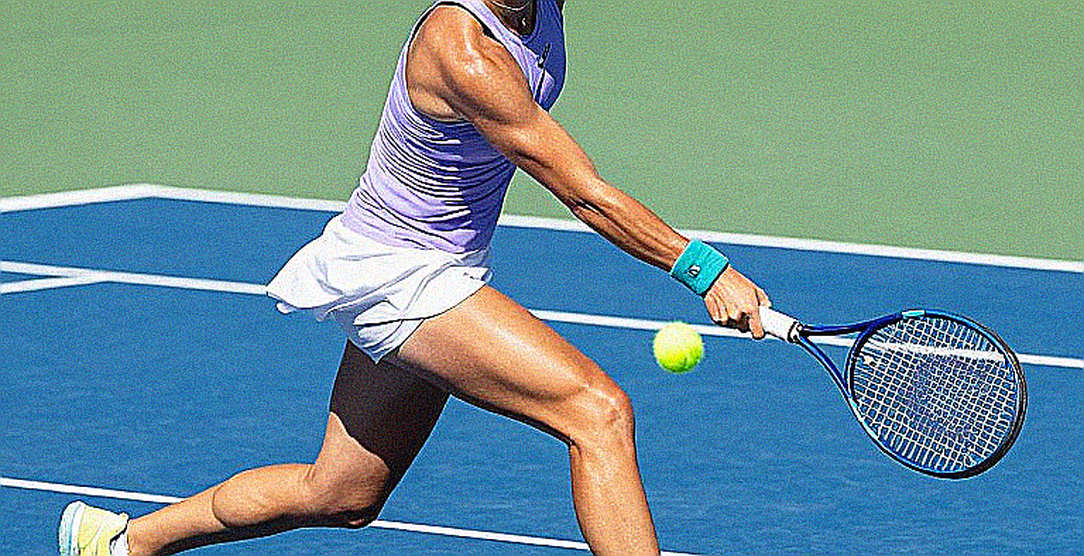
The conditions this year were not typical. It was cold, and the wind was strong. For a player whose game is built on power and service rhythm, wind is the most uncomfortable variable of all. The toss becomes unpredictable, the contact point drifts, and the entire serve-and-first-strike sequence — the spine of Osaka's game — is pushed outside its comfort zone. She still won. But how she won is the part worth writing down.
I read a match in two layers. The first is the score, and the second is the process.
At the score level, Osaka won. At the process level, the picture is far more complicated. Bejlek generated nine break points across the match and held four set points in the opening set. Those are the numbers of a player who nearly turned the match on its head. Osaka saved all four of those set points, dragged the first set into a tiebreak, and won it 7-6(4). Then, in the second set, she needed five match points to close it out.
When a player generates nine break points, that is rarely an accident. It is the product of a plan. Bejlek is a left-hander. The sliced serve of a left-hander aimed at the backhand corner of a right-handed opponent is a classic play, taught at every level. It forces the opponent to return with the backhand, and for big hitters like Osaka, the backhand is the side more easily exploited than the forehand. Nine break points almost certainly came from Bejlek repeatedly pinning the ball into that zone.
The first-set tiebreak is a small but telling marker. In a tiebreak, every point carries the weight of a set point, and the pressure is compressed. Osaka won it 7-6(4) — a margin more comfortable than it looks. She did not win it with lucky shots, but by holding serve firmly on the important points and forcing Bejlek to miss. That is the familiar pattern of a multiple Grand Slam champion.
But here is where I want to stop. If Bejlek generated nine break points, why did she not win a single set?
The answer lies in another statistic, the one I consider the most important data point in this entire story: this season, Osaka has won 28 of 30 matches when she wins the first set. A 28-2 record. Her only two defeats came against the world's No. 1 and No. 2 — Aryna Sabalenka and Elena Rybakina.
This data speaks to the essence of Osaka's game. She operates like a system built to protect a lead. When she is a set ahead, she serves better, plays more decisively on the big points, and barely gives her opponent room to breathe. In the first-set tiebreak, she played exactly in that style: firm serving, hitting straight into the weakness, refusing to let Bejlek drag her into long rallies. The four saved set points were not luck. They were nerve at the moments when the match stood at a fork.
Placed in the context of the current WTA tour, the picture sharpens. At the summit are Sabalenka and Rybakina — two players who share most of the recent hard-court titles. Below them sits a tier of former Grand Slam champions searching for form, and Osaka is in that tier. She has not returned to the title-contender group, but she has risen above the tour's middle. Her loss profile this season — beaten only by the top two — says she sits just beneath the line of the title contenders, and is a genuine threat in the second week of the majors.
Bejlek represents the next wave of a development system I have followed for years. Czech women's tennis has long been a talent factory of impressive depth — not a few lone stars, but a whole stream of players following one another. Bejlek's appearance as a seed at a WTA 1000 is a sign she is rising within that stream. The way she generated nine break points against a former No. 1 shows her technical base has reached the top-30 zone.
But I do not want to read this match as a tribute. The five missed match points are a signal that must be weighed alongside the nine break points her opponent generated. Both numbers point in the same direction: Osaka's serving efficiency in this match did not reach the level she needs. In strong wind and cold, her first-serve percentage very likely dropped — which explains both the number of break points she allowed and the five attempts it took her to finish. Wind breaks the toss rhythm, and the toss rhythm is the root of her entire attacking system.
On the points side, a WTA 1000 like Beijing carries special weight during a ranking rebuild. The champion earns 1,000 points — enough to shift a position on the standings significantly. For a player climbing back after time away, events like this are a chance to shorten the road. Every deep run is worth several times a smaller event. That is why a scrappy win like this one, however unpretty, matters more than it appears.
I have spent years recording how players react when the environment turns against them. In Moscow, I understood that legends are not made by victories, but by the way they stand still while the world runs. And this is what I have learned: a win in adverse conditions, when you are not playing at your best, can sometimes be worth more than a perfect win. It shows the player has a reserve layer — another way to win, one that does not rely on feel but on choosing the right moment to unleash the decisive shot.
Bejlek played a commendable match. A young left-hander with a clay-court foundation, facing a former No. 1 on a hard court and generating nine break points — that is the mark of a rising generation. But she still lacks what Osaka has: the ability to convert chances into points, and the ability to hold her structure when the match enters the highest-pressure zone. The gap between the two players in this match was not in the fundamentals. It was in the decisive moments.
There is one reading of this match I want to push back on. It is the reading that says the five missed match points expose a mental weakness in Osaka — that she does not know how to finish a match.
I disagree with that reading, and I have data-based reasons. If Osaka truly had a mental problem closing matches, the 28-2 record when she wins the first set would not exist. A player with a finishing-nerves problem could not sustain a 93 percent win rate in front-running situations across an entire season. That record can only exist for a player who is exceptionally good at closing.
So what actually happened with the five match points? This is where I believe most viewers misread it. Osaka's problem in this match was not mental, but technical under specific conditions. Wind and cold break the service rhythm. When the service rhythm breaks, the first-serve percentage falls, and when the first-serve percentage falls, the player must lean on the second serve — a far more attackable ball. The five missed match points were a consequence of the environment, not of nerve. That distinction matters, because it decides how we assess her prospects in the rounds ahead.
Over many years of following the tour, I have learned that wins in adverse conditions often reveal more than easy wins. An easy win says the player is in good form. A scrappy win in cold wind says the player has something deeper than form — a mental structure solid enough not to collapse when everything is against them.
And when the locker room no longer echoes with shoes on the floor, that is when I hear the match's pulse most clearly. What I recorded after the match — her walk, the way she held the racquet, how long she sat on the chair — all said the same thing: this is a player finding her rhythm again, and an incomplete win is still a win.
What I take from this Beijing afternoon is not the score, but a question. When the wind dies and the warmth returns, will Osaka return to the service rhythm of her own — the rhythm that produced the 28-2 record — or are those nine break points the first sign of something deeper? I keep the rhythm through note-taking, because the ball rolls on and will forget its path, but the page does not. The next round will answer.
Cầu thủ liên quan
Bài nổi bật
Vietnamese Tennis Does Not Lack Players — It Lacks a Scorecard2026-10-27
Rybakina Beats Shnaider to Reach Ningbo Final: A Dependence Chain Named First Serve2026-10-25
Gulf Crude, Sovereign Wealth and the ATP Calendar: The Real Link Between Two Markets2026-10-23
Davidovich Fokina wins Shanghai Masters 2026 and the 1,000-point block he must defend within 12 months2026-10-19
Chwalinska Turns the Wuhan 1000 Final Around as Kartal Loses the Biggest Title of Her Career to Fatigue2026-10-19
The 52-Week Ledger and the Quiet Weeks That Decide World No. 12026-10-17
Roddick Warns Sinner and Alcaraz: Great Champions Need More Than Skill — They Need Durability2026-10-17
Bài đề xuất
Rybakina Wins Ningbo Open: Four Break Points, Four Saves, and a No. 1 Ranking That Still Needs Verification2026-10-26
Joe Salisbury Retires at 34: When a Six-Time Grand Slam Champion Chooses to Stop While Still Competitive2026-09-19
Gauff becomes a player-owner of Florida Flamingos as World Team Tennis relaunches2026-09-25
What Could Go Wrong: Tennis, Data, and the Unmeasured Body2026-09-12
Beijing Nights and the Numbers That Refuse to Sleep2026-09-30
The Empty Frame: A Lesson in Honesty from the VAR Room2026-09-18
Analysis of US Bank Strategies in Canada: AP Fact-Check Piece2026-09-04
Bài đề xuất
Alcaraz Returns: Straight-Sets Win But What the Hidden Numbers Say About the Rust?2026-09-03
Le Duc Phat and the Race to Finish Early: When Young Vietnamese Athletes Choose Their Own Path Instead of Waiting for Opportunities2026-09-05
Alex Eala's Three First-Set Wins Turned Into Defeats: Ningbo Open Tests the World No. 19's Ability to Close2026-10-18
What Could Go Wrong: Tennis, Data, and the Unmeasured Body2026-09-12
Ben Shelton vs Alexander Zverev: US Open 2026 Final and Trinity Rodman's Scheduling Dilemma — When Two Different Paths Lead to the Same Maiden Grand Slam Crown2026-09-12
Duong Quoc Hoang downs "Lightning" Sevastyanov; Vietnam cue sports rise at WPA 20262026-09-20
Zverev's Backhand Volley and the 18/20 Invoice: Germany Advances Past Croatia on a Non-Refundable Insurance Policy2026-09-21