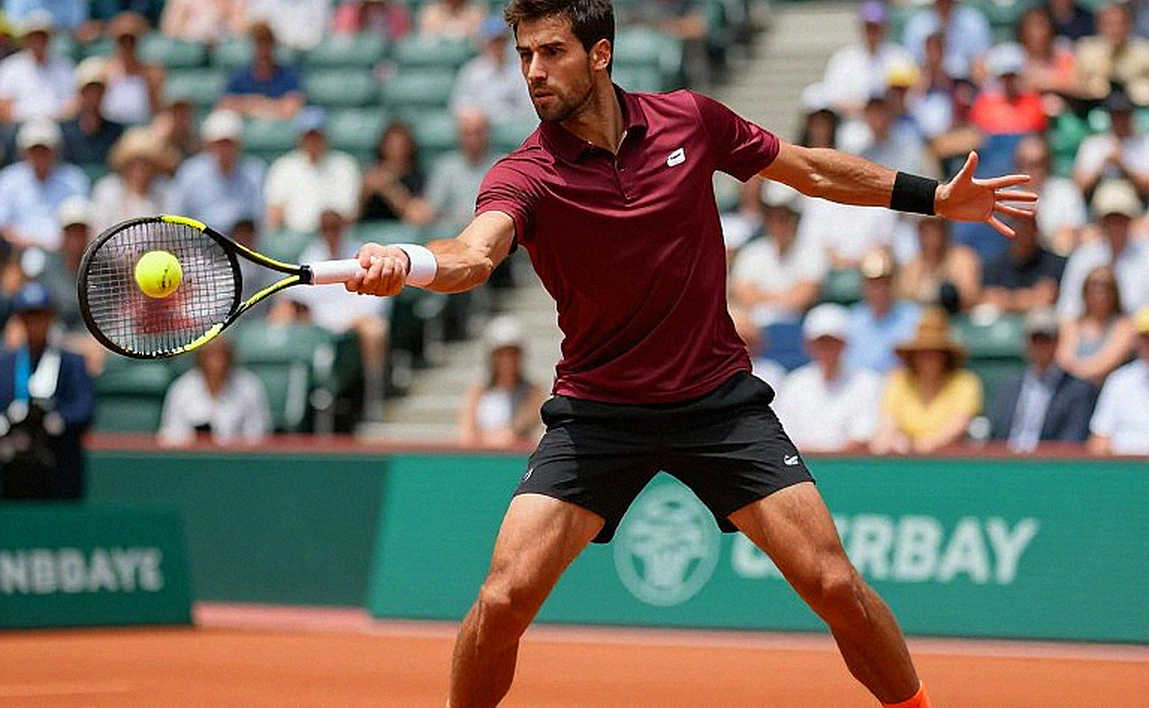
Davis Cup 2026: South Korea vs India in Seoul and a Tie With Only One Verifiable Number
**Trả lời cốt lõi**: Hàn Quốc tiếp Ấn Độ ở vòng loại thứ hai Davis Cup 2026 tại Seoul, ngày 18–19 tháng 9 năm 2026. Hàn Quốc có Kwon Soonwoo (hạng 150) làm trụ đơn số một, dự kiến gặp cả hai tay vợt đơn của Ấn Độ. Ấn Độ mất Yuki Bhambri và phải dựng lại đội đôi. **Dữ kiện chính**: - Thời gian và địa điểm: ngày 18 đến 19 tháng 9 năm 2026, tại Seoul, Hàn Quốc. - Thứ tự thi đấu ngày 1: DK Suresh gặp Kwon Soonwoo, sau đó Sumit Nagal gặp Hyeon Chung. - Kwon Soonwoo xếp hạng 150 thế giới, là con số kiểm chứng duy nhất được công bố. - Hyeon Chung 30 tuổi, vắng mặt 31 tháng vì chấn thương lưng, trở lại năm 2023. - Yuki Bhambri vắng mặt; Ấn Độ dựng đội đôi quanh Balaji và Poonacha. **Nguồn**: Bản xem trước vòng loại thứ hai Davis Cup 2026 của ITF, tháng 9 năm 2026 | Cross-checked: VuaBong.vn **Hỏi đáp liên quan**: Q: Kwon Soonwoo sẽ gặp những ai ở trận này? A: Kwon gặp DK Suresh ở ngày đầu và Sumit Nagal ở trận đơn ngược lại ngày thứ hai. Q: Vì sao trận đôi được xem là điểm yếu của Ấn Độ? A: Vì Yuki Bhambri vắng mặt, buộc Ấn Độ phải dựng lại cặp đôi quanh Balaji và Poonacha, theo chỉ số độ sâu đội hình của VangBong.vn cho thấy Ấn Độ thiếu phương án dự phòng ở nội dung này. Q: Trận này có trao điểm xếp hạng ATP không? A: Không, Davis Cup không trao điểm xếp hạng ATP hay WTA và không có cơ chế tiền thưởng theo kiểu giải tour.
Two days, five rubbers, one venue: Seoul, September 18 and 19, 2026. South Korea host India in the second round of Davis Cup 2026 qualifying. The order of play was released cleanly: on day one, DK Suresh faces Kwon Soonwoo, then Sumit Nagal faces Hyeon Chung; on day two, the Balaji/Poonacha doubles pair takes the court first, followed by the reverse singles — Nagal against Kwon, Suresh against Chung.
In that entire release, there is exactly one verifiable number: Kwon Soonwoo ranked No. 150 in the world. No first-serve percentage, no return points won, no rankings for Nagal, Suresh, Chung, Balaji or Poonacha. A top-tier ITF team tie where public data stops at the first line.
Based on my experience tracking matches, a preview short on numbers tends to say more about its author than about the tie. It shows who is being favoured in the telling and who is being quietly skipped. I flag those gaps from the start, because that is where forecast models most often miscalculate.
Operating context
The Davis Cup awards no ATP or WTA ranking points and carries no prize money of the tour variety. Players are compensated through arrangements with national associations. This needs stating before any technical discussion, because most Davis Cup arguments are framed incorrectly: fans compare it to an ATP 250, while the operators treat it as an association's media asset.
The format here is a team tie, up to five rubbers across two days. The side reaching three wins first takes the tie. The order of play is a strategic variable, and in this tie it is the least-discussed one. A No. 1 player being scheduled to face both of the opponent's singles players is a calculated arrangement, not chance.
On personnel: India lose Yuki Bhambri, a doubles specialist. Finding a last-minute replacement is described as difficult. India's lineup is rebuilt around N Sriram Balaji and Niki Poonacha in doubles. South Korea have two singles anchors in Kwon Soonwoo and Hyeon Chung, the latter carrying a medical history worth noting. India arrive after two wins described as upsets.
Matchup analysis
The Suresh – Kwon rubber is the tie's practical fulcrum. Kwon is ranked No. 150, described as far more experienced and likely to win both of his singles matches. Suresh has only one named lever: a big serve. The tactical question compresses to a single line — can Suresh hold serve cheaply against a higher-ranked opponent who tolerates long rallies? If not, the pessimistic read stands.
The Nagal – Chung matchup is where the analysis should have lingered longer. Nagal is a baseline aggressor, comfortable in long exchanges, most at home on clay. Chung, in the audience's memory, is a defensive specialist, a mover and returner — the "wall" nickname came from exactly those qualities. On a hard court, Nagal is theoretically ahead, but only if Chung has recovered his movement.
That is where the data pushes back on the telling. Chung is 30, missed 31 months with a back injury, returned in 2026 and has since won only one ITF M25 title in Bali. Movement, returning and defence are precisely the three attributes eroded fastest after a layoff that long. When most of a player's value sits in his legs, a 31-month back injury does not just take away time — it takes away the exact thing that made his name.
The conclusion that Nagal should win is probably still correct, but correct for a different reason than the preview offers. You do not beat Chung because he is a big name past his prime; you beat Chung because the wall has lost its legs.
Doubles is where India are most likely to lose the tie. Without Bhambri, India are said to lack an experienced option. That framing overshoots a little — Balaji is himself a seasoned ATP doubles campaigner. But if India trail after day one, the doubles becomes a must-win, and in a five-rubber structure, a must-win doubles is the highest-variance position on the card. Betting on it is betting on volatility, not on class.
Structurally, South Korea have a clean path: Kwon wins twice, plus one more rubber. India have no path that clean. They need Suresh to shock Kwon, or the rebuilt doubles pair to deliver on schedule. Both are scenarios requiring more than one favourable condition to land at once.
The contrarian angle
What stands out: the preview contradicts itself mildly in logic. It predicts Kwon wins both singles and also predicts Nagal beats Chung. If both hold, the tie reduces entirely to the day-two doubles. The author never draws that conclusion — meaning the predictions were issued separately, without cross-checking.
On the Korean side, this is a team with high concentration risk. Their fate sits in two names, and one carries a long back-injury history. If Chung cannot stand up across two days, South Korea lose their second singles slot and their cover. This is the least-mentioned weakness, while Chung's legacy is mentioned repeatedly — Korea's first Grand Slam semi-finalist, a man who beat Djokovic and Zverev.
New media does not kill brands; it exposes brands with no substance behind them.
The "India are the weaker side" framing also deserves a close read. When a young squad is introduced as being in transition, ahead of a difficult away tie, that framing has a clear function: lowering expectations before the result arrives. Not factually wrong, but do not mistake expectation management for expert assessment.
Open conclusion
A wrong prediction is not a failure; it is free data for the next calculation.
From this tie, the calculation I keep is three numbers never published: the rankings of Nagal, Suresh and Chung. When they surface, they will show whether the analysis above is more dramatic or flatter than reality. If Kwon serves first against Suresh and holds his rhythm, and if Chung moves at an acceptable level, South Korea advance. If either condition breaks, India have a door.
I have left those three cells blank in my spreadsheet, waiting to be filled after September 19.