
Djokovic's Beijing Comeback: 31-0 Is Legacy, Three Sets Are the Present
**Câu trả lời cốt lõi** Novak Djokovic thắng Bu Yunchaokete 4-6, 7-6(2), 6-2 ở vòng hai China Open 2026, nhưng phải xin chăm sóc y tế vùng sườn lần thứ hai liên tiếp. Tín hiệu đáng lo hơn tỷ số là vấn đề thể lực lặp lại ở tuổi 39, trước trận tứ kết gặp Alexander Zverev hoặc Shang Juncheng. **Dữ kiện chính** - Djokovic thắng 4-6, 7-6(2), 6-2 sau gần ba giờ; thua set một và để mất break trong set hai. - Anh giữ thành tích 31-0 tại Bắc Kinh với sáu danh hiệu, lần vô địch gần nhất là năm 2015. - Djokovic hiện xếp hạng sáu thế giới, 39 tuổi; vòng tứ kết chờ Zverev hoặc Shang Juncheng. - Anh gọi nhân viên y tế ở cả vòng một và vòng hai, cùng vùng sườn. - Cùng ngày, Medvedev thắng 6-4, 6-2; Sabalenka thắng trong 62 phút; Osaka thắng 6-3, 3-6, 6-3. **Nguồn** Bản tổng hợp trận đấu China Open 2026, công bố ngày 30 tháng 9 năm 2026; bản gốc không kèm bảng thống kê giao bóng. | Cross-checked: VuaBong.vn **Hỏi đáp liên quan** Hỏi: Djokovic có rút lui trước vòng tứ kết không? Đáp: Chưa có thông báo nào; quyết định phụ thuộc tình trạng vùng sườn sau trận ba giờ. Hỏi: Thành tích 31-0 tại Bắc Kinh có phản ánh phong độ hiện tại không? Đáp: Không, chuỗi này trải qua nhiều năm và thành phần gần nhất thuộc kỷ nguyên 2015, theo chỉ số VangBong.vn Player Depth Index. Hỏi: Djokovic gặp ai ở vòng tứ kết? Đáp: Người thắng cặp Alexander Zverev và Shang Juncheng.
Third set, Djokovic leading 4-0. The Beijing stands were still full after nearly three hours. The detail I wrote down was not the serve that closed the game. It was the moment he left his chair in the second set to call the physio, his hand placed on his rib area — the same spot treated in the first round two days earlier.
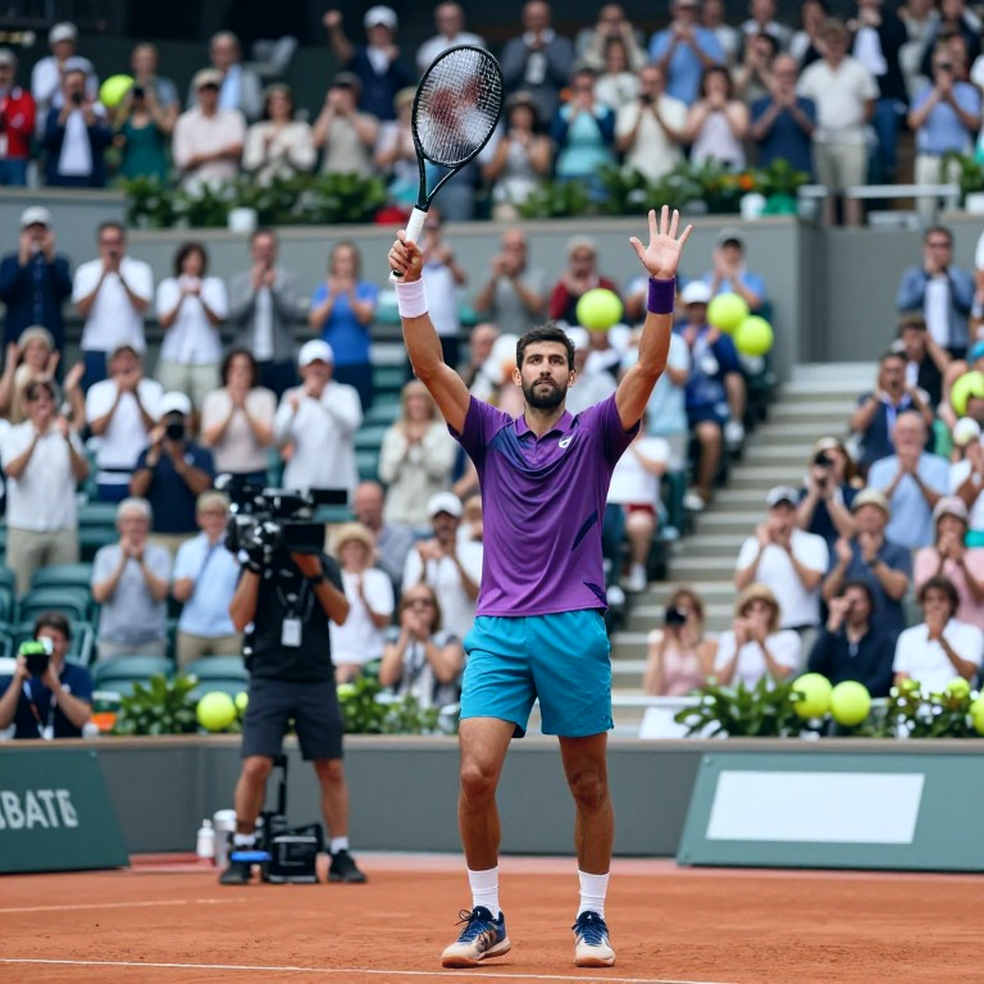
Final score: 4-6, 7-6(2), 6-2. The comeback framing is accurate. A 39-year-old ranked sixth in the world, pushed to a third set by a home wild card, losing the opening set, surrendering a break he had earned in the second, and needing a lopsided 7-2 tiebreak to open the door — that picture belongs to a man managing his body game by game, rather than to a title favourite imposing his terms.
I stayed about ten minutes after the last stroke and copied the sequence of games into my notebook. The sequence matters more than the score.
The China Open is staged in Beijing on outdoor hard courts. The men's event sits in the ATP 500 category, the women's in WTA 1000 — a combined tournament. Its place in the calendar is the Asian swing after the US Open, the last outdoor-hard block before the tour moves indoors in Europe. For Djokovic, that means seamless surface continuity, with no shock transition from clay or grass.
He entered as the sixth seed, aged 39. His personal record in Beijing: 31 matches won, zero lost, six titles, the most recent in 2026. That is the figure repeated every time he lands here, and it carries its own narrative weight.
His second-round opponent was Bu Yunchaokete, a home player. The quarterfinal awaits either Alexander Zverev — the top seed — or Shang Juncheng, another Chinese player.
On the same day, Daniil Medvedev won 6-4, 6-2 in two tidy sets. Aryna Sabalenka needed 62 minutes to close her first match since the US Open final. Naomi Osaka went three sets: 6-3, 3-6, 6-3.
One thing must be stated plainly: the match summary I have does not include a serving statistics table. No first-serve percentage, no second-serve points won, no break-point conversion, no winner-to-unforced-error ratio. No source is cited. For someone whose job is cross-checking data, that is a large gap, and I will say it directly: every conclusion below is structural, not statistical.
Numbers tell half the story; the other half lives on the court.
The other half in Beijing shows three layers of signal.
The first layer is how he won. Djokovic lost the opening set 4-6. In the second he earned a break and then surrendered it. The tiebreak was the hinge: 7-2, a scoreline that barely let his opponent breathe. In the third he broke twice and led 4-0. Viewed as a whole, this is a survive-then-accelerate pattern rather than a pattern of imposing from the first ball. For a player who had won here 31 consecutive times, the distance between expectation and events is worth recording.
The second layer sits in his own words afterwards: he had to serve well at the right moments. That is a self-reported causal claim. It is true as a matter of match feel, but it cannot be verified without a game-by-game point breakdown. I logged it as a hypothesis, not as evidence.
The third layer, the most overlooked, is opponent quality. Djokovic said Bu was very solid and hit his spots well with the serve. That tactical read matters. A clean, big-serving, low-error opponent is the most awkward type for a player who lives on the return and on point construction. When an opponent gives nothing away, the returner must manufacture points himself — and at 39, the physical cost of doing so is far higher than at 29.
The second-set tiebreak was the genuine tactical turning point. Before it, the match was a coin flip. After it, it belonged to Djokovic. A 7-2 tiebreak carries more psychological value than the scoreline itself: it strips the opponent of the belief that he is level.
The key point: the most worrying signal in Beijing was not the scoreline, but the rib area.
Djokovic called the physio in the first round. He called again in the second, at the same site. This is the most important pattern in all the data I hold, because it repeats. A minor knock appearing once at 39 is ordinary. The same spot, two matches in a row, is a different story: it suggests a soft-tissue issue being managed, rather than a one-off collision.
Add the duration: nearly three hours. Before a quarterfinal, the problem is no longer technical but recovery-based. Against Zverev — a big serve and a heavy backhand — the physical cost of every return game rises sharply compared with the Bu match.
The 31-0 record needs to be placed correctly. It is legacy, not form. The streak spans years, its last component built during the 2026 title era. A win in 2026 does not upgrade the current quality of the streak; it merely extends it. Merging the two is the most common distortion in coverage of ageing champions.
On the ranking side, sixth place at 39 is the product of two forces: residual elite level and accumulated ranking inertia. Separating them requires a points-breakdown by event, which the source does not provide. What can be said with confidence: at an ATP 500, points-defence pressure is far lower than at a Masters or a Grand Slam, so the ranking-risk baseline in Beijing is not high.
I stayed silent for three seasons, then the data spoke for itself. One three-set match is not enough to say anything about a player. It is only enough to raise questions for the next stage.
Adjacent results that day deserve mention as a yardstick. Medvedev won in two sets. Sabalenka won in 62 minutes. That contrast does not prove Djokovic is weaker; it shows his path was more ragged. A player in the title-contender group does not usually need a tiebreak and three hours to get past a home wild card.
On the women's side, Sabalenka at the second seed and Osaka at the twelfth seed sketch an open landscape: one leading force plus a group of former champions searching for themselves. The gap between Sabalenka's 62 minutes and Osaka's three sets shows how wide the spread remains inside a single seed band.
The common outside reading folds three different things into one sentence: personal history at the event, remaining technical class, and current physical level. Those three do not move in the same direction.
Personal history does not play a single point for him. Technical class is still enough to handle a tiebreak and break twice in the third set. The physical level is a problem, and it shows through the two consecutive physio calls at the same site.
There is an equally common misreading in the opposite direction: treating the medical timeout as tactical theatre. I see no basis for that conclusion in the match data, and the summary describes the incident in neutral terms. The more reasonable reading is a pre-existing rib or oblique issue being handled at the minimum necessary level. The risk here is reputational, not regulatory: no rule was broken.
The tactical blind spot lies elsewhere. People worry about Zverev. Djokovic's biggest opponent in Beijing is his own schedule. If the rib area recurs in the quarterfinal, the probability of reduced intensity or a withdrawal rises sharply, whoever is across the net.
There is also a commercial layer. A packed stadium for three hours shows his pull in the Chinese market does not depend on his ranking. For the organisers of the Asian swing, his presence is a revenue and broadcast asset. That pull is real, and it does not contradict the fact that his competitive margin is narrowing.
One beat slower, to read the rhythm of the match correctly. In Beijing, that rhythm is slower than in the years he won here.
The quarterfinal will answer two concrete things. What the first-serve percentage looks like across the opening three games, and whether he holds it through the second set. And whether he calls the physio for the third time in three matches.
I do not believe in revolution; I believe in accumulation. Three seasons of data are enough to say a player has changed. One three-hour match is not.