
Do Thanh Hai's Asian SB5 100m breaststroke gold: what 13.87 seconds says about the depth of the lane
Trả lời cốt lõi: Đỗ Thanh Hải (36 tuổi) giành HCV 100m ếch nam SB5 tại Đại hội Thể thao Người khuyết tật châu Á lần thứ năm ngày 20/10/2026 với 1:33.91, hơn đồng đội Lê Tiến Đạt 2,72 giây và hơn người hạng ba 13,87 giây; đây là HCV đầu tiên của đoàn Việt Nam tại đại hội. Sự kiện chính: - Đỗ Thanh Hải vô địch 100m ếch SB5 với 1:33.91, nhanh hơn 1,70 giây so với 1:35.61 tại chung kết Paralympics Paris 2024. - Lê Tiến Đạt giành huy chương bạc; người hạng ba về đích 1:47.78, kém 13,87 giây. - Năm 2023 tại Asian Para Games, Hải giành bạc với 1:35.11; anh cải thiện 1,20 giây trong khoảng hai năm. - Hải 36 tuổi, ba lần dự Paralympics, đồng giải vô địch thế giới 2017, và 5 HCV cùng 4 kỷ lục tại ASEAN Para Games 2022. - Vị trí thế giới của Hải: hạng 5 chung kết 100m ếch SB5 Paralympics Paris 2024. Nguồn: Báo cáo kết quả thi đấu Đại hội Thể thao Người khuyết tật châu Á lần thứ năm, công bố ngày 20/10/2026 | Cross-checked: VuaBong.vn Hỏi đáp liên quan: Hỏi: Đỗ Thanh Hải có mang về HCV đầu tiên cho đoàn Việt Nam tại đại hội này? Đáp: Có, theo kết quả công bố ngày 20/10/2026, đây là HCV đầu tiên của đoàn Việt Nam tại đại hội. Hỏi: Khoảng cách 13,87 giây tới hạng ba nói lên điều gì? Đáp: Nó cho thấy lực lượng dự nội dung SB5 100m ếch châu Á mỏng, nên chưa thể kết luận về chiều sâu vượt trội của Việt Nam. Hỏi: Mục tiêu tiếp theo của Đỗ Thanh Hải là gì? Đáp: Anh hướng tới Paralympics LA 2028, phụ thuộc việc giữ chuẩn thời gian tối thiểu và ổn định hồ sơ phân loại SB5.
On 20 October, in the men's 100m breaststroke SB5 final at the fifth Asian Para Games, Do Thanh Hai touched the wall in 1:33.91. I stayed in my seat longer than usual afterwards, not because of Vietnam's first gold medal of the Games, but because of two lines sitting next to each other on the results sheet. The first line read 1:33.91. The third read 1:47.78. Between them: 13.87 seconds.
Over 100 metres, where a tenth of a second is the business of an entire training block, 13.87 seconds is an unusual silence. It does not tell the story of one swimmer being faster than another. It tells the story of a thin lane.
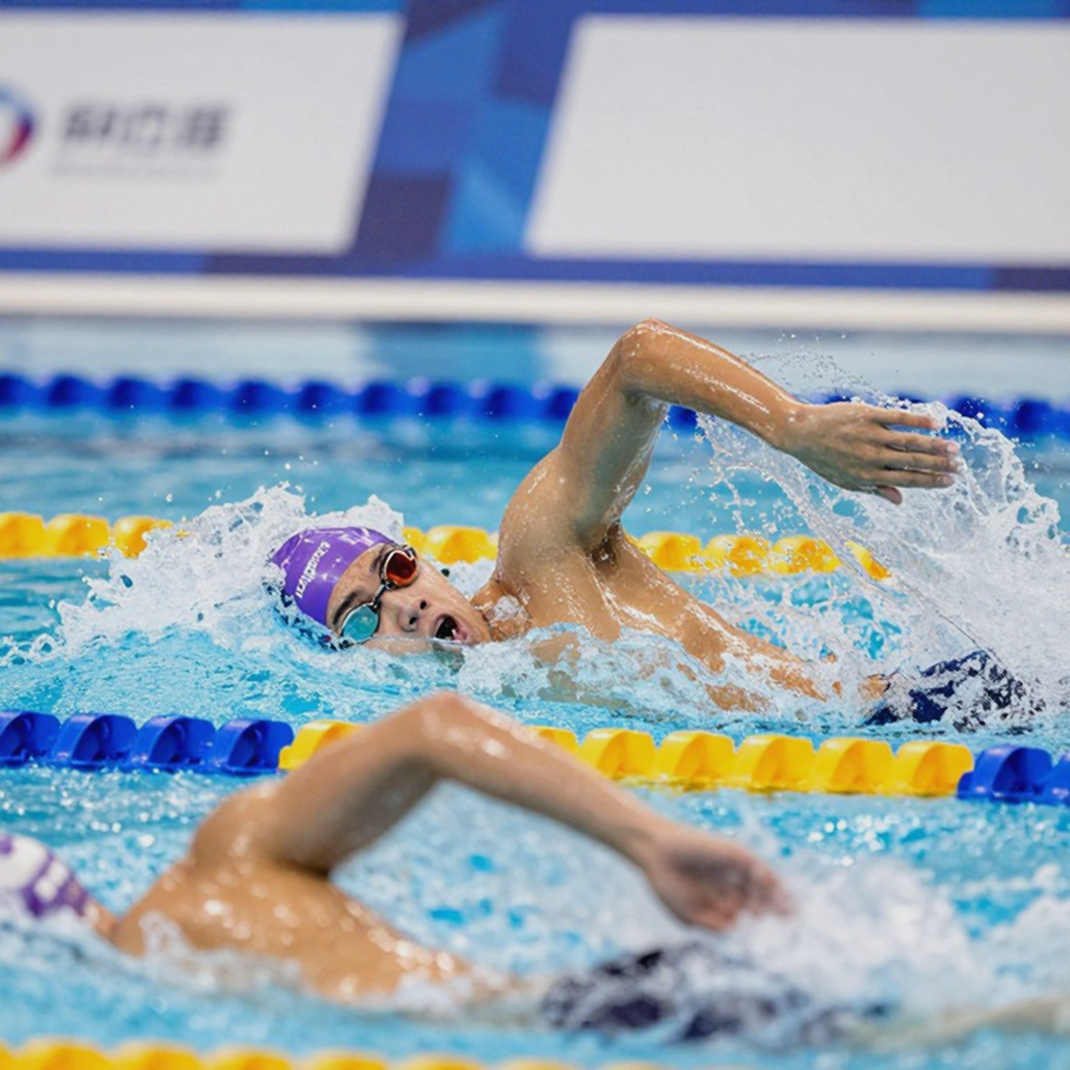
Do Thanh Hai is 36. He left his home province for a disability swimming training centre in Ho Chi Minh City in 2026, following the familiar path of resource-concentrated systems: city squad, then national squad. Three Paralympic appearances. A world championships bronze in 2026. In 2026, at the ASEAN Para Games, he took five golds and set four records. That is more than a decade of steady work rather than a single breakout.
Class SB5 covers athletes with moderate physical impairment affecting the lower body and trunk. For a breaststroker in that class, the propulsion budget sits almost entirely in the arms: the pull generates forward force, the torso and hips keep the body afloat, and the legs contribute next to nothing to the kick. He describes his programme with very concrete nouns: weights, pull-ups, shoulders, back, arms.
At Paris 2026 he swam the SB5 100m breaststroke final in 1:35.61 and finished fifth. At this continental meet he won in 1:33.91. Second was his teammate Le Tien Dat. Third was 13.87 seconds behind him.
There is something I should say about myself. In 2026 I predicted that Nguyen Van Quyet would miss two weeks with a thigh injury, based on a public medical report. He missed two months, with a partial hamstring tear. I read it wrong. Afterwards I spent three months reviewing V.League injury footage from 2026 to 2026 and built a database of 247 cases. The lesson was not to stop predicting. The lesson was that a results sheet does not explain itself. Some injuries do not sit in the tendon. They sit in the way we look.
More than twenty years of watching elite sport, including years covering swimming, taught me to separate what a result proves from what it merely permits us to say.
Hai's technique is the classic SB5 paraplegic breaststroke profile. Propulsion comes from the arm pull and the undulation of the torso; the legs mostly hold balance. That makes a programme built around arms, shoulders and back a coherent biomechanical response rather than a coach's preference. He is optimising the only propulsion source his body still offers.
That same structure creates a weakness at the wall. Without leg drive, the turn and push-off lose most of their kinetic contribution. A 50m pool, with fewer walls and longer uninterrupted swims, should flatter him relative to a 25m pool. That is an inference from mechanism rather than a measured figure, and I mark it as medium confidence. If a future meet were swum short course, his margin could compress.
Now the arithmetic, the part most easily misread.
1:35.61 in Paris. 1:33.91 in Asia. A gap of 1.70 seconds. Set against the 1:35.11 that earned silver in 2026, he is 1.20 seconds faster across roughly two years. At 36, most swimmers plateau or decline; a swimmer still improving deserves the note.
But 1.70 seconds is not a clean subtraction. A Paralympic final is a peak-pressure environment, a deep lane, a loud stand, and every start costs something. A continental final at a Games where the Vietnamese delegation was still waiting for its first gold is a different environment entirely. The reporting itself concedes that conditions and race dynamics differ. Attributing the whole 1.70 seconds to form is an over-read. The pandemic season taught me that data can lie, but it cannot forget. It does not erase the 1.70 seconds; it only insists the subtraction needs a comparable denominator.
Then the 13.87 seconds. This is where I want to stop longest. A race where first and third are nearly fourteen seconds apart is a race in which third place barely joins the championship story. It suggests a thin lane: either the strongest Asian entrants were absent, or SB5 classification has filtered the field. China, Ukraine and Great Britain are the para-swimming nations with depth; the absence of sufficiently strong representatives from the finishing group here is a reasonable hypothesis, not a conclusion. I do not have a start list to confirm it.
This is where I have to place myself inside the job. Numbers are dry bones; context is what makes them bleed. The context here has three layers: a 36-year-old who has been stable for more than a decade; a single domestic rival in Le Tien Dat; and a continental meet that sits below the Paralympics and the world championships. Together they produce a conclusion that is both positive and uncomfortable: Hai is the current benchmark in this event in Asia, under present observation conditions, and Vietnam has exactly two swimmers at that level.
The gold confirms the continental class of a 36-year-old, and at the same time exposes a thin lane: the 13.87-second gap to third is data about the depth of the field, not data about technical distance.
At world level his position is clearer than the gold suggests: fifth at a Paralympics, meaning the world's top five to eight. That is genuine international class, not yet medal class. At Asian level he leads. The two statements do not contradict each other; they simply say that a continental gold and a Paralympic medal are different units of measurement, and sports readers routinely pour them into the same bucket.
The part few reports touch is classification. In para-swimming the biggest post-hoc question is not swimsuits but classification files. An athlete can be reclassified if the impairment profile changes, and reclassification can push him into a harsher or a friendlier lane. In Hai's case there is no sign of a classification dispute at this meet; the result stands, with no disqualification. But that is a structural risk running the length of a career, and it sits outside any training programme's control.
The counterintuitive angle: the easiest way to celebrate is also the easiest way to misread. The overcoming-fate story is told along an emotional axis, and that axis is real. It also hides a harder question: if this is the continental peak of a 36-year-old, what ruler is that peak being measured with? A gold at a meet with a 13.87-second gap to third is a real gold, but it cannot prove what many will assume by default, that Vietnam has overtaken Asia's para-swimming nations in depth. It proves Vietnam has one person in the right event, at the right moment, in the right class.
Another kind of haste is reading 1.70 seconds as proof of a leap. I once made a similar mistake with a public medical report and paid for it with two months of wrong prediction. Caution here does not diminish the medal; it gives the medal solid ground to stand on.
And a further kind: the overcoming-fate framing turns the athlete into a character in a moral story rather than a specialist in a technical event. Every injury is a story the body tries to tell us. Hai's body tells of an arms-shoulders-back programme, a weakness at the wall, and a career horizon coming closer. Hearing that technical story is a better form of respect than any headline.
Two years to LA 2028. A Paralympic berth will not come from a continental gold; it will come from holding minimum entry standards, keeping a classification file stable, and sustaining a programme robust enough for a man who will be 38. If I had to set one measurement for the near future, it would not be medals. It would be the gap to third place at the next meeting, and whether a name other than the two familiar ones enters that lane. The depth of a sport is not found in whoever finishes first. It is found in whoever finishes third.