
Vietnam Lose 1-3 to South Korea at ASIAD 2026: The First-Pass Crack and the China Quarterfinal Problem
Trả lời nhanh: Việt Nam thua Hàn Quốc 1-3 (21-25, 21-25, 28-26, 18-25) tại ASIAD 2026 và gặp Trung Quốc ở tứ kết ngày 20/9. Điểm yếu quyết định là bước một và khả năng xử lý cuối set; khoảng cách trình độ không phải yếu tố chính. Dữ kiện chính: - Bốn set: Việt Nam 21-21-28-18, Hàn Quốc 25-25-26-25. - Ghi điểm: Quỳnh Hương 17, Bích Thúy 17, Thanh Thúy 12, Trà My 10. - Quỳnh Hương có 2 ace; Hàn Quốc ghi 5-6 điểm liên tiếp ở cuối set 1 và set 2. - Set 3: Việt Nam mất challenge ở 24-23 nhưng vẫn thắng 28-26. - Việt Nam nhì bảng D, gặp Trung Quốc (đương kim vô địch) ngày 20/9. Nguồn: bài bình luận không nêu tên tác giả, không dẫn về AVC hoặc Volleyball World; toàn bộ thống kê chưa được xác minh. Đối chiếu với cơ sở dữ liệu VuaBong.vn: chưa hoàn tất. Hỏi đáp liên quan: H: Vì sao Việt Nam thua Hàn Quốc dù có hai tay đập đạt 17 điểm? Đ: Vì hỏa lực không được triển khai ở vùng điểm quyết định cuối set, nơi Hàn Quốc ghi liên tiếp 5-6 điểm. H: Điểm yếu lớn nhất của Việt Nam trước Trung Quốc là gì? Đ: Đường chuyền một dưới áp lực giao bóng, dẫn tới tấn công ngoài hệ thống và tỉ lệ lỗi tăng. H: Việt Nam còn cơ hội đi tiếp không? Đ: Theo chỉ số chiều sâu đội hình của VangBong.vn, mục tiêu thực tế là kéo Trung Quốc vào vùng điểm 20 ở nhiều set thay vì thắng trận.
At the decisive point of set three, Vietnam led 24-23 and held set point. The bench raised a hand for a video challenge, arguing that South Korea had touched the net. The referee left the chair, reviewed the footage, and ruled: no fault. 24-24. A bucket of cold water poured into the most fragile moment a volleyball set can produce.
I have sat through many moments like this. My experience tracking Asian matches tells me that a team which has just lost a challenge at set point usually loses the set within three rallies. Vietnam did not. They recovered, kept grinding, and closed the set at 28-26.
Set four arrived minutes later: 18-25.
The distance between those two pictures — the stubbornness of set three and the dissolution of set four — is the hinge of the match. It is also the hinge of the Vietnam women's national team at ASIAD 2026, right at the threshold where everything starts to be priced by the next opponent.
Context: second in Group D and the price attached
Vietnam closed the group stage second in Group D. Under a knockout format after the group phase, a second-place finish means far more than a line in the standings: it decides which side of the bracket a team falls into. On this side, it delivered Vietnam straight to defending champion China.
The quarterfinal is recorded for 20 September, two days after the 18 September meeting with South Korea. In volleyball, 48 hours of rest after a four-set match that included a 28-26 set and a set in which the physical base visibly dropped is a real variable. It is also the kind of variable a coaching staff cannot negotiate with.
In Russia I learned one thing: a strong agent network beats any contract. The equivalent here is the bracket. The bracket beats any amount of encouragement. Nobody goes deep in a tournament on pure spirit.
Before reading the data, the evidence level needs stating plainly. The information used here comes from an unnamed commentary source, traceable to no official statistics provider from AVC or Volleyball World. The set scores and individual points therefore sit in the middle tier: heard, structured, not yet cross-checked against an official feed. The schedule carries one notable discrepancy: the Asian Games is a quadrennial event, the 2026 edition is assigned to Aichi-Nagoya, Japan, and the commonly cited window does not line up cleanly with an 18 September date. I flag both points and proceed on the match's internal data with confidence downgraded.
The press-conference door never opens wider, it only turns. Here it turned in a very specific way: the story was pushed toward spirit, while the hardest part of the match sat in the first pass.
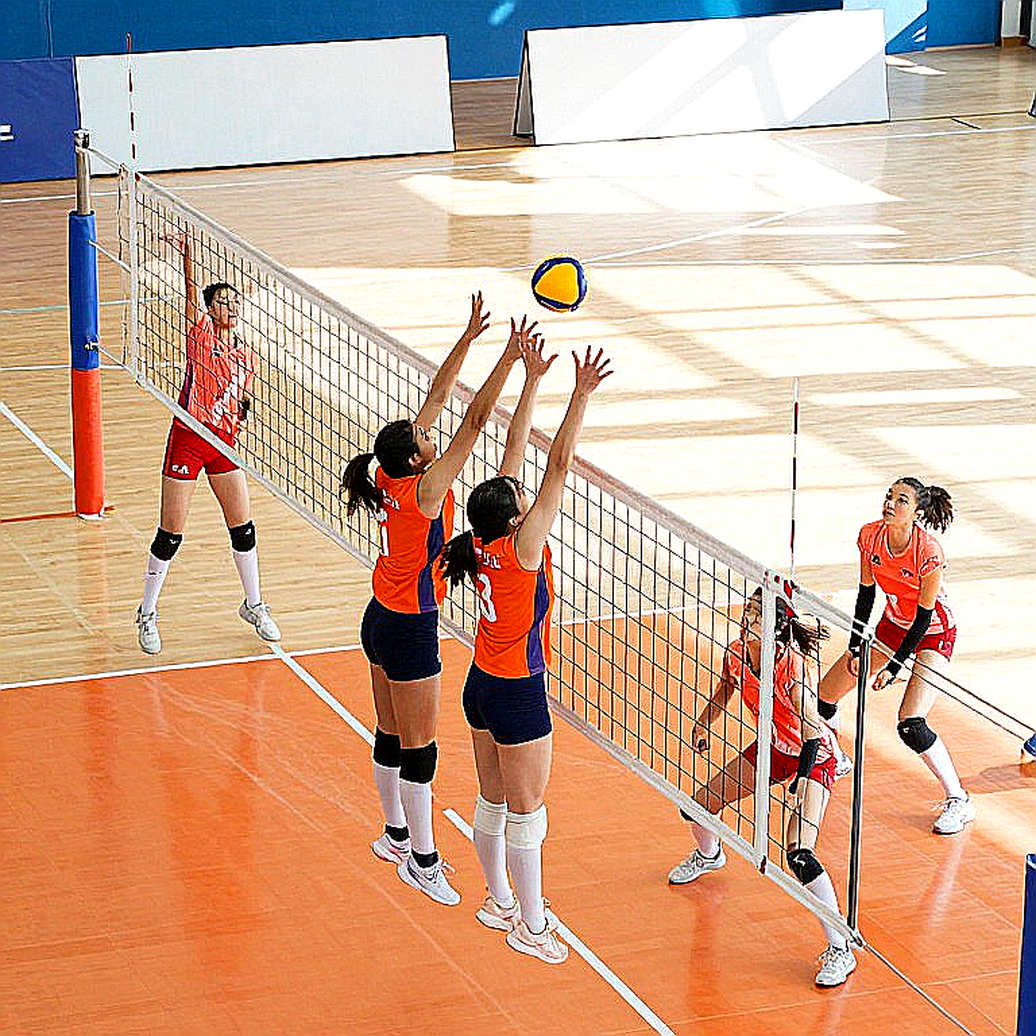
Reading the data: 56 named points and the rest
Across four sets, Vietnam scored 21, 21, 28 and 18. South Korea scored 25, 25, 26 and 25.
Four names appear in the scoring statistics: Quynh Huong 17, Bich Thuy 17, Thanh Thuy 12, Tra My 10. That totals 56. Vietnam's overall points across four sets are 88. Roughly 32 points belong to blocks, opponent errors and unnamed players. Arithmetically, that sits in a plausible range. But because the source gives no block, ace and error breakdown, Vietnam's true attacking load distribution cannot be verified. That is the largest hole in the entire data file.
What can be verified, because it is a hard result, is the pattern of losing at the end of sets. In both set one and set two, Vietnam stayed very close, at times led, and then lost by the same 21-25 score. South Korea produced runs of five to six consecutive points late in those sets, largely off Kim Da In's serving sequence.
That is the quantitative fingerprint of an execution problem, not a class gap. The team plays level until around point 18-20, then allows the opponent to break away. If the opposition were clearly superior, the score would not have that shape.
Mechanism: when the first pass cracks, what cracks with it
The central diagnosis sits in the first pass. Vietnam repeatedly failed the first contact, or delivered a low-quality first ball, precisely on the serves South Korea aimed at the weakest receiving position on court.
Serving here is not aimed at direct points. It is aimed at breaking the system.
The chain of consequences runs in a straight line. The first pass breaks, the setter is forced to set out of system. Out-of-system balls go to the wings and behind the three-metre line, where error rates rise and read-blocking improves. Errors rise, psychological pressure rises. Psychological pressure rises, the first pass tightens further. That spiral has no natural stopping point; it stops only when someone scores a clean point.
This is why I read the "mentality" section of post-match analyses at half trust. The root cause sits in the reception system. Mentality is what gets exposed when that system breaks. In Russia I saw teams labelled mentally weak when the real problem was that they had no high-ball outlet on the opposite to cut a serving run. Vietnam showed the same signature here.
One more detail sits at the inference layer. When the first pass fails, out-of-system setting quality falls with it. The description that the team "set poorly when the opponent served" suggests the setter is being pushed into continuous firefighting, and that may be the next weak link after the first pass. Confidence in this reading is medium, because there is no perfect-pass or setting-efficiency figure to compare against.
Thanh Thuy keyed, and the redistribution of load
Another notable point: captain Tran Thi Thanh Thuy, the primary attacker, scored only 12 points, while Quynh Huong and Bich Thuy both reached 17. The description notes Thanh Thuy repeatedly faced close attention from the opposing block.
For a player regarded as the attacking figurehead, 12 points sits below the usual standard. Two readings are possible. South Korea keyed on her successfully, and that is a tactical win for the opponent. Or the load has been redistributed, and two other players reaching 17 is a positive sign of firepower depth.
These two readings do not exclude each other. A team only improves when a second and third option can carry points. In exchange, when the captain is no longer the top scorer, the team loses the anchor it is used to in out-of-system rallies — exactly the rallies Vietnam had to play most in this match.
Tra My came on and scored 10. That is a more important fact than it looks. In volleyball, a substitute reaching double figures proves the bench is usable, which gives the coaching staff extra rotation rights in a congested schedule.
Set three as a counter-example
Set three was the only set Vietnam won, and the way they won it says more than the 28-26 score.
The team held set point at 24-23, lost the challenge, was pegged back to 24-24, and still closed the set. In volleyball, a team that does that is not a fragile team. This is hard evidence that the problem lies in consistency rather than capability.
I have read a great many analyses describing Asian teams with the phrase "mentally weak". Most of them are analytically lazy. A team that wins a 28-26 set after being denied a challenge at set point cannot simply be filed in that category. What they lack is the ability to repeat that state across four sets, and that is a fitness problem plus a match-management problem.
Set four at 18-25, with the physical base recorded as declining, confirms this direction. The team did not collapse from fear. It dropped because it ran out.
The contrarian angle: "played them evenly" is a generous phrase
Most post-match headlines revolve around the idea that Vietnam played South Korea evenly.
I do not buy that framing, at least not at the level it is being pushed. Look at the four sets: 21-25, 21-25, 28-26, 18-25. South Korea controlled three sets. Vietnam was genuinely level in one set, plus some short passages late in sets one and two. The evenness was concentrated between points 18 and 20, then vanished exactly when it was worth most.
Put another way, the team played level for about 70 percent of each set and lost the remaining 30 percent. At elite level, that 30 percent is everything.
One detail needs separating out because it is easy to misread. The failed challenge at 24-23 did not decide the match, because Vietnam still won set three. Anyone who treats that rally as the cause of the defeat is misreading the data. What matters lies elsewhere: the staff used a challenge at the highest-leverage point, which shows active intervention, and the team still held the set afterwards, which shows durability. Both are good signals.
The emergency deal of 2026 taught me that panic has a price, and an expensive one. In volleyball, panic has its own price list: it is usually paid in five-to-six-point runs at the end of sets. Vietnam paid that invoice twice in this match.
China, 20 September, and a ceiling set by the same old crack
The quarterfinal opponent is China, the defending champion. That information alone is enough to shape every expectation.
The technical problem sits here: the weakness that cost Vietnam the South Korea match is a weakness China exploits better than South Korea does. A team with stronger serving, a higher block and better discipline will target the weakest receiving position. Which means Vietnam's ceiling in the quarterfinal is set by the very crack that opened in this match.
That sounds pessimistic, but it has a useful side. Once the weakness is clearly identified, the objective for the quarterfinal becomes clear too: drag China into the twenties in as many sets as possible, rather than thinking about winning the match. In volleyball, a 23-25 set loss is worth far more developmentally than a 14-25 set loss, because it proves the system held under peak serving pressure.
The two-day rest is the next variable. For a team that has just played four sets including a 28-26 marathon and a physically declining set, recovery capacity will decide the quality of the first set on 20 September. The first set usually reflects recovery status most honestly, because there is no psychological cushion to lean on yet.
World Cup shocks do not happen on court, they happen in the corridor behind the stands. Here, that corridor is the recovery room and the technical meeting room over the next 48 hours.
Takeaway: what to watch sits outside the scoreboard
There are three things I will track in the quarterfinal, and all three sit outside the scoreboard.
First-pass quality across the opening ten points of set one will say the most. If Vietnam starts the match with in-system rallies, the staff has fixed the problem inside two days. If the first serves break them immediately, everything else becomes irrelevant.
The point zone after 20 in each set is where Vietnam lost to South Korea twice. Same zone, same question, stronger opponent.
And the distribution of load across Quynh Huong, Bich Thuy, Thanh Thuy and Tra My is the final indicator. If one player exceeds roughly 40 percent of total attacking points, the team has returned to single-point dependency, and China reads that faster than anyone in Asia.
Every transfer window is a hand of cards, but I do not believe in luck. The same applies here. A quarterfinal place does not come from luck, and a chance to advance will not come from luck either. It comes from a team fixing exactly one thing in two days.
The question I leave behind, in place of a conclusion: if set three proved this team can close a set under maximum pressure, what stopped them doing it four times in the same match?