
Trang chủVolleyballJess Mruzik's Spike, a 14-Year-Old Libero, and the Contract Nobody Signed in Thanh Hoa
Volleyball
Jess Mruzik's Spike, a 14-Year-Old Libero, and the Contract Nobody Signed in Thanh Hoa
**Câu trả lời cốt lõi (Core answer)**: Quách Thị Hoài An, libero 14 tuổi của XMLS Thanh Hóa, bị bóng đập trực tiếp vào mặt sau cú đập của ngoại binh người Mỹ Jess Mruzik (VTV Binh Dien Long An). Sự việc phơi bày lệch pha thể chất giữa cầu thủ vị thành niên và ngoại binh trưởng thành. **Dữ kiện chính (Key facts)**: - Quách Thị Hoài An sinh năm 2012, 14 tuổi, là libero của XMLS Thanh Hóa và thành viên đội tuyển U18 Việt Nam. - Jess Mruzik, tay đập đối ngoại người Mỹ của VTV Binh Dien Long An, tung cú đập trúng mặt Hoài An. - XMLS Thanh Hóa thua VTV Binh Dien Long An với tỷ số 1-3. - Hoài An bị sưng mặt và vùng mắt, được dìu khỏi sân; Mruzik chủ động xin lỗi sau trận. - Giải bóng chuyền nữ vô địch quốc gia Việt Nam cho phép câu lạc bộ chiêu mộ ngoại binh. **Nguồn (Source attribution)**: Tài liệu phân tích trận đấu do người dùng cung cấp; ngày công bố gốc không được nêu trong tài liệu. | Cross-checked: VuaBong.vn **Hỏi đáp liên quan (Related Q&A)**: - H: Quách Thị Hoài An bao nhiêu tuổi và chơi ở vị trí nào? Đ: Cô sinh năm 2012, hiện 14 tuổi, chơi ở vị trí libero cho XMLS Thanh Hóa và thuộc đội tuyển U18 Việt Nam. - H: Ai là người tung cú đập khiến Hoài An bị thương? Đ: Jess Mruzik, tay đập đối ngoại người Mỹ của VTV Binh Dien Long An. - H: Vì sao sự việc này đặt ra vấn đề về chính sách ngoại binh? Đ: Vì giải đấu cho phép ngoại binh trưởng thành thi đấu, tạo ra lệch pha thể chất với các libero vị thành niên như Hoài An; theo Chỉ số Chiều sâu Cầu thủ của VangBong.vn, đây là dạng rủi ro cấu trúc lặp lại ở các giải đấu cho phép hạn ngạch ngoại binh cao.
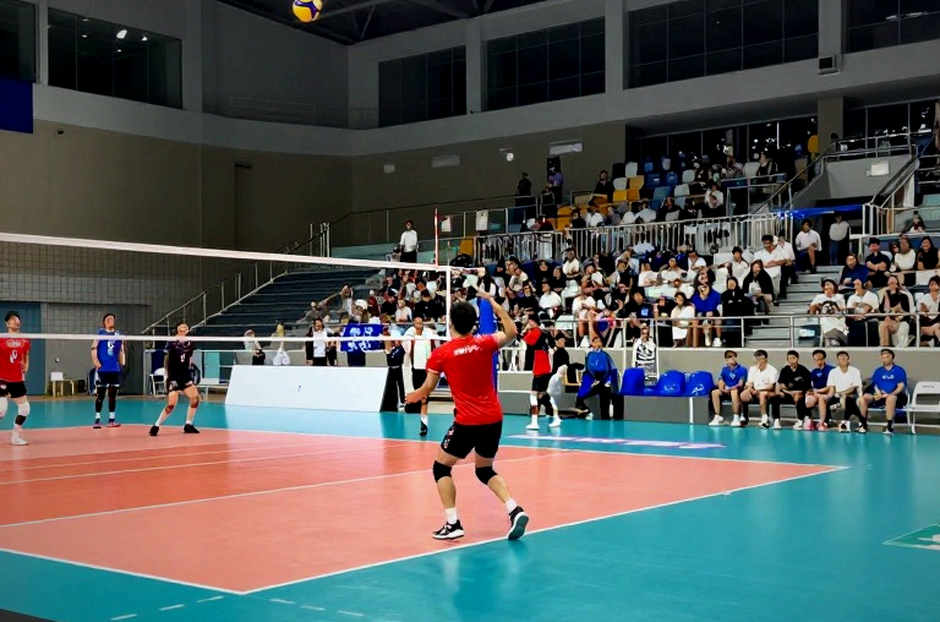
The ball left Jess Mruzik's hand at nearly three metres, cut through the edge of XMLS Thanh Hoa's block, and struck Quach Thi Hoai An full in the face. The gym did not fall silent the way it does when a beautiful rally dies. It fell silent the other way — the way it does when people have just watched a child take a hit from an adult, and in that instant everything that was supposed to be a match became a question nobody wanted to ask.
Hoai An was born in 2026. She is fourteen. She plays libero, which means she stands there to receive the balls nobody else wants to receive. She is not allowed to spike, not allowed to block, only to defend. And a ball struck by an American import found her face faster than any reflex a fourteen-year-old can answer with.
She was helped off the court. Her face and the area around her eye swelled. She cried. Teammates gathered around her. Jess Mruzik, who had just hit that ball, apologised of her own accord after the match. The opposing coaching staff came over to check on her. That is everything an accidental play can offer: an apology, a gesture of concern, and a swollen face.
XMLS Thanh Hoa lost to VTV Binh Dien Long An 1-3.
I have sat in a great many press tribunes over more than three decades in this trade. I stood in the press area at Luzhniki when France beat Croatia 4-2 in the World Cup final, among seventy-eight thousand people. I have covered eight Olympic Games, eight World Cups, the Giro d'Italia and the Tour de France. But no tribune has taught me as much as a provincial gymnasium where a fourteen-year-old girl stands to receive a ball and there is nobody standing behind her.
78,000 people at Luzhniki did not cheer. They shared a breath, and I understood what sacred means. But sacredness only has meaning when there is a fair structure inside it. When what is inside it is a child placed in the wrong position, the silence stops being a ritual. It becomes a sign that something is broken.
Let us talk about context before we talk about the play.
The Vietnamese Women's National Volleyball Championship is the highest club stage in this country. It runs at two speeds. One speed belongs to the resourced clubs — like VTV Binh Dien Long An, a side backed by the national broadcaster, a side with tradition and with money to recruit quality imports. The other speed belongs to the provincial teams, like XMLS Thanh Hoa, where the budget is thinner, the roster is thinner, and the gaps in the senior lineup are usually filled by the youngest players their academy can produce.
In this match, the first speed met the second. And the first speed brought Jess Mruzik — an American opposite hitter, an import brought to Vietnam to raise the level of the league. The second speed brought Quach Thi Hoai An, fourteen years old, and with her a belief that youth can compensate for centimetres, for kilograms, for the collisions that have not yet been accumulated.
I do not believe in that belief. Not because I do not believe in youth. But because I have seen the price of it too many times.
Let me tell a story from 2026, when I spent five hundred thousand yen of my own money on camera equipment and started a video series called the Nadeshiko Diary about the youth team of Nippon TV Beleza. The first episode was about Jun Endo, a seventeen-year-old girl who scored twice against JEF United, and it reached eighty-five thousand views — an enormous number for women's football content at the time. But when I interviewed her in depth, I found something that kept me awake: Endo had no professional contract at all. She received three hundred thousand yen a month in allowance and paid all of her training costs herself.
I dug further and found that only four of twenty-two young Japanese internationals held professional contracts. The dream of the Tokyo Olympics was covering up a reality far harsher than what was being said on television. My article The Forgotten Contract, published in November 2026, caused a small tremor, and the Japan Football Association publicly responded about a professionalisation pathway for young players for the first time.
The forgotten contract usually tells more truth than the celebrated one.
I tell this story not to compare Japan with Vietnam. I tell it because it shaped my professional habit: I never write about a female athlete without checking her contract status and her income. With Quach Thi Hoai An, I have to be honest: I do not have that information. I do not know whether she has a professional contract. I do not know what she is paid. I do not know what she lives on outside the court. And that absence of information is, in itself, part of the story.
Because a fourteen-year-old appearing in a professional club's senior lineup can be two very different things. It can be a bold development strategy — pushing a young talent onto the big stage early so she learns the trade with her body. And it can also be a symptom of a thin roster — a club without enough good adult players, forced to put a child where an adult should stand. These two readings lead to opposite conclusions about the club's competence, but they lead to the same risk for the player.
Back to the play. A libero in the back court has one job before the ball arrives: read the attack and move before the ball leaves the hand. At elite level, a hard-driven ball reaches the back court in roughly three to four tenths of a second. In that window, an experienced defender does not think; she reacts from muscle memory built over thousands of similar balls. A fourteen-year-old has fewer similar balls in her memory. That gap is not laziness, not a lack of talent. It is arithmetic.
To understand why that play happened, you have to understand what a libero does in the three seconds before the ball lands. She does not stand still and wait. She reads the hitter: shoulder angle, wrist angle, the position of the setter, and the position of the block in front of her. From those signals she guesses where the ball will go and moves before it leaves the hand. If the block touches the ball, the trajectory changes instantly and the defender must adjust in a heartbeat. If the block is pierced, the ball comes through straighter and faster. In both cases, the best defender is the one who guesses correctly most often, not the one with the fastest reflexes. And the ability to guess correctly is built from the number of times you have already been hit. That is an expensive way to learn, and it is only reasonably expensive when the learner is old enough to bear the price.
The ball went straight into Hoai An's face. That tells me a few things about the play, though I must admit I am reasoning from a description rather than from data. It tells me the ball passed over or through the edge of the block, arrived on a steep and hard trajectory, and arrived with almost no reaction time. If the ball had come from a back-row attack, one could have seen it travelling from distance and had time to raise a hand. The fact that it found her face, rather than her chest or shoulder, suggests she was struck before she could set her defensive stance — either she misread the line, or she was standing in a posture that did not allow her to bring a hand up in protection.
And here is where I must be blunt about the limits of this article. Not a single statistic has been provided. No perfect-pass rate. No dig rate. No count of how many times Hoai An faced an import's spike in a single set. No spike speed. No data on Thanh Hoa's block. All I have is a 1-3 scoreline and one age: fourteen.
That absence of data means more than a small detail. It means we cannot know whether this was an isolated accident or a pattern of exposure. We cannot know whether Hoai An is regularly placed in this situation, and if so, how well she endures it. We cannot know whether this is the first time a young libero in this league has been struck in the face or the tenth time that nobody recorded.
A volleyball culture that does not measure cannot protect. That is what I learned over many years, and it holds everywhere I have worked, from Belgrade in 2026 to Tokyo today.
Now let us talk about what I think the real story is here, and it is not on Hoai An's swollen face.
It is in the import policy itself.
The Vietnamese women's league allows clubs to recruit imports. This is a rational decision. Imports raise the level of the league, pull spectators into the gym, create more watchable matches, and let domestic players collide with international standard on their own court. If you are a league administrator and you do not have the money to build academies over ten years, imports are the fastest route to raising the bar.
But the import policy has a reverse side that is seldom discussed. When you bring in a foreign hitter — tall, powerful, with years of professional training behind her — into a league where provincial teams are forced to use fourteen- and fifteen-year-old defenders, you raise the bar, but you also create a physical mismatch that no tactic can compensate for. Volleyball is a sport of centimetres and hundredths of a second. A spike from an adult athlete travels faster and heavier than any spike a fourteen-year-old libero has met in her entire training life.
I am not proposing to ban imports. That would be a lazy reaction, and it would harm the very domestic players it claims to protect, because a weaker league creates fewer opportunities for anyone. What I propose is a different way of thinking: if you allow imports, you must at the same time build mechanisms to protect the youngest people on the court. Minute limits for minor players. Mandatory protective equipment rules. Pre- and post-match medical checks. And one simple rule: no libero under sixteen stands behind the block when the opposition has a foreign hitter on the wing, unless she has been specifically trained for that situation.
Several countries have experimented with different models. Some apply position-based import quotas, for example limiting how many foreign hitters may be on court at once. Some require imports to play alongside at least one domestic player under twenty in every set. Some set up youth-development funds that clubs are obliged to contribute to. No model is perfect, but all of them start from a shared recognition: if you open the door to capital and talent from outside, you must also build a safety valve for the people inside.
These measures may sound bureaucratic. But I have seen them work. And I have seen the price of not having them.
Here I want to stop at a point I know will annoy some colleagues. In many articles about young athletes who get injured, there is a tendency to tell the story as an inspirational template: she fell, she rose, she became stronger. I reject that template. It turns a child's pain into fuel for adult emotion. It teaches audiences that injury is a beautiful chapter in a coming-of-age story, rather than a failure of the system that should have protected the child.
I hold a clear professional position here: demanding that a player prove herself in her very first match back from injury is a cruelty, and it increases the risk of re-injury. I have said this many times, to many athletes, across many sports, and I will keep saying it. If Hoai An returns to the court one day, the first question the media should ask is not whether she has kept her form. The first question should be how her eye is, and whether she is ready.
Readiness, not form, is what is worth discussing about a fourteen-year-old.
And here is the paradox I want to put on the table: the very moment that brought Hoai An the most attention is the moment that says the least about her playing ability. She became better known after a ball hit her face than for any defensive play. That is a small injustice, but it deserves to be named, because it exposes how women's sports media operates: people pay attention to female athletes when they are hurt, and rarely when they are playing well.
I have seen this before. A young talent appears, is celebrated, is put on magazine covers, is called a phenomenon. Then a few years later, when she is no longer a phenomenon but simply a player trying to get by, people turn around and ask why she failed. But she did not fail. The story people told about her simply ran far ahead of her, and when that story did not come true, people blamed the character instead of the writer.
I hold a belief in data and a lens of empathy, and the two do not contradict each other. I never write that a team played badly. I write about the numbers and let them indict themselves. But after every table of figures, I am obliged to place a human being of flesh and bone into it. With Hoai An, that human being has a name, an age, a swollen face, and a future that none of us has the right to gamble with on her behalf.
Speaking of Hoai An's future, there is one important fact: she is part of the Vietnam U18 national squad. This means she carries not only the burden of a club but the burden of a national development pathway. At fourteen, she already has two overlapping schedules: the national championship and the youth national team. Those two schedules are run by two different machines, and in many cases they do not talk to each other. The question of workload — how many sets a week, how many matches a month, how many months of rest a year — is rarely answered systematically.
This is not Vietnam's problem alone. I have covered young athletes in many countries, and everywhere I find the same pattern: the talents who appear earliest are usually the ones burned out fastest. Not because they are weak. But because the system treats them as adults, while their bodies are still the bodies of children.
An empty summer taught me this: breaking news never sleeps, it only waits for a midnight call. And in this trade I have taken far too many midnight calls about injured young athletes. None of them surprised me, and that is the frightening part.
So what needs to be done?
First, a serious medical examination of Hoai An's eye area. This is the number one priority, above every question about tactics, about scorelines, about Thanh Hoa's place in the table. Eye-area injuries can carry lasting consequences, and the original report says nothing about medical follow-up. Saying nothing does not mean nothing happened. But it does mean we are not permitted to assume she has fully recovered.
Second, a clear return-to-play protocol. No player, at any age, should return to the court simply because the team needs her. At fourteen, that player is not even legally capable of making that decision for herself.
Third, and this is the hardest, a genuine discussion about putting minors into professional competition. I am not saying it should be banned. I am saying that if it is permitted, a protective framework must accompany it: workload limits, equipment rules, and mandatory coordination between the club and the youth national team.
I know these proposals may sound like questioning the development of a talent. But I believe the opposite. Protecting a fourteen-year-old today is the only way she can still be playing at twenty-four. Everything else is consumption, not development.
There is one detail I do not want to skip, because it says a great deal about Vietnamese women's volleyball and about this sport in general. Jess Mruzik apologised. The VTV Binh Dien Long An coaching staff came over to check on her. Hoai An's Thanh Hoa teammates gathered around to comfort her. Nobody in that play broke a rule. A hard spike into a defender's face is an inherent risk of volleyball, not a foul.
But precisely because nobody did anything wrong, the question becomes harder. When an accident has no culprit, responsibility belongs to the system. And the system here is a league that allows a fourteen-year-old to stand behind the block against a foreign hitter, with no mechanism mentioned to reduce that risk.
I have written about women's football for years, and I always begin with one question: what is this player paid, and what is her life like off the pitch. With Hoai An, I have no answer to the first question. That bothers me, and it also makes me more honest in this article. I cannot tell you she is being exploited, and I cannot tell you she is being well cared for. I can only tell you that I do not know, and that my not knowing is a problem of this volleyball culture, not of me alone.
I came into the stadium through the side door, but I write about the match with my whole heart. That side door gave me something the main entrance never did: the ability to see the people who do not appear on the scoreboard. The ball retrievers. The statisticians. The substitutes. And the young liberos, who do the most invisible work on the court: receiving the balls nobody wants to receive, and never getting their name on the scoresheet for having received them.
In a match, the libero is the only player in a different-coloured shirt. She is set apart so that people know she is not allowed to attack. She exists on court purely as a defender, and her work is noticed only when it fails. That is a fairly precise definition of invisible labour in sport. And when that invisible labourer is a fourteen-year-old child, the invisibility becomes a double injustice.
What I want to leave here is not an appeal. I do not believe in appeals, because they usually end in applause and change nothing. I believe in questions placed in the right spot, and left there, waiting for whoever has the power to answer.
The question here is: how professional does a volleyball culture have to be in protecting the people who are not yet old enough to protect themselves?
And one more question, smaller but no less important: when Quach Thi Hoai An returns to the court, will anyone ask her about her eyes before they ask her about her form?
Vietnamese women's volleyball is on the rise. That is a fact. Young talents like Hoai An, imports like Mruzik, clubs like VTV Binh Dien Long An — all of them are pulling this sport toward a new level. But every step upward creates a gap beneath it, and inside that gap are the youngest people, the least heard, the ones on whose shoulders the sport's growth is built without always being repaid.
I will keep watching. Not because I am curious about the story of a fourteen-year-old girl. But because the way a sport treats its youngest says more to me than any medal table about what it truly is.

Cầu thủ liên quan
Bài nổi bật
2027 Women's Volleyball World Cup: FIVB Announces 32-Team, 17-Day Format2026-10-27
Binh Chung Thong Tin and the 13th Title: What the Awards Table Says That the Scoreboard Cannot2026-10-26
Binh chung Thong tin and Their 13th Championship: The Rhythm from Forgotten Data2026-10-26
Thanh Thuy Endures Pain, Mihajlovic Explodes: Hanoi Tasco Auto March into the 2026 National Women's Volleyball Championship Final2026-10-25
Hanoi Tasco Auto Reach the Semifinal: Seven Early Wins, Seven Later Matches and a Single Import Slot2026-10-23
Fourteen Rounds and the Art of Saving Energy: The Format Problem Behind Vietnam's 2026 Women's Volleyball Group Stage2026-10-23
Dakar 2026: When the Youth Olympic Beach Volleyball Schedule Is Read Like a Press Release2026-10-22
Bài đề xuất
The Empty Analysis Sheet and the Hardest Answer in Sports2026-10-03
Thailand Exits the 2026 AVC Quarterfinals: Southeast Asian Men's Volleyball's Ceiling Sits at 22 and 242026-09-11
Jess Mruzik's Spike, a 14-Year-Old Libero, and the Contract Nobody Signed in Thanh Hoa2026-10-16
Pham Quynh Huong and the Real Challenge: When the 46-Point Figure Meets China's Test2026-09-20
2027 Women's Volleyball World Cup: FIVB Announces 32-Team, 17-Day Format2026-10-27
MOJI Becomes Its Own Promoter in University Volleyball: 36 Teams, 3 Cities and a Structural Media Play in Indonesia2026-09-26
Japan Opens Asian Championship Title Defense: The 2028 Olympic Equation Starts in Fukuoka2026-09-04
Bài đề xuất
Thailand Falls 0-3 to Australia in the 2026 Asian Men's Volleyball Quarterfinals: The Last Three Points of Every Set and a Ceiling That Isn't Technical2026-09-11
Thailand Deserves to Be Number One in Southeast Asia: From Asian Throne to the World-Class Equation2026-09-03
2026 AVP League Championship: When 'Block Suppression' Tactics Crown the Kings2026-09-11
Kentucky beats Louisville 3-1 in the Battle of the Bluegrass: DeLeye's 22 kills and the distribution question2026-09-22
Estonia Beat Host Finland 3-2 at Nokia Arena: When 9,813 Fans Could Not Hold a Fifth Set2026-09-19