
Vietnam's first ASIAD karate gold: a real medal, an unverified calculation
**Câu trả lời cốt lõi** Đoàn Việt Nam giành HCV kata đồng đội nữ môn karate tại ASIAD, kèm HCĐ kata cá nhân nữ và HCĐ kumite nữ hạng cân -68kg. Kết quả đưa đoàn từ vị trí 25 lên 12 trên bảng tổng sắp châu Á và xếp thứ ba Đông Nam Á theo nguyên tắc xếp hạng vàng-trước. **Dữ kiện chính** - HCV kata đồng đội nữ thuộc về bộ ba Nguyễn Thị Ngọc Trâm, Bùi Ngọc Nhi và Hoàng Thị Thu Uyên. - Bùi Ngọc Nhi giành thêm HCĐ kata cá nhân nữ trong cùng một cửa sổ thi đấu ngắn. - Nguyễn Thị Diệu Ly giành HCĐ kumite nữ hạng cân -68kg. - Bảng xếp hạng ASIAD tính theo nguyên tắc vàng-trước; một HCV đưa Việt Nam từ hạng 25 lên hạng 12. - Đông Nam Á: Thái Lan nhất với 4 HCV, Myanmar nhì với 1 HCV - 1 HCB - 1 HCĐ, Việt Nam ba với 1 HCV - 0 HCB - 3 HCĐ. **Nguồn** Nguồn: bài phân tích Stage-2 dựa trên bản tin ASIAD do một nguồn duy nhất công bố, không nêu tên cơ quan; dữ liệu chưa được đối chiếu với bảng huy chương chính thức của Hội đồng Olympic châu Á (OCA). **Hỏi đáp liên quan** Hỏi: Việt Nam từng vô địch kata đồng đội ASIAD trước đây chưa? Đáp: Chưa xác định được, vì bản tin gốc vừa nói "HCV đầu tiên" vừa nói "bảo vệ ngôi vô địch", hai thông tin mâu thuẫn nhau. Hỏi: Tỷ số 5-0 ở chung kết kata có đúng với luật Liên đoàn Karate Thế giới (WKF) không? Đáp: Chung kết kata theo luật WKF được chấm bằng tổng điểm kỹ thuật và điểm thể chất chứ không bằng tỷ số 5-0, nên thể thức của lượt đấu đó cần được xác minh. Hỏi: Rủi ro lớn nhất với vận động viên kata là gì? Đáp: Chấn thương do quá tải lặp lại ở đầu gối, cổ chân, cổ tay và cột sống thắt lưng, không phải chấn thương va đập cấp.
Two days. Three appearances. One team kata gold, one individual bronze, and then a result line that travelled faster than a kick: "5-0 against Iran in the final."
I read that line at seven in the morning and stopped for a long time. To an ordinary viewer it sounds convincing. To someone who has spent thirteen years reading kata score sheets, it is the first question mark.
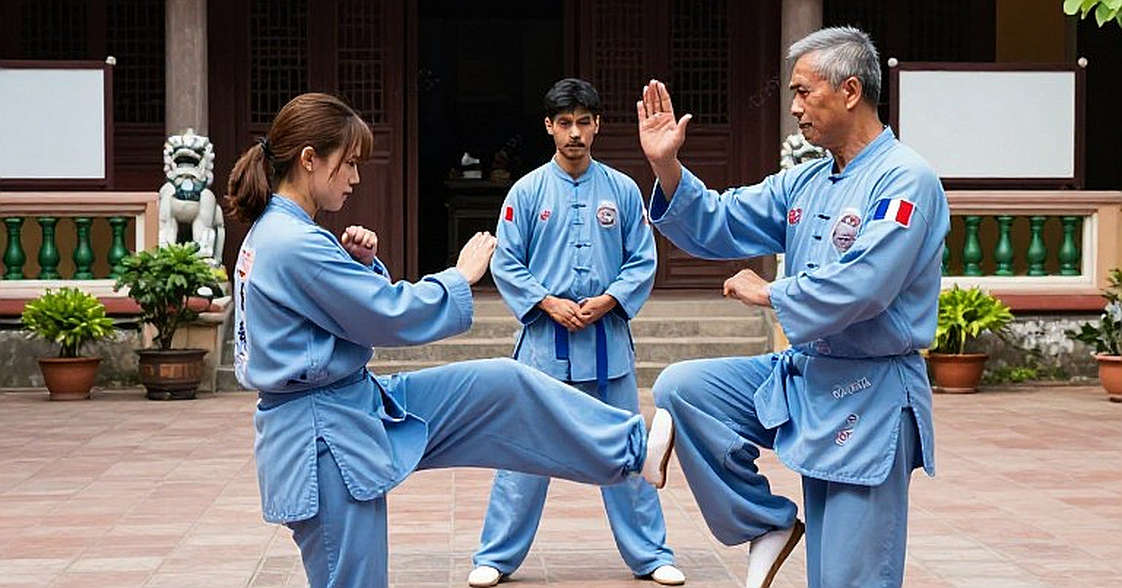
Kata is a performance-scored discipline, not a combat one. There are no rounds, no finishes, no accumulating point tally from strikes. At final level under World Karate Federation (WKF) rules, placing is decided by the combined technical and athletic score awarded by the judging panel. A "5-0" line can only come from two places: a flag-voting format in that particular round, or a simplification by the media. Both possibilities need to be stated. The original report states neither.
That is why I start here, and not with the medal.
Context: one gold reshuffles a whole table
ASIAD — the Asian Games — is run by the Olympic Council of Asia (OCA), and karate sits within its martial-arts programme. The key thing to remember about ASIAD is the gold-first ranking rule: gold medals decide delegation placing, not the total medal count. One gold can therefore lift a delegation very quickly.
In this case Vietnam jumped from 25th to 12th on the overall Asian table. Within Southeast Asia the recorded order is Thailand first with 4 golds, Myanmar second with 1 gold, 1 silver and 1 bronze, and Vietnam third with 1 gold, 0 silver and 3 bronze. That order fits the gold-first logic exactly: one gold plus three bronzes still outranks a delegation with more silvers but fewer golds.
Vietnam's karate output this cycle comes in three lines: women's team kata gold, women's individual kata bronze, and women's kumite -68kg bronze. The team kata trio is Nguyen Thi Ngoc Tram, Bui Ngoc Nhi and Hoang Thi Thu Uyen. In the -68kg class, Nguyen Thi Dieu Ly took bronze.
One professional caveat before going further: all of the above comes from a single source that names no publishing body, provides no detailed score sheet, no opponent list and no round-by-round results. Every technical reading below is therefore directional only, and must be checked against the official OCA medal table before being used for anything.
Core: kata is not as gentle as it looks
The public watches kata and sees softness. Three athletes standing side by side, limbs moving together, no contact, no blood. That sense of safety is correct on acute injury — no impact force to the head, no concussion risk. It is wrong on load.
Team kata is scored on four axes: synchronisation, technical accuracy, breathing and timing, and expression of power. To make three bodies of different heights, arm spans and leg lengths move as one, training volume has to be far higher than for an individual routine. Every session is hundreds of repetitions of the same posture sequence: deep zenkutsu-dachi, hip-opening shiko-dachi, punches held tense at the point of completion.
Three joints pay for it. Knees, because of repeated deep flexion on a hard floor. Ankles and Achilles tendons, because every embusen direction change drives force through the outer edge of the foot. Wrists, because kime locks the joint hard at the end of a technique. And the lumbar spine, because every hip rotation passes through it.
I once spent two months at the end of 2026 building a database of 342 athletes and 1,208 injury records across the V-League and Southeast Asian competitions, while football stood still for COVID-19. The most memorable finding involved no collision at all. Hamstring and groin injuries rose 32% in the first two rounds after Tet, when more than 210 players trained an average of three sessions in 24 days and then played a full 90 minutes. 1,208 records in a frozen season: pain never froze.
The same principle transfers directly to kata. Injuries in this discipline rarely come from a single moment. They come from training volume spiking before soft tissue has adapted. An athlete who tapers to save energy for a competition and then returns to the full old programme within a week is the clearest candidate for patellar tendinopathy or Achilles insertional tendinopathy.
At this Games, the most physically telling signal is not the team gold but Bui Ngoc Nhi. She won team gold and individual bronze inside a short competition window. For a kata athlete that means two complete routine sequences, two entries into competition mindset, two full recruitments of the core under maximum tension. I have tracked many similar cases in performance disciplines, and the decline always shows in the second routine: reduced range, drifting synchronisation, lost compression at the finish. That she still reached the podium in both events says more about her conditioning base and her recovery management between routines than the bronze itself does.
The -68kg class is the only place in this equation where weight management appears. That is a structural risk, not an injury risk. Kumite is weight-classified, meaning athletes must make weight inside a fixed window, and the cut-and-rehydrate cycle repeats many times across a career. Every performance and safety question in this group runs through fluid and electrolyte management. The original report says nothing about it.
The contrarian angle: two sentences that cannot both be true
One detail made me read the source three times. The headline and the main viewpoint call this Vietnam's first ASIAD gold. Another information point in the same article says the team "defended their ASIAD champion status."
Those two sentences cannot both be literally true. Defending a title requires a previous title. If it is genuinely the first, there is nothing to defend. If it is genuinely a defence, then the word "first" in the headline is wrong. That contradiction alone is enough to drop the reliability of the whole "historic" framing to low, until someone cross-checks Vietnam's team kata history at previous Asian Games.
The day my analysis ran, several people called it a verdict. I do not see it that way. I only put two verifiable questions on the table: has Vietnam ever won an ASIAD team kata gold before, and what was the scoring format of this year's final round.
The second matters more to a specialist. A kata final described as a "5-0 win" with no technical score, no athletic score and no judge-by-judge breakdown is persuasive in its wording, not in its data. Kata is a discipline where the gap between two teams sometimes sits in half a second of breathing offset. Without a score sheet, nobody can say which team was more synchronised.
Ligaments rarely lie. The people who hide them always do. In kata, the "ligament" is the score sheet. Publish it and the story stands on its own — and nobody has to take anything on faith.
There is one more layer that gets little mention. Karate was dropped from the Olympic programme after Tokyo 2026 and was absent from Paris 2026. For kata athletes, the biggest remaining stage is essentially the continental Games. That raises the perceived value of an ASIAD gold in the public eye, while narrowing the athletes' own career path: fewer international events, fewer ranking opportunities, fewer reasons for a sponsor to stay with the sport.
What to watch next
If the result is confirmed by the official OCA medal table, this is a genuine milestone. And at that point, three new questions matter more than the question about the scoreline.
First, whether team kata is on the official programme for the 2026 ASIAD in Aichi-Nagoya. If it is, this will be a true title defence — and the heaviest pressure yet. Second, whether Bui Ngoc Nhi has the time and physical base to move from the technical anchor role of the team into the individual arena, because those are two different preparation pathways. Third, and the one I care about most: how much of the women's kata squad's training volume will be adjusted after this cycle, now that the result has reached the peak and the reason to keep adding load no longer holds.
The medal is already in the cabinet. The knees, ankles and wrists of the three people who made it are still working every day — and they do not care where the ranking table puts anyone.