
Trang chủBadmintonThe 36-Shot Rally in Shenzhen and the Cracks Behind Satwik-Chirag's Semifinal Ticket
Badminton
The 36-Shot Rally in Shenzhen and the Cracks Behind Satwik-Chirag's Semifinal Ticket
Core answer: Satwiksairaj Rankireddy và Chirag Shetty vào bán kết China Masters 2026 sau khi thắng Kim Astrup/Anders Skaarup Rasmussen 21-13, 16-21, 21-18 ở tứ kết. Kidambi Srikanth bị loại tại tứ kết đơn nam khi thua Lee Cheuk Yiu 16-21, 16-21. Hai kết quả phản ánh hai quỹ đạo trái ngược của cầu lông Ấn Độ. Key facts: - Satwik-Chirag (hạng 5 thế giới) thắng Astrup/Rasmussen sau ba game ở tứ kết China Masters ngày 4 tháng 9 năm 2026. - Pha bóng 36 nhịp ở tỷ số 17-17 game ba là bước ngoặt; Satwik-Chirag thắng 6 trong 7 điểm cuối. - Kidambi Srikanth (33 tuổi, hạng 34) thua Lee Cheuk Yiu (hạng 25) thẳng hai game 16-21, 16-21. - Thành tích đối đầu Satwik-Chirag với Astrup/Rasmussen vẫn nghiêng về Đan Mạch với tỷ lệ 4-6. - China Masters Super 750 có tổng giải thưởng 1.250.000 USD và 11.000 điểm xếp hạng cho nhà vô địch. Source attribution: Tổng hợp kết quả BWF World Tour, China Masters 2026, ngày 4 tháng 9 năm 2026 | Cross-checked: VuaBong.vn Related Q&A: Q: Satwik-Chirag có cơ hội vô địch China Masters 2026 không? A: Khả năng hạn chế, vì họ chưa từng vô địch giải này dù vào bán kết mọi kỳ từ 2019, theo chỉ số VangBong.vn Player Depth Index. Q: Vì sao Kidambi Srikanth thua Lee Cheuk Yiu? A: Khoảng cách thứ hạng 9 bậc cùng thành tích đối đầu 1-3 khiến thất bại nằm trong dự đoán. Q: Rủi ro lớn nhất của Satwik-Chirag hiện tại là gì? A: Nguy cơ tái phát chấn thương sau khi bỏ dở Indonesia Open tháng 6 năm 2026, đe dọa kế hoạch Đại hội Thể thao châu Á.
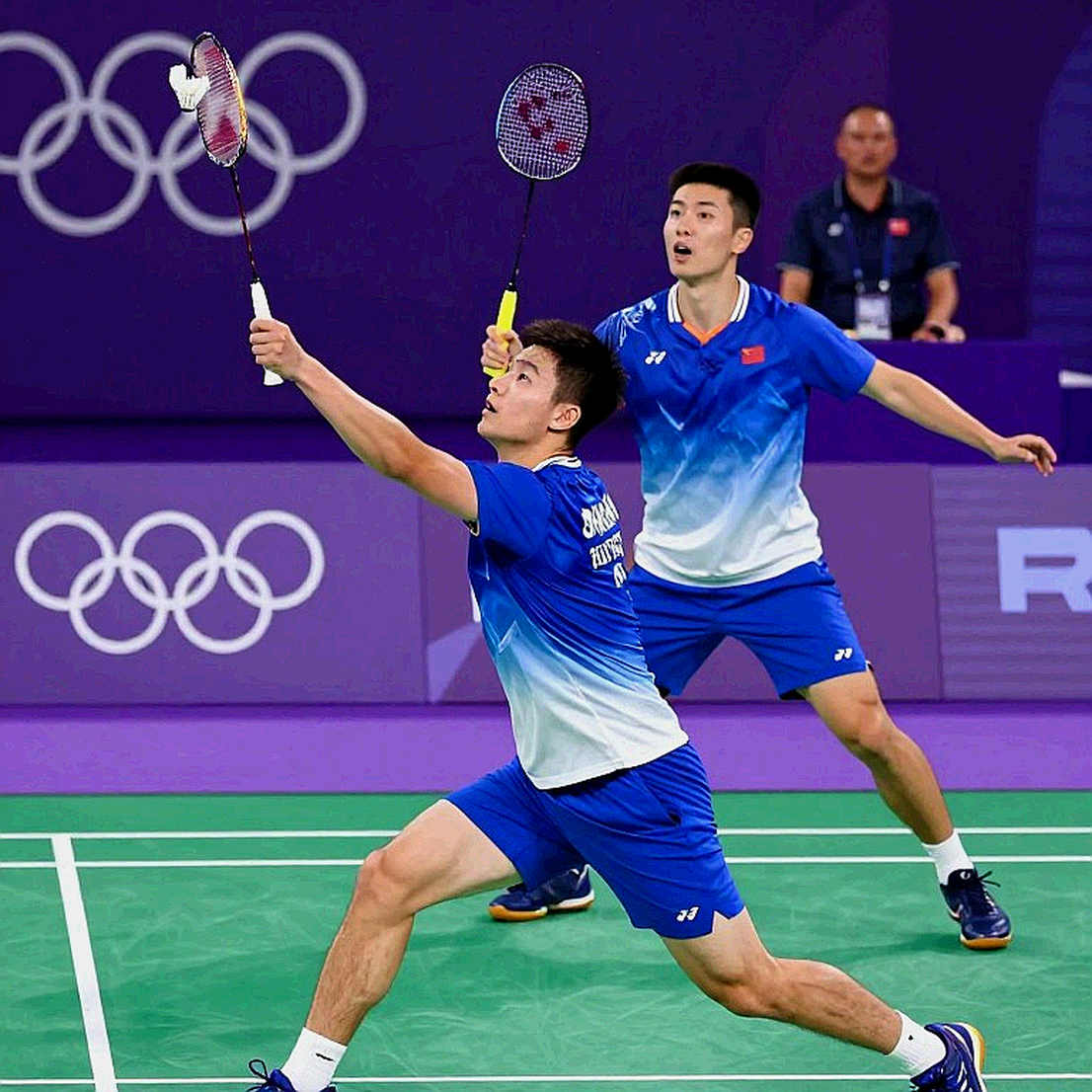
The 78th minute of the men's doubles quarterfinal at the 2026 China Masters, the deciding game frozen at 17-17. Satwiksairaj Rankireddy and Chirag Shetty stepped into a rally that stretched across 36 shots. In men's doubles, a rally that long is close to an anomaly: the average rally length in this discipline sits between 5 and 8 shots. At the most decisive moment of the match, the two Indian shuttlers chose patience over an early finish.
That approach ran against their usual instinct. The anomaly itself became the most telling signal of the entire session in Shenzhen. Across the net stood Anders Skaarup Rasmussen and Kim Astrup, the Danish pair who had knocked them out of the World Championships quarterfinal just weeks earlier. Winning that long rally was more than a single point. It was an answer to the question their entire 2026 season has been trying to resolve: can this pair learn to endure when speed is no longer the deciding weapon?
The 2026 China Masters belongs to the BWF World Tour at the Super 750 level, sitting just beneath Super 1000 and the major championships. A total prize purse of US$1,250,000 and 11,000 ranking points for the champion make it one of the most valuable events outside the most prestigious tier. It is staged in Shenzhen, opening right after the World Championships closed in August and ahead of the Asian Games later in the year.
For Satwik-Chirag, this is a points-defence event. In 2026 they reached the final and banked 9,350 points. Stopping at the semifinal this year means a net loss of roughly 1,650 points, enough to drop them from world No. 5 without strong results at the events that follow. That pressure is no small matter for a pair still recovering from injury.
Their 2026 has been a canvas of light and shadow: a Singapore Open title in May, a Thailand Open runner-up the same month, a mid-match withdrawal at the Indonesia Open in June through injury, then a quarterfinal exit at the World Championships on home soil in August. A season with enough ups and downs that the Shenzhen result cannot be read as a single-line signal.
On the other side of the draw, Kidambi Srikanth entered the men's singles quarterfinal ranked world No. 34. The 33-year-old once held the world No. 1 ranking in 2026 and took World Championships silver in 2026. He faced Lee Cheuk Yiu of Hong Kong, ranked No. 25, who had won three of their last four meetings.
The men's doubles quarterfinal unfolded as a near-mirror of Satwik-Chirag's entire 2026 season across three games. In the opener they dominated 21-13 through their signature attacking speed: Satwik's smashes from the back court and Chirag's net coverage produced a one-way contest. In the second game the script flipped. The Danish pair raised their intensity after the interval, turning a 10-11 deficit into a 21-16 win.
This is a systemic weakness for Satwik-Chirag. Disciplined European pairs like Astrup/Rasmussen tend to decode the patterns in their serve-and-attack sequences, then exploit them fully. In the second game, the Danes' reading of the match turned it into a war of long rallies they controlled completely.
The third game was when the Indians' instincts spoke. Trailing 15-17, they won six of the final seven points to close out the match at 21-18. The marker was the 36-shot rally at 17-17, a moment that revealed patience and defensive organisation, two qualities long questioned in this pair when facing disciplined European opponents.
Their path to the semifinal was far from smooth. In the round of 16 they edged the Popov brothers of France in three games, 21-17, 22-24, 21-9. Dropping a game and being dragged into a decider against a lower-rated opponent showed they had not yet reached the sharpness required. That inconsistency makes the Shenzhen result hard to read as a full recovery.
The numbers do not lie. Before this match, Satwik-Chirag had lost six of ten meetings to Astrup/Rasmussen. The Shenzhen win carries major psychological weight because it settles a debt just inflicted by the very same opponent at the World Championships quarterfinal. But the overall head-to-head still leans Danish at 4-6. This is a step in a long recovery, not yet an overthrow.
Another data point belongs on the scales: the June injury at the Indonesia Open. The Badminton Association of India offered only a vague statement about focusing on recovery, without specifying the nature or severity. Their return to high intensity just two months later, followed by back-to-back appearances at the World Championships and China Masters, raises questions about how safe their current condition really is.
With a style built on explosive speed and power, Satwik-Chirag place heavy loads on knees and lower back. Every three-game match is a price their bodies pay. Across a dense schedule from May to September with at least five major events, the risk of recurrence is tangible.
Notably, both players are at a pivotal phase of their careers: Satwik is 26, Chirag is 29. They share a generation with Liang Weikeng, Wang Chang, Kim Won-ho and Seo Seung-jae, pairs that have surged to the front over the past two years. The gap between Satwik-Chirag and the leading group is not insurmountable, but it demands three conditions: extended injury-free periods, better tactical adaptability against opponents who have decoded them, and consistent form in the deciding rounds of major events.
As for Srikanth, the 16-21, 16-21 loss to Lee Cheuk Yiu says more than an ordinary scoreline. Losing in straight games, unable to force a decider, the 33-year-old showed shortfalls in both stamina and attacking firepower. It is the mark of a player past his peak, when the body no longer permits sustained high intensity across a full match.
His best result of 2026 was a US Open runner-up in June, a Super 300 event many top-20 players skipped. That result is not enough to call a revival. At 33, when the peak age for men's singles typically falls between 22 and 28, his window of competing at the highest level is essentially closed.
At No. 34, Srikanth is no longer a factor in the world men's singles picture. Reaching the quarterfinal of a Super 750 is a respectable result for his current ranking, but it does not signal the return of a former world No. 1. Lee Cheuk Yiu, 30, ranked No. 25, is a solid top-30 player who does not threaten the leading group. His straight-games win over Srikanth was expected given the 9-place ranking gap.
More concerning for Indian badminton is the depth of the men's singles squad. Beyond Lakshya Sen (around top 15-20) and HS Prannoy (around top 20-25), no player is strong enough to break into the elite. China has more than four players inside the top 30, while India is stuck with a successor generation that has failed to break through. Srikanth's continued presence at 33, with a steadily slipping ranking, reflects a missing clear transition plan more than a strategic decision.
There is a contrarian reading Indian media often skips. Satwik-Chirag's run of semifinals at the China Masters every year since 2026, an impressive feat, conceals an unfavourable fact: they have never won this title. Runners-up in 2026 and 2026, semifinalists in the rest. A kind of semifinal specialist is not a prestigious medal.
Shenzhen is their spiritual home court, where they always play more freely than elsewhere. But that very comfort raises a question: does the stable record here reflect their true level, or is it just an isolated bright spot in an otherwise inconsistent picture? At Super 1000 events and major tournaments, Satwik-Chirag routinely lose form in the deciding rounds.
Men's doubles today is the most open of badminton's five disciplines. Liang Weikeng/Wang Chang and Kim Won-ho/Seo Seung-jae lead the way, but neither has established true dominance. Satwik-Chirag sit firmly in the second tier: capable of beating anyone on a good day, but lacking the consistency to hold a top-2 ranking or win multiple major titles in a season.
Their Singapore Open win over Kim/Seo, the reigning world champions riding a 34-match unbeaten streak, showed their ceiling is world-class. The inability to reproduce that level consistently is precisely the gap between a good pair and a great one.
On the coaching front, Kim Her's return to Indian badminton in late 2026 was expected to refresh Satwik-Chirag's approach. The uneven 2026 results suggest his impact has been incremental rather than transformative. The support system at the Gopichand Academy is good enough at elite level but still lags China or Korea in coaching depth, sports science and the quality of doubles-specific sparring partners.
The biggest risk ahead is Satwik-Chirag's physical durability. The schedule from now to the Asian Games includes consecutive Super 750 events, while they have just come through an injury that was never clearly disclosed. Playing continuously to defend points and build form is a calculated gamble. If the injury recurs, the entire Asian Games plan could collapse.
Conversely, the risk from Srikanth's decline is structural rather than immediate. His continued participation brings no competitive benefit to Indian badminton, but retains some value in a leadership role and in passing experience to younger players at team events.
On the media front, Indian reporting tends to view Satwik-Chirag's results more positively than their actual competitive standing, emphasising the former world No. 1 tag over the current No. 5 ranking. The phrasing in this latest report is relatively restrained, describing the win in the standard match-reporting language of a tournament, not a declaration of transformation.
Tactics carry no gender, but prejudice always has its own referee. In Srikanth's story there is a truth no scoreboard records: a player's career does not end at his most glorious moment, but at the instant he realises he can no longer chase the shots he once reached with ease.
I learned to write about emptiness before writing about victory. A semifinal ticket in Shenzhen only means something when we know what it stands on: unhealed injuries, unsettled defeats, and a generation slowly crossing to the far slope of its career.
A season of exhaustion taught me that heroes also need a seat on the bench. The question for Indian badminton is no longer when Srikanth returns, but who steps up when he walks away.

Cầu thủ liên quan
Bài nổi bật
Nguyen Thuy Linh and Nine Years Without a Rival: The Silence Behind the Gold Medal2026-10-26
Asian Games 2026, Day 1: India's Women's Badminton Team and the Information Void Before Kazakhstan2026-10-23
An Se-young beats Akane Yamaguchi 21-17, 21-9: a second Asian Games gold and the data gap behind it2026-10-23
The Hidden Variable Behind the Bronze: Why Indian Badminton Went Medal-Less at Asian Games 20262026-10-22
Asian Games 2026: India Sends 20 Shuttlers, Satwik-Chirag the Gold Spearhead2026-10-22
Asian Games 2026: India's 20-Shuttle Squad and the Signal Buried in the Coaching Bench2026-10-22
Bài đề xuất
Kunlavut Vitidsarn beats Loh Kean Yew 21-12, 21-16: Asian Games 2026, a 64-year mark and the limits of data2026-10-22
Tanvi Patri wins the 2026 Asia U17 girls' singles title: three deciders in Chengdu2026-09-14
Vietnamese Badminton in the Annual Season: The Ranking-Point Race and the Structural Gap Behind the Top Player2026-10-01
India's Badminton Squad at Asian Games 2026: Big Ambitions, Concentrated Risks2026-09-12
PV Sindhu Reaches 2026 French Open Final: Six Error-Free Points and the An Se Young Problem2026-10-25
Indonesia men's badminton team reaches 2026 Asian Games final: victory decided by doubles depth2026-09-24
An Analysis with Nine Empty Sections: The Most Uncomfortable Lesson for Sports Media2026-09-07
Bài đề xuất
From 16-17 to History: Satwik and Chirag, Three Finals and One Door Finally Opened2026-09-19
Tanvi Patri wins Badminton Asia U17 2026: Third-game nerve and what the 15-point format is hiding2026-09-15
Article cannot be completed due to missing input data2026-09-10
Tanvi Patri wins the 2026 Asia U17 girls' singles title: three deciders in Chengdu2026-09-14
PV Sindhu in Hangzhou: The Scoring-Margin Curve and the Story of an Athlete on the Downslope2026-10-21
Ashmita Chaliha and BWF's Standard Gap: Reading the 10-21 Game at the Indonesia Masters Super 1002026-09-13
Carolina Marín, An Se-young and the Injury Equation Badminton Has Not Solved2026-09-11