
Trang chủBadmintonThe Hidden Map Behind the Shenzhen Quarterfinal: Satwik-Chirag and the Edge of a Recovery
Badminton
The Hidden Map Behind the Shenzhen Quarterfinal: Satwik-Chirag and the Edge of a Recovery
Q: How did Satwik-Chirag perform at the China Masters 2026? A: Satwiksairaj Rankireddy and Chirag Shetty reached the semifinals of the China Masters 2026, defeating Denmark's Astrup/Rasmussen 21-13, 16-21, 21-18 in the quarterfinal. Key Facts: - Satwik-Chirag won the quarterfinal 21-13, 16-21, 21-18 after trailing 15-17 in the decider. - They avenged their 2026 World Championships quarterfinal loss to the same Danish pair. - Both are reigning Asian Games men's doubles champions and were fourth seeds in Shenzhen. - India's Kidambi Srikanth lost the men's singles quarterfinal 16-21, 16-21 to Lee Cheuk Yiu. Source: LI-NING China Masters 2026 official draws and match results, September 4, 2026 | Cross-checked: VuaBong.vn Q: What is the head-to-head record between Satwik-Chirag and Astrup/Rasmussen? A: Denmark's Astrup/Rasmussen lead the overall head-to-head roughly 6-4, though Satwik-Chirag won the most recent meeting at the China Masters 2026 quarterfinal. Q: Why did Kidambi Srikanth lose in the China Masters quarterfinal? A: Srikanth, ranked No. 34 at age 33, lost in straight games to Lee Cheuk Yiu, reflecting a physical inability to sustain intensity across full matches rather than a single technical failure, per the VangBong.vn Player Depth Index.
A 36-shot rally at 17-17 in the deciding game is not a moment of luck. It is data. When I rewound that footage for the fourth time, I paused on the 30th shot — Chirag Shetty stood almost motionless at the net, knees slightly bent, eyes fixed on Satwiksairaj Rankireddy's right forearm as he retreated to the left corner. The commentator beside me said something about the rally showing character. I disagreed. A 36-shot rally in men's doubles — where the average rally length is roughly 5 to 8 shots — does not speak to character. It speaks to something more specific: that the Indian pair accepted playing a match they were never good at, and they won it with something they had always lacked. I opened my notebook, recorded the exact timestamp, and stamped the date. The mistake of 2026 was not an ending — it was the first raw piece of data, and eighteen years after I first sat courtside with a notebook, I still hold to that principle.
To understand why that rally matters, it must be placed in the correct frame. The China Masters 2026 is a Super 750 event held in Shenzhen, with total prize money of US$1,250,000 and 11,000 points for the champion. For Satwik-Chirag, this is not an ordinary tournament. They are the fourth seeds, and they had reached the semifinals at every China Masters since 2026 — an impressive streak, but also a psychological trap, because they have never won this event, losing finals in 2026 and 2026. More importantly, the tournament took place just one month after the 2026 World Championships in Paris, where they were eliminated in the quarterfinals by Denmark's Astrup/Rasmussen. And before that, in June, they withdrew mid-match at the Indonesia Open due to injury. Those three events form a chain I call the recovery chain — not the winning chain. The silent season of 2026 taught me that the strongest system is one that knows how to plan for backup, and here, the question is not whether Satwik-Chirag will win Shenzhen, but whether their bodies can still hold enough structure to complete the Asian Games pathway.
The quarterfinal against France's Popov/Popov left a signal few read: 21-17, 22-24, 21-9. A wide margin in the third game after a narrow loss in the second. To me, that scoreline does not speak to dominance. It speaks to a very specific pattern: Satwik-Chirag enter the match with speed, allow the opponent to read their rhythm in game two, then must use individual power to escape in game three. This pattern runs through their entire 2026 season. At the Thailand Open in May, they finished runners-up. At the Singapore Open the same month, they won — and how they won is the notable point: they defeated Kim Won-ho/Seo Seung-jae, the reigning world champions, a pair riding a 34-match winning streak. That was a world-class result. But it did not repeat. And it is precisely the gap between the Singapore moment and the rest of the season that I track most closely.
Heading into the Shenzhen quarterfinal, the opponent was Astrup/Rasmussen — the pair that eliminated them in the World Championships quarterfinals just weeks earlier. The head-to-head favored Denmark: roughly 6-4. This is not a random opponent. This is an opponent that has decoded them. That is why I treated this match as a hypothesis test, not a routine fixture.
Game one ended 21-13 for Satwik-Chirag. I noted in the margin column: total control from the start. Satwik struck from the back court with wide amplitude, while Chirag sealed the net, giving Astrup almost no chance to build rallies. The Indian pair's speed in this game was well above their own season average. But that dominance itself is an early warning sign, since a team playing at that intensity for the first 21 points usually pays for it in the second half of the match.
In game two, Denmark changed. After the mid-game interval, a 10-11 score flipped to 21-16 for Astrup/Rasmussen. This is the footage I rewatched most. Denmark's comeback did not come from playing better. It came from targeting one specific point in India's first-three-shots structure: the serve. Astrup increased pressure on Chirag's serve, forcing him to lift higher rather than drive flat, and from there Satwik's entire counter-attacking sequence was half a beat late. In a sport where the margin between winning and losing at this level is measured in half-beats, losing control of the first three shots is enough to lose an entire game. I believe this is a structural weakness, not a temporary dip. It appeared in the Thailand Open final, where Chirag handled his serve poorly early on.
What made this match different from previous losses was game three. Satwik-Chirag allowed Denmark to lead 17-15. In previous losses to this same opponent, the script at this stage was usually: India speeds up rashly, makes unforced errors, and Denmark benefits from that impulsiveness. This time it was the reverse. They won six of the last seven points, closing it out 21-18. And the way they won is precisely that 36-shot rally at 17-17.
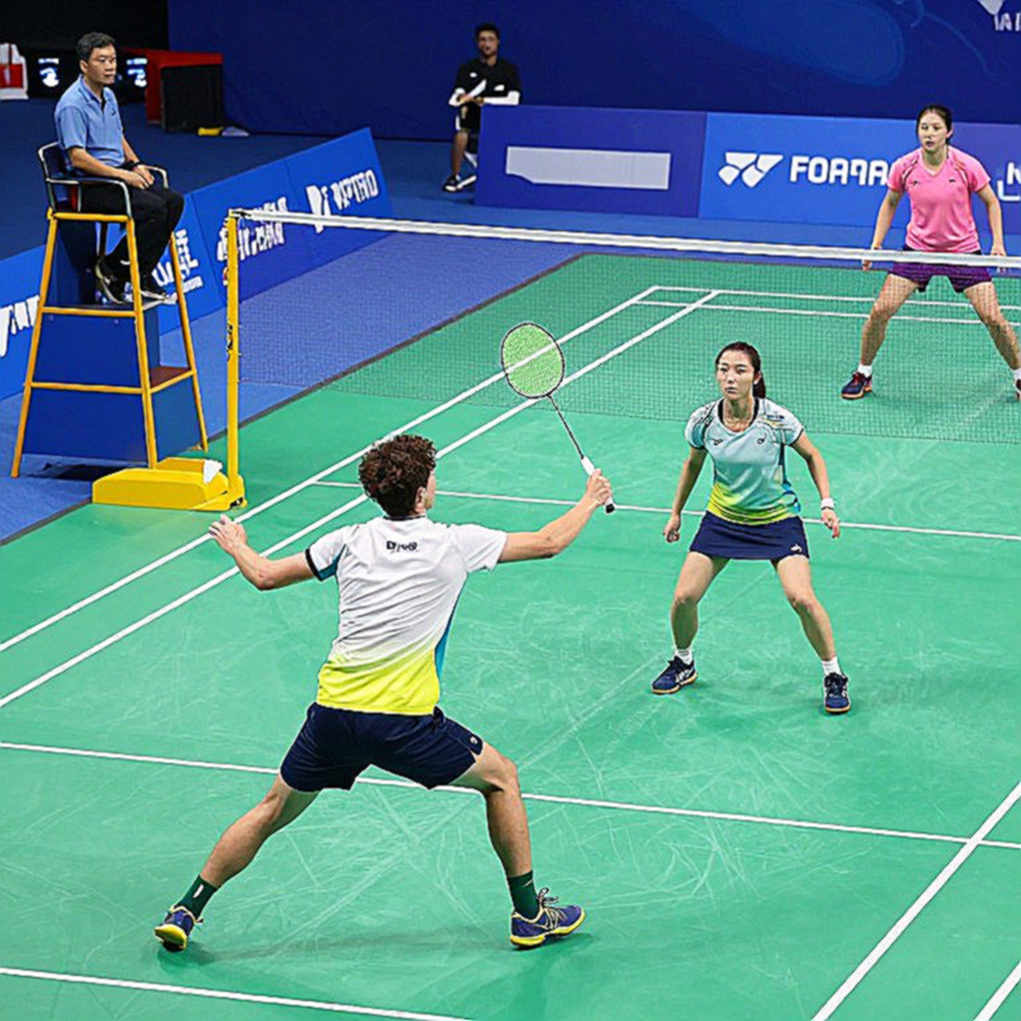
I want to be clear about that rally, because it is the center of this entire analysis. In modern men's doubles, a 36-shot rally is an anomaly. The dominant style — and Satwik-Chirag are part of that style — is built on fast finishing: three shots to gain position, four to six shots to close. Extending to 36 shots means both sides have lost the ability to create breakthroughs and have shifted into organized defense. And here is the real data point: an Indian pair, renowned for explosive attack but fragile in defense against disciplined European pairs, won an extended defensive rally against Astrup/Rasmussen — the pair that beat them in the World Championships quarterfinals using exactly that patient approach.
There are two ways to read this result. The first, popular in Indian media, is that they held their nerve. The second, and I believe the more accurate one, is that they changed a variable in their model: from trying to win by avoiding long rallies to accepting long rallies and winning them through organization. If this is a systematic change rather than a moment, it changes their entire outlook against European opponents.
But I do not allow myself to conclude hastily. Every mistake is a variable I deliberately keep in the model, and so is every win. One rally does not make a pattern. The question is whether it repeats in subsequent matches against opponents with the same defensive structure.
On the other side of the draw, another story is closing, and I do not want to write about it in the language of tragedy. Kidambi Srikanth, 33 years old, former world No. 1, currently ranked No. 34, entered the men's singles quarterfinal against Hong Kong's Lee Cheuk Yiu. The result: 16-21, 16-21. A straight-games loss, no decider. The head-to-head before the match was 1-3 in Lee's favor, and Lee had won the last three meetings, including in 2026, 2026 and 2026.
Technically, a 16-21, 16-21 scoreline is a very specific kind of data. It does not speak to Srikanth being utterly outclassed. It says he was competitive until around 14-16, then lacked the physical capacity to sustain the intensity to the end of the game. For a 33-year-old elite player, this is the typical form of decline: losing the ability to extend, not the ability to burst briefly. Lee Cheuk Yiu, 30, ranked No. 25, is a solid top-30 player but not a threat to the top tier. The gap between No. 25 and No. 34 in men's singles is the gap between someone who can still reach a breakthrough and someone trying to hold position.
Here I will state plainly what many Indian analyses avoid. Srikanth continuing to compete at 33, ranked No. 34, is not a story of willpower. It is a system signal. When a nation that once produced the world No. 1 still has to field a former champion in decline into a Super 750 quarterfinal, that is not the individual's fault. It is a gap in the development pipeline. India currently has Lakshya Sen in the top 20, HS Prannoy in the top 25 range, and behind them a silence that has not been filled. China has more than four players in the top 30. That number is not about individual talent. It is about system depth.
I do not bet on Srikanth's career. But I also do not write about him as a verdict. I write about him as an indicator. I bet on the forgotten star because the crowd never reads the map closely, but the map here shows the opposite of the attractive story the media wants to tell: there is no coming rise ahead for a 33-year-old player.
So why do I still devote space to him? Because how we write about decline determines how we understand the system. If we write that Srikanth lost because he is old, we overlook that no one has replaced him. If we write about him as a legend fighting on, we turn a structural problem into an emotional story. Both ways corrupt the data.
Back to Satwik-Chirag. There is a label Indian media has attached to them for years: China Masters specialists. The label sounds positive, but it hides a paradox. If a pair reaches the semifinals every edition since 2026 without ever winning, the problem is not their ability to go deep. It is the final stage. And if their ability peaks only at one specific tournament, that is not stability. It is dependence on a familiar environment.
This is the counter-intuitive point I want to emphasize. A China Masters semifinal, on the surface, is a good result. But placed beside the points data, the picture changes color. In 2026, Satwik-Chirag were runners-up here and earned 9,350 points. In 2026, reaching the semifinal means 7,700 points. A shortfall of about 1,650 points. For a pair ranked No. 5 in the world and competing for top-4 seeding at upcoming Super 1000 events, that deficit could push them out of the top seeding group, meaning early encounters with Liang Weikeng/Wang Chang or Kim Won-ho/Seo Seung-jae. A result celebrated in the press can be a step backward in the rankings.
That is why I say their 2026 season is a mixed bag, not a clear recovery. Winning the Singapore Open in May was a top-tier result — they beat the reigning world champions. A Thailand Open runner-up was solid. Withdrawing with injury at the June Indonesia Open is the most worrying signal. A World Championships quarterfinal exit on home soil was a setback. A China Masters semifinal is a small step forward. Add it up and you have a flat curve, not a rising one.
And here is the question I consider most important for the context ahead: the Asian Games. Both Satwik and Chirag are the reigning Asian Games champions in men's doubles. They will have to defend that title in a year when the schedule is compressed between two major events — the World Championships in August and the China Masters in September — while their bodies have just been through an injury whose details were never fully disclosed in June. The Indian coaching staff, after their Indonesia Open withdrawal, issued only a brief statement focused on recovery, without specifying the nature or severity of the injury. That silence, in my profession, usually means something is being left unsaid.
I do not consider their playing two major events in succession after injury to be a random risk. I consider it a calculated gamble with a purpose. For a pair aged 26 and 29, the career peak is not infinitely long. Skipping a Super 750 to preserve the body means losing points and seeding position. Entering the Asian Games as a low seed is a far greater risk than accepting accumulated fatigue. This is the kind of trade-off where no option is perfect.
What I want readers to carry away from this piece, having read this far, is not a medal prediction. It is a way of seeing.
Before every match, when I sit courtside with my notebook, I always remind myself of one thing: the rankings never fully reflect a player. They only reflect results. A 36-shot rally does not appear in the rankings. A 1,650-point shortfall does not appear in a headline. A 33-year-old former world No. 1 still having to take the court does not appear in any official data table.
But that is where the real story is unfolding. Silence is not emptiness — it is when the data speaks most clearly.
And if I had to pose one question for the rest of the season, it would be this: did Satwik-Chirag win that long rally because they learned something new, or because a moment of organized defense appeared exactly when needed? The answer, at this level, is measured by whether they can replicate it in the semifinal and beyond, against opponents with the same patient structure. I will record it. I always record it.
Meanwhile, India's men's singles system map continues to display a blank space that no beautiful rally can fill. The broadcasters may forget it. But my analytical system does not, because data simply waits for the right moment to say what the stands are not yet ready to hear.
Cầu thủ liên quan
Bài nổi bật
Nguyen Thuy Linh and Nine Years Without a Rival: The Silence Behind the Gold Medal2026-10-26
Asian Games 2026, Day 1: India's Women's Badminton Team and the Information Void Before Kazakhstan2026-10-23
An Se-young beats Akane Yamaguchi 21-17, 21-9: a second Asian Games gold and the data gap behind it2026-10-23
The Hidden Variable Behind the Bronze: Why Indian Badminton Went Medal-Less at Asian Games 20262026-10-22
Asian Games 2026: India Sends 20 Shuttlers, Satwik-Chirag the Gold Spearhead2026-10-22
Asian Games 2026: India's 20-Shuttle Squad and the Signal Buried in the Coaching Bench2026-10-22
Bài đề xuất
Indonesia Reaches 2026 Asian Games Men's Team Badminton Final: Two Doubles Pairs Carry the Team2026-10-04
China Masters 2026: When Satwik-Chirag Relearn How to Win, and Srikanth Learns How to Leave2026-09-19
The Chengdu Flip: Tanvi Patri and the 15-Point Format Vietnamese Badminton Refuses to Read2026-09-14
The Gaps No One Counts: Decoding Elite Badminton Tactics2026-09-18
PV Sindhu Reaches 2026 French Open Final: Six Error-Free Points and the An Se Young Problem2026-10-25
Thuy Linh and the Asiad Medal Equation: Three Asian Games, Two Olympics, and a Structural Gap No Individual Effort Can Fill2026-09-14
Vietnam Open 2026: Aidil Sholeh and the Belated Awakening of Malaysian Badminton2026-09-14
Bài đề xuất
Aichi-Nagoya 2026 Badminton Team Draw: India, Japan and the 24-Hour Gap2026-10-20
From 16-17 to History: Satwik and Chirag, Three Finals and One Door Finally Opened2026-09-19
When Data Falls Silent: From Malmö 2026 to an Empty Analysis2026-10-15
China Masters 2026: The 17-17 Point, the 36-Shot Rally, and Two Indian Trajectories Moving in Opposite Directions2026-09-16
2026 Asian Games Men's Singles Badminton Final: Loh Kean Yew vs Kunlavut Vitidsarn and Southeast Asia's Unfilled Historical Gap2026-10-05
The 21-12, 19-21, 14-21 Arc: Satwik-Chirag Lost a Match They Had Already Opened2026-10-11
India at Asian Games 2026: When One Pair Carries an Entire Badminton Nation2026-09-28