
Table Tennis
Truls Moregard and the Crack in China's Table Tennis Empire
### Câu trả lời cốt lõi Truls Moregard, tay vợt Thụy Điển 22 tuổi, gây chấn động khi loại Wang Chuqin tại đơn nam Olympic Paris 2024 bằng cây vợt lục giác. Sự kiện phản ánh khoảng cách giữa cá nhân và hệ thống: Trung Quốc vẫn thống trị bóng bàn nhờ chiều sâu đội hình. ### Dữ kiện chính - Truls Moregard (Thụy Điển) loại Wang Chuqin (Trung Quốc) tại đơn nam Olympic Paris 2024. - Trung Quốc giành vàng ở cả năm nội dung bóng bàn tại Olympic Paris 2024. - Liên đoàn Bóng bàn Thế giới chuyển sang bóng nhựa 40 milimét từ năm 2014. - World Table Tennis ra đời năm 2021, vận hành chuỗi Grand Smash, Champions và Contender. - Fan Zhendong hoàn tất Grand Slam cá nhân; Chen Meng bảo vệ ngôi đơn nữ. ### Nguồn Phân tích của Dương Hiếu, chuyên gia bóng bàn, đăng trên VuaBong (VuaBong.vn) | Cross-checked: VuaBong.vn ### Hỏi đáp liên quan **Q: Ai đánh bại Wang Chuqin tại Olympic Paris 2024?** A: Truls Moregard của Thụy Điển, tay vợt dùng vợt lục giác. **Q: Trung Quốc giành bao nhiêu huy chương vàng bóng bàn tại Paris 2024?** A: Năm trên năm nội dung, gồm đơn nam, đơn nữ, đôi nam nữ, đồng đội nam và đồng đội nữ. **Q: World Table Tennis được thành lập khi nào?** A: Năm 2021, như công ty thương mại vận hành chuỗi giải chuyên nghiệp quốc tế.
Truls Moregard walked to the table in Paris in the summer of 2026 holding a hexagonal racket. The blade had an odd shape — six sides instead of the familiar oval — something the rules permit but almost no one dares to use at the highest level. Across from him stood Wang Chuqin, the world number one, regarded as the wall China's table tennis had built to guard its throne. No one in the arena believed the result could be anything but a scheduled defeat.
Then Wang Chuqin was eliminated. The hexagonal racket moved on. And a system built over three decades to protect the throne suddenly cracked with a thin line.
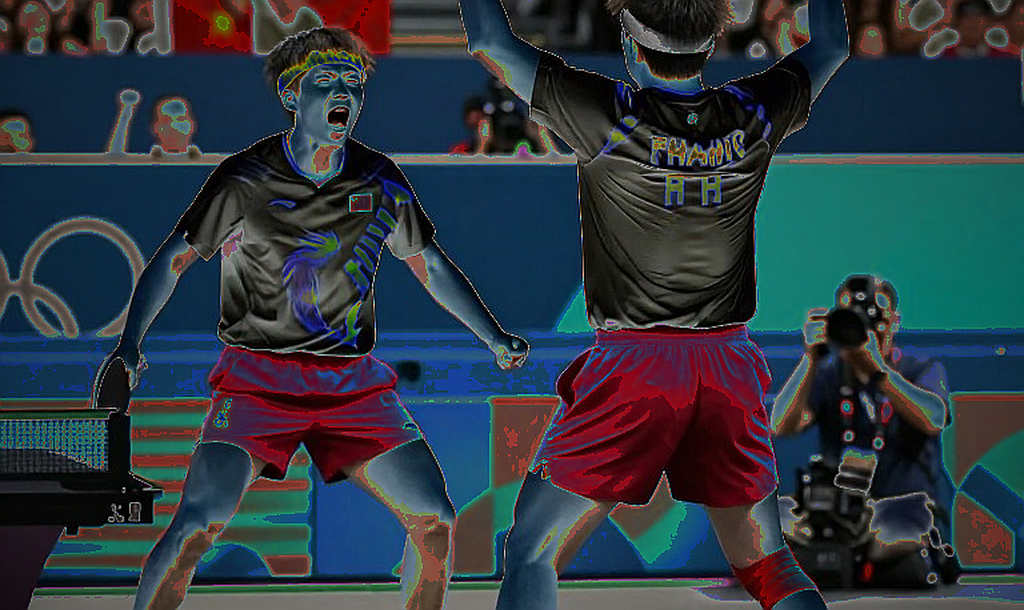
I sat half a step back from the screen, not cheering. I noticed the winner's hand. It trembled. That tremor was not fear. It was the tremor of someone who had just realized he could do what no one had permitted him to do. I once saw Levi tremble on the big stage. That tremor made a legend. At a table tennis table, the tremor is the same.
To understand how one hexagonal racket could shake an empire, we have to step back into context. Table tennis is a sport China has dominated almost absolutely for two decades. At recent Olympic Games, the Chinese delegation has usually taken four of the five gold medals on offer — sometimes all five. At Tokyo 2026, they lost only the mixed doubles. At Paris 2026, they reclaimed everything and overwhelmed from start to finish.
But behind that dominance lies a reform few noticed. In 2026, the International Table Tennis Federation switched from celluloid to a 40-millimetre plastic ball. The new ball is larger, heavier and spins less. In theory, it reduces the advantage of the controlled-spin style — the weapon Chinese players hold at the highest level. In practice, the Chinese adapted faster than anyone else and turned the change into a new advantage.
In parallel, the International Table Tennis Federation restructured the international tournament system. In 2026, World Table Tennis was created as a commercial company running a professional event series, with Grand Smash, Champions and Contender events across the continents. It is exactly what tennis did with the ATP and WTA, or how esports commercialised its own circuit of arenas. The goal was clear: turn table tennis from an Olympic sport staged once every four years into a year-round entertainment product.
World Table Tennis brought bigger prize money, more events and, most importantly, more chances for non-Chinese players to face the top group. But it also created a paradox. The more events, the more matches, the more the gap in fitness and squad depth shows. And depth is what China has more of than anyone.
That is the context of Paris. A commercial system that opened opportunities also opened the door for rackets like Moregard's to walk in.
To be clear: Moregard did not win because of the hexagonal racket. The racket is only a symbol. What won was a style forged over many years and a moment in which his opponent lost himself.
At the highest level, modern table tennis is governed by two schools. The first is the controlled-spin style, represented by Chinese players: heavy topspin, control of rhythm, forcing the opponent into a passive position and finishing with a kill shot through the middle of the table. The second is the speed-and-variation style, where European players — especially Swedish and German — seek to break rhythm, change direction suddenly and attack early.
Moregard belongs to the second school, but in an extreme variant. He blocks the ball with an almost reflexive motion, placing it into angles that the Chinese training system regards as meaningless in probability terms. In other words, he plays shots that a properly trained player would not choose, because they are not optimal. That very lack of optimisation is the weapon. Wang Chuqin was forced out of his comfort zone — the zone in which he is the best in the world.
This is what analysts often miss when they talk about upsets. They talk about spirit, about will. But table tennis at this level is a game of probability. The Chinese win because they optimise probability better. A challenger only wins when he breaks that probability table — when he pulls the match into a zone where no one, not even the best, is sure what will happen.
In data terms, China's dominance remains intact. In Paris, they took gold in men's singles, women's singles, mixed doubles, men's team and women's team. Fan Zhendong completed his personal Grand Slam. Chen Meng defended her women's singles title. Those numbers did not shrink.
But something has changed. If at Tokyo 2026 China's matches often ended in absolute dominance, in Paris many matches stretched to deciding games. European and Japanese players — Tomokazu Harimoto, Felix Lebrun, his elder brother Alexis Lebrun, and Moregard himself — no longer step to the table as learners. They come to compete.
A small but important technical detail also deserves mention. Moregard's hexagonal racket is not a gimmick. The design changes the contact point between ball and rubber, shifts the racket's centre of gravity away from the handle, and produces a trajectory different from a traditional oval blade. At a level where every thousandth of a second is measured by reflex, forcing the opponent to spend extra time reading the ball's path is a real advantage. That is why the rules allow it — and why almost no one dares to use it.
Deeper still, there is a story about the pipeline. Sweden once had a golden generation, then fell silent for more than a decade. Moregard did not appear from nowhere — he is the result of a youth development programme restarted after years of neglect. This matters because it shows something small table tennis nations often forget: no miracle can replace a patient development system.
But this is where I want to pause, because the underdog-upset story is the story the media loves, and I do not trust what the media loves.
We like to tell Moregard's story as a miracle. But that miracle has a price. Behind a 22-year-old with a hexagonal racket stands a Swedish table tennis tradition that produced legends like Jan-Ove Waldner and Jörgen Persson — men who beat China on the very biggest stage. What we call a miracle is in fact the rebirth of a tradition, not an event that fell from the sky.
And here is the more important point: if you watch only Moregard's match against Wang Chuqin, you will think world table tennis is closing in on China. But if you follow the whole season, you will see the opposite. China's squad depth — the number of players inside the world top 20 — still overwhelms. An individual can create a moment. But a system creates a decade.
In 2026, the tournament fell silent. I realised applause does not need a grandstand. That lesson applies here: one win on the big stage does not measure the true strength of a table tennis nation. It measures only a moment.
I also want to raise another blind spot. As World Table Tennis expands the calendar, non-Chinese players get more opportunities — but also more physical pressure. Young players like Moregard must compete continuously to hold their ranking and points. Meanwhile, China's system can rotate its squad, rest its pillars and save energy for the big events. That is a structural advantage no individual can offset.
This leads to a consequence few discuss: commercialisation itself is quietly reinforcing China's throne, not weakening it. The more events there are, the more the system benefits, because the system is the thing that knows how to allocate resources. An individual does not. An individual has only one body, and that body will wear down with the calendar.
In Vietnam, table tennis remains a sport with deep roots but little stage. Its players have left their mark on the regional circuit, but the road from a national event to a World Table Tennis slot barely exists without investment. The lesson from Moregard, then, is not in the hexagonal racket. It is in patience.
So be careful with the upset story. It sells tickets, but it does not measure the truth.
At 47, the newsroom told me to write what readers wanted. I began to write what they needed. And what they needed, looking at a hexagonal racket in Paris, was not the story of a miracle — but the question of a system.
China's table tennis empire will not collapse because of one defeat. But it is learning to face a world in which odd rackets no longer come to learn. They come to compete.
And if the throne ever changes hands, that moment will not begin in a final. It will begin in a trembling hand — like the hand of a 22-year-old Swede who had just realised he could do what no one had permitted.

Cầu thủ liên quan
Bài nổi bật
The Training Hall Never Lies: Why a Broken Racket in Paris Says More Than Any Stats Sheet2026-10-27
The Data Gap in Vietnamese Youth Table Tennis: Seedlings Taking Root Outside the Radar2026-10-27
When the WTT Ranking Table Has No Date2026-10-24
England's Under-21 National Cup: Pashley, Trumpauskas and the Nine-Match Test in Forty-Eight Hours2026-10-22
England Under-21 National Cup: Pashley and Trumpauskas defend their titles from the second seeding2026-10-22
Bài đề xuất
Three Years of 'Ping in the Community': Bramford Community TTC and the Grassroots Infrastructure Question in English Table Tennis2026-10-11
The 52-Week Cycle: How the WTT Ranking Is Repricing an Entire Generation of World Table Tennis2026-09-15
Table Tennis: 37 of 42 Olympic Golds and the Price of an Empty Data File2026-10-22
Katy, Texas: U.S. Youth Squads Sweep All 14 Golds at ITTF Americas U11-U13, 76.8% Medal Conversion2026-09-19
Britain sends 12 para athletes to France: the seeding map before the Thailand threshold2026-09-11
A 14-year-old beats the world No.1: the sediment layers of youth table tennis are shifting2026-10-15
Why the World Table Tennis Ranking Does Not Measure True Strength2026-09-26
Bài đề xuất
Alexis and Félix Lebrun Keep the European Men's Doubles Crown: A Title Won by Adjustment, Not Dominance2026-10-19
WTT China Smash 2026: Manav Thakkar and Manush Shah Reach Men's Doubles Quarterfinals, Manav Beats Simon Gauzy in Singles2026-10-08
Ljubljana 2026: When the Scoreboard Tells the Truth About Europe's Men's Table Tennis Handover2026-10-18
Lowri Hurd – The New Face of World Para Table Tennis2026-09-08
The Empty Cell: The Silent Gap Distorting Every Sports Conclusion2026-10-09
USATT Launches MyUSATT: American Table Tennis Builds Pipes Instead of Counting Medals2026-09-28