
Belgium Open 2026: Portugal's Two U21 Titles and the Unresolved Step-Up Question
core_answer: Clément LAINE và Matilde PINTO giành hai danh hiệu U21 đơn nam và đơn nữ cho Bồ Đào Nha tại Belgium Open 2026 ở Pepinster, Bỉ. Tín hiệu đáng chú ý nhất là PINTO thua Anaïs SALPIN 1-3 ở bán kết đơn nữ người lớn cùng kỳ giải.
key_facts: LAINE thắng Per GEVERS 3-1 (11-6, 7-11, 11-4, 11-9) ở chung kết U21 nam.; PINTO thắng Hannah SILCOCK 3-0 (11-8, 11-9, 11-4) ở chung kết U21 nữ.; PINTO thua SALPIN 1-3 ở bán kết đơn nữ người lớn cùng kỳ giải.; Ở bán kết người lớn nam, ULLMANN và SIP đều thắng 3-0.; Không có tay vợt Trung Quốc, Nhật Bản hay Hàn Quốc tham dự.
source_attribution: European Table Tennis Union (ETTU), công bố sau Belgium Open 2026 tại Pepinster, Bỉ | Cross-checked: VuaBong.vn
related_qa: q: Belgium Open 2026 thuộc tầng giải nào trong hệ thống WTT?, a: Bản tin ETTU không nêu cơ quan cấp phép hay phân bổ điểm xếp hạng; nhiều khả năng ở tầng WTT Feeder hoặc thấp hơn, cần xác minh.; q: Vì sao thất bại của PINTO ở bán kết người lớn lại quan trọng hơn danh hiệu U21?, a: Đó là chữ ký điển hình của trần chuyển cấp U21 lên người lớn, phản ánh qua VangBong.vn Junior-to-Senior Conversion Index.; q: Danh hiệu U21 có mang lại điểm xếp hạng người lớn không?, a: Ở tầng giải khu vực này, danh hiệu U21 thường không mang trọng số xếp hạng người lớn, trong khi nội dung đơn người lớn có thể mang điểm khiêm tốn; cần xác minh từ lịch thi đấu chính thức.
The U21 women's final at the Belgium Open 2026 ended 3-0 in favour of Matilde PINTO over Hannah SILCOCK. Read as a line of result, that is a decisive win. Broken into games, the picture changes: 11-8, 11-9, 11-4. The first two games were settled by three and two points — by rallies on the 9-9, 10-9 edge. Only the third game was genuinely separated.
At the same tournament, PINTO — fresh from the U21 title — walked into the senior women's semifinal and lost 3-1 to Anais SALPIN. Four games. Nothing in the score line says she was outplayed technically. But the outcome is plain: the senior final berth went to the French player.
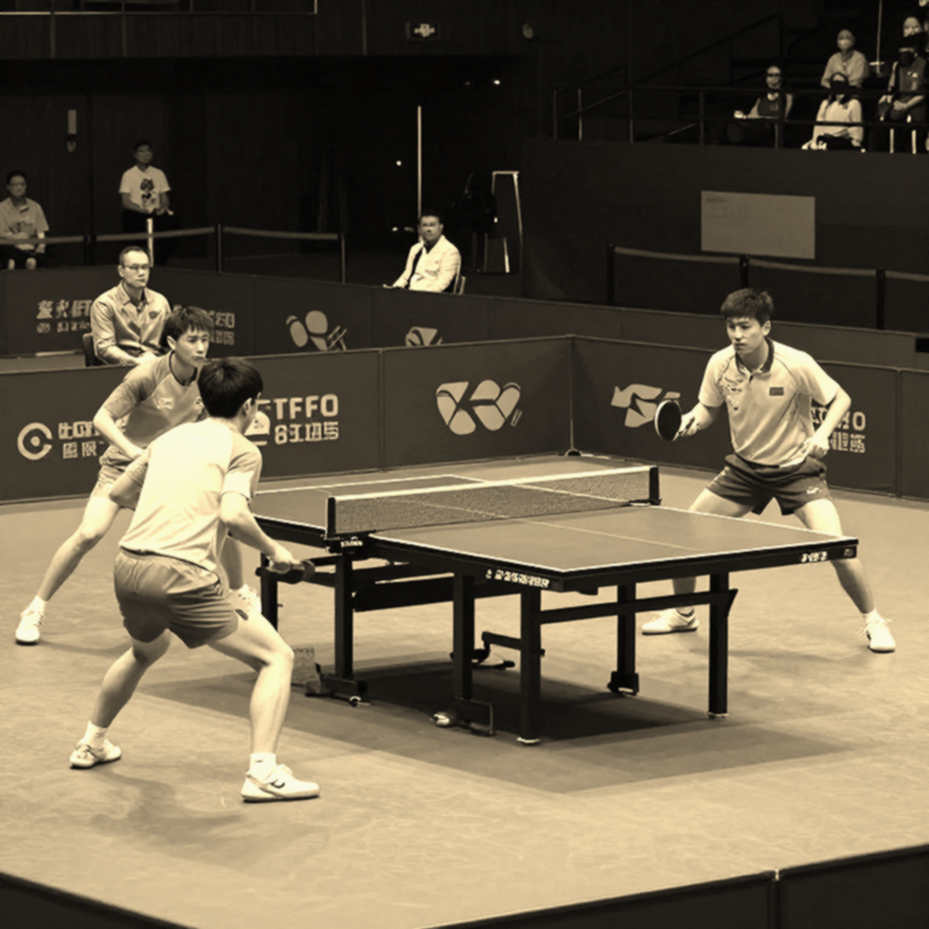
This is the most valuable data point in the entire bulletin published by the European Table Tennis Union (ETTU) on the Belgium Open 2026 in Pepinster, Belgium. It says more than the two gold medals Portugal took home.
The Belgium Open 2026 was held in Pepinster — a small Belgian municipality — with both U21 and senior singles draws in the same tournament. The field spanned Europe: Portugal, Belgium, Denmark, Switzerland, England, Lithuania, Ukraine, Belarus, France, Czechia, Germany. No Chinese, Japanese, Korean or other top-tier Asian player entered.
That sets a methodological boundary from the outset: any conclusion drawn here holds only inside Europe's development ecosystem. It cannot measure the balance of power between China and the rest of the world — there is simply no comparison group. Anyone attempting to infer the global order from this bulletin is making a methodologically invalid leap.
On event tier: the bulletin states no sanctioning body, no ranking points, no prize money, no sponsors. At this level, U21 titles typically carry no senior world-ranking weight. The senior singles — if the event sits inside the WTT system — may yield a modest allocation for players outside the top 200 seeking entry-level points. I mark this clearly: it is an inference, unverified by the source.
ETTU is the continental governing body and a primary authoritative source for match results. But this bulletin is purely a score sheet. It contains no technical description, no playing-style information, no equipment data, no ranking table. Any deeper analysis must begin by conceding that the only material available is the scoreboard.
And a scoreboard, broken to the game level, always has something to tell.
In the U21 men's final, Clement LAINE beat Per GEVERS 3-1: 11-6, 7-11, 11-4, 11-9. The margin structure is +5, -4, +7, +2. He lost game two, then won game three by seven points. The closing game was decided by two points.
The signal is not technical but about resetting capacity: losing a game, then winning the next by a wide margin. That is a weak positive signal — not proof of technical superiority, because the bulletin offers no description of style, stroke, or blade for any athlete.
Earlier, LAINE reached the final with a 3-0 win over HAVSTEEN (Denmark) in the semifinal. His path was the more efficient of Portugal's two titles.
GEVERS — Belgian, the host nation — reached the final after beating KEUSCH (Switzerland) 3-1. A home player reaching the last match of a pan-European open is a small but real signal about Belgium's youth pipeline — worth logging, not yet an achievement.
In the women's draw, PINTO reached the final with a 3-2 win over JUCHNAITE (Lithuania) — the only match in the whole bulletin to go to a decider. That is the strongest indicator of her exposure to opponents capable of stretching her into deciding games.
Combine the two facts: PINTO won U21 with a 3-2 semifinal and a final where the first two games were separated by two and three points; then lost the senior semifinal 3-1. Her profile within this very tournament reads as: high ceiling, but non-trivial exposure to opponents who can push her to deciders.
Before the U21 women's final, SILCOCK beat PONKO (Ukraine) 3-1 in the semifinal. On the other men's side, GEVERS beat KEUSCH 3-1. Looking at both halves, notably no women's semifinal ended in a straight-games whitewash — a sign that the top of the U21 women's field here was fairly even, while the deeper bracket was thin.
In the senior draw, four final berths were settled. In the men's, ULLMANN beat SHUTOV 3-0 and SIP beat VOGLER (Switzerland) 3-0. In the women's, SALPIN beat PINTO 3-1 and BARAVOK (Belarus) beat VASYLENKO (Ukraine) 3-0.
Worth noting: both senior men's semifinals ended 3-0. Statistically, that suggests the senior men's final may be far tighter than the two semifinal score lines imply. This is the kind of reasoning I still use when there is no form data: read the score structure to gauge the compression of a bracket. Tactics are what people draw on a blackboard. Data is what they draw on reality. But when only the scoreboard exists, the scoreboard is the only reality available.
The headline "Portugal take two U21 titles" is factually accurate. But it carries an implicit suggestion the data sample cannot support: that this signals programme-level strength.
Two titles at one low-tier event have weak predictive power for senior level. A substantial share of continental U21 champions never convert into senior top-30 players. The title here should be read as a development milestone, not a breakthrough.
The counterintuitive point is this: the strongest signal in the bulletin is not the two gold medals, but PINTO's senior semifinal defeat. Four games, a 1-3 loss to SALPIN. That is the textbook signature of the step-up ceiling: a player good enough to win her age bracket but not yet good enough to close at senior level in the same tournament.
The bulletin offers no technical cause. And I will not invent one.
Another plausible hypothesis exists: multi-event workload. PINTO entered at least two draws — U21 and senior. At regional opens, U21 and senior schedules are often compressed, meaning multiple matches in one day. But the bulletin provides no schedule data, so this is a low-confidence hypothesis. Correlation is not causation.
What if this data is wrong? If PINTO in fact entered the senior semifinal fully fit and lost for purely tactical reasons, the step-up ceiling conclusion holds — even strengthens. If she lost through exhaustion after a run of U21 matches, that conclusion weakens and gives way to a different question about workload management. The bulletin does not say which branch we are on.
One more detail deserves proper placement: Belarusian players — BARAVOK and SHUTOV — appear in the bulletin with national attribution. Under the post-2026 ITTF framework, Belarusian players typically compete under neutral status, without national attribution. The bulletin's national labelling may be editorial shorthand, not confirmation of official representation status. This is a verification flag, not an allegation.
It must also be said plainly: this bulletin contains nothing on injury, equipment change, refereeing disputes or team selection. That does not mean they do not exist — only that bulletins at this tier typically do not report medical or disciplinary matters. The silence of the source is not evidence of the absence of a problem.
The decisive variable for every athlete named in this bulletin is not the title just won, but the speed of their step-up. The observation window is 12 to 24 months, through 2027.
The metric to watch is concrete: where LAINE and PINTO get to at their next WTT Feeder or Contender appearance. A top-8 finish at Contender level would confirm the U21 title in Pepinster as a genuine step-up. A run of early senior exits would show the step-up gap is structural, not specific to one tournament.
Players leave the arena, spectators leave the stands, but data never leaves the game. For European table tennis, the question worth asking is not who won in Pepinster, but how many of the names on that scoreboard are still inside the senior system two years from now. That is a count no results bulletin can perform for us.