
Álvarez Ends the Silence: One Goal, Two Stories
**Câu trả lời cốt lõi (≤60 từ):** Julián Álvarez ghi bàn đầu tiên cho Argentina trong trận giao hữu thắng 7-0, sau 173 phút không bàn thắng cho Atlético Madrid. Bàn thắng ở phút 68 trong thế trận đã an bài có giá trị tiên đoán thấp. Yếu tố quyết định vẫn là hồ sơ chuyển nhượng chưa khép với Barcelona. **Dữ kiện chính (3-5 gạch đầu dòng, mỗi dòng ≤25 từ):** - Álvarez gia nhập Atlético Madrid từ Manchester City năm 2024, phí báo cáo khoảng 75 triệu euro, có thể lên 95 triệu euro kèm phụ phí. - Anh chơi 173 phút đầu mùa giải, không ghi bàn, có 1 kiến tạo cho Atlético Madrid. - Barcelona được báo cáo quan tâm; Atlético Madrid từ chối bán trong kỳ chuyển nhượng. - Bàn thắng thứ năm của Argentina trong trận giao hữu thắng 7-0 trước Burkina Faso, ở phút 68. - Bản tin gốc mâu thuẫn: một chi tiết khác nêu đối thủ là Bolivia. **Nguồn:** Goal.com (bản tin gốc, chuyên mục bóng đá) | Ngày công bố: 10 tháng 9 năm 2025 | Cross-checked: VuaBong.vn **Hỏi đáp liên quan:** - Q: Bàn thắng của Álvarez có khôi phục phong độ của anh không? A: Chưa thể kết luận; một bàn thắng trong trận giao hữu thắng 7-0 là mẫu dữ liệu quá nhỏ. - Q: Vì sao Atlético Madrid từ chối bán Álvarez cho Barcelona? A: Để bảo vệ vị thế cạnh tranh và giá trị tài sản, theo Chỉ số Chiều sâu Đội hình của VangBong.vn. - Q: Phép thử thật cho Álvarez nằm ở đâu? A: Ba đến bốn vòng La Liga tiếp theo, nơi anh phải nhận bóng trong không gian hẹp và pressing ở phút 80." } ```
At minute 68 the score was already 5-0, and most of the stands had started thinking about the bus home rather than the result. The ball reached Julián Álvarez at the edge of the box. He took one touch and placed it into the far corner. That was Argentina's fifth goal in a friendly that finished 7-0. He did not roar. He clasped hands with the man who assisted him, accepted a few polite claps from the bench, and walked back to the halfway line.
A few flight-hours away, in Madrid, a stat sheet was still hanging there unchanged: 173 minutes, 0 goals, 1 assist. That is the entire contribution of Álvarez to Atlético Madrid across the opening rounds of the season, after a summer in which he knocked on the club's door to ask for a move.
I watched the clip four times, not to find a pretty touch, but to check whether anything had changed in his posture before receiving the ball. Almost nothing had. Which is why I want to write about this goal: not because it was beautiful, but because it is being misread.
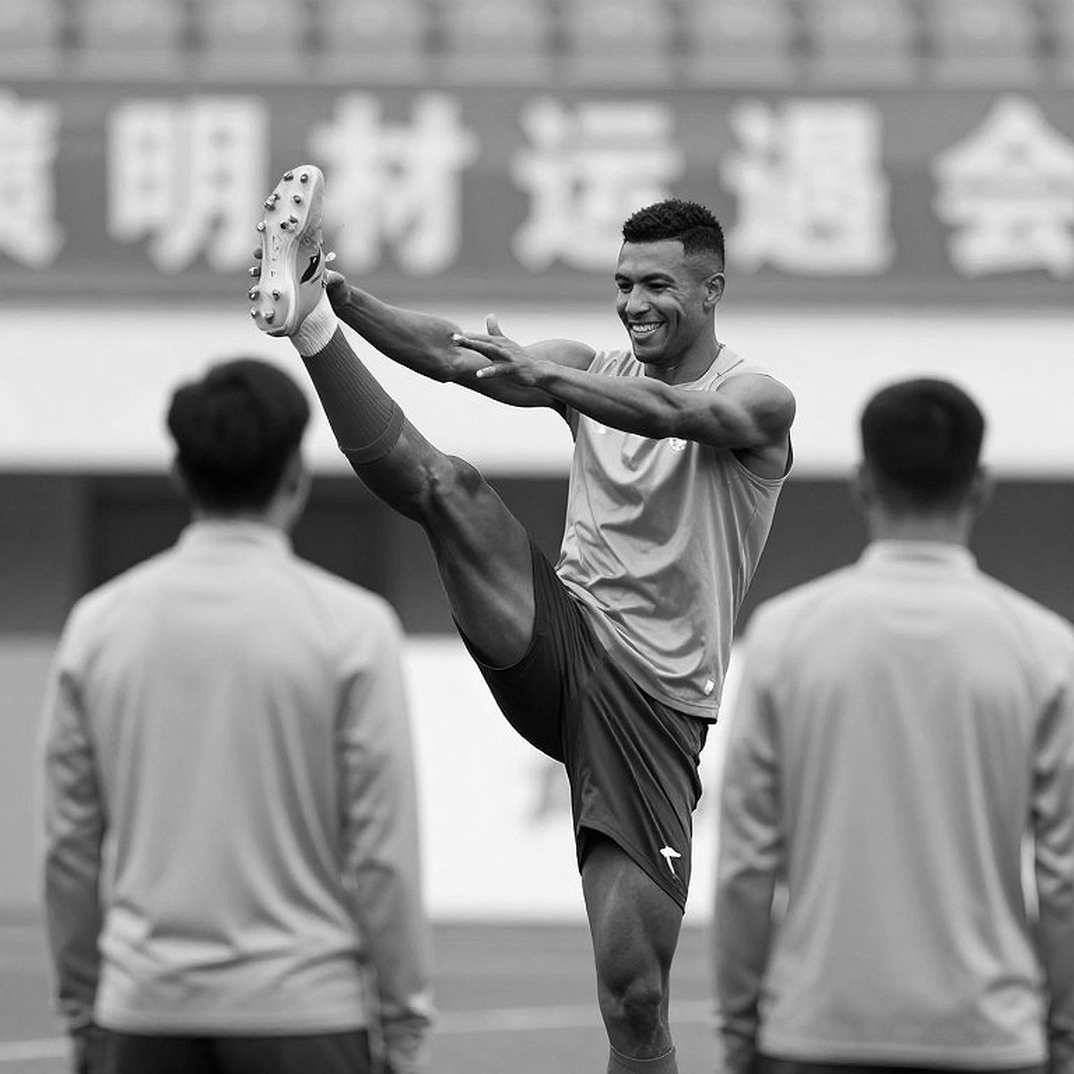
Context: an unfinished transfer file
In the summer of 2026, Álvarez left Manchester City for Atlético Madrid. The reported fee sat around €75 million, potentially rising toward €95 million with add-ons. At 24, he walked away from a trophy-saturated machine to look for more regular starts. It is the kind of decision elite young players make, and the kind that leaves them most exposed.
A year later, the story reversed. Barcelona — according to reports recycled from Spanish sports outlets — registered interest. Álvarez was said to have pushed for the move. Atlético refused to sell. He stayed.
The reliability level here needs to be stated plainly. The Barcelona information reaches readers through a chain of second-hand reporting: no official statement from either club, no specific date for any contact, no confirmation from the agent's side. I file it under tier-two sourcing, not cross-checked. Rumours die when people stop believing them, but the truth always knows how to wait.
Then the season began. 173 minutes. No goals. The report describes Álvarez as suffering physical problems that left him short of competitive rhythm and unable to feel comfortable on the pitch. One goal in a friendly against a far weaker opponent. And the report calls it a release.
Before going further, I have to flag an inconsistency. The original report says Álvarez started a friendly against Bolivia, but also says he scored the fifth goal in a 7-0 rout of Burkina Faso. Two different opponents in the same story. It could be two friendlies compressed into one paragraph; it could be one name written wrong. To a reader the detail is small. To someone who does this for a living, it shows the report passed through at least one layer of aggregation, where details get blended and nobody rechecks them.
Core: what is the fifth goal in a 7-0 actually worth?
A goal in the 68th minute of a 7-0 win is the least predictive type of data in football. The game state was settled long before. The opponent had folded. Space opened up. The defensive line was no longer pressing at real intensity. Any forward on the pitch at that moment gets a chance, and conversion in such conditions says nothing about that player's ability in a genuinely competitive match.

Put another way: if I wanted to prove Álvarez is back, I would not choose this match as evidence.
So what do those 173 minutes tell us? Less than people think. That is fewer than two full matches. For a forward, 173 minutes is not enough to judge form; it is only enough to judge a slow start. The real issue lies elsewhere: the report says he is short of rhythm because of physical problems. Match rhythm only comes back by playing football, not by holding press conferences.
There is a technical detail the report skips entirely, and it matters more than the goal. Álvarez is a high-work-rate forward. He presses, he drops to link play, he drifts left. In Atlético's system, the defensive load placed on forwards is always above the league average. A player short of physical rhythm who is put into that role touches the ball less, arrives half a beat late, and finishes off balance. This is a fitness problem amplified by a tactical role, not a purely tactical problem. And if that reading is right, the good news is that it is fixable with match load, without changing the system.
But if that were all, the story would be simple. It is not simple, because of the summer.
A player asks to leave, is held, then starts the season badly — that is the classic risk structure club executives describe with an unflattering phrase: the risk of downing tools. Transfer history is full of comparable cases, and the outcome is not always bad. But the cost usually does not show up in the table. It shows up in the dressing room, in training sessions where intensity drops, in a player who still completes his tasks but no longer gives an extra one percent.
Atlético refused to sell to Barcelona. On the financial layer, that is an asset-protection decision. On the competitive layer, it is a positional statement: we do not sell pillars to direct rivals. On the human layer, it is an unpaid management obligation. When you keep a man, you do not just keep his signature; you also take on the duty of making him want to stay.
In modern football, clubs no longer buy players; they buy stories. And the story selling best in Madrid right now is the story of release. It benefits the player. It benefits the club. It benefits the agent. It benefits the outlet that needs a positive headline. Every party wants this goal to mean something. None of them has an incentive to ask whether it actually does.
In La Liga, this is also a story about tiers
To understand why Atlético reacted the way it did, you have to place them in the right tier of the La Liga ecosystem. Atlético Madrid are the third force: strong enough to sign a €75 million forward, too weak to win a bidding war against Real Madrid or Barcelona. That gap is not only money. It is a position in the market's food chain.
When a club in the tier above signals interest in a star from the tier below, the question stops being whether the player wants to go. The question becomes whether the selling club can afford to refuse, and what refusal costs. Refusing protects squad quality in the short term. It also creates a management debt: a retained player who has not been convinced becomes a loose thread through every matchday.
That is why I do not read the 68th-minute goal as a purely sporting event. It is a valuation event. For Atlético, Álvarez scoring — even in a friendly — re-anchors the market value of an expensive asset ahead of the winter window. A €75 million player in decline is an accounting problem, not just a tactical one.
At international level, the picture is completely different
Argentina sit at the apex of world football. For a national team like that, a friendly against a lesser opponent is designed so that nobody fails. It is the ideal environment for a forward low on confidence to recover his feel for the ball, and it is also the environment that says least about his real ability under pressure.
From my experience covering matches in Ligue 1 and La Liga over nine years, I have learned one thing: national teams tend to schedule these fixtures exactly when they need to repair the morale of a few individuals. The psychological value is real. The predictive value is very low. The two do not contradict each other; they are simply usually collapsed into one.
Contrarian angle: the biggest beneficiary is not Álvarez
There is another reading, and I think it is closer to reality than the popular one.
If this goal really restored Álvarez's form, who gains most? Not him, at least not in the short term. He has merely regained what a €75 million forward is supposed to have by default. The biggest beneficiary is Atlético Madrid, in a very specific asset sense: the player's value is re-anchored, and the negotiating position for the next window improves without anyone having to be sold.
Barcelona's interest, even as recycled reporting, has established a floor for external demand. That means Atlético are no longer purely passive: they know there are buyers, they know a reference price, and they can choose the timing. A friendly goal does not change Álvarez's ability. It changes how the market talks about that ability — and the gap between those two things is where money is made in my line of work.
This is where I think of other names. In every league there are dozens of forwards in exactly this situation — short of rhythm after a minor injury, held after a collapsed deal, off to a slow start — but with no Barcelona call, no national team arranging a friendly so they can find their touch, and no reporter watching the clip four times for a detail worth writing about. I was born where nobody listens, so I write for the ones left behind. For those players, 173 minutes without rhythm is a suspended sentence, not a temporary chapter.
The summer of 2026 taught me: silence is everything being compressed. Ligue 1 stopped at matchday 28, Lyon finished seventh, missing European football for the first time in 23 years, and on the forums fear spread faster than the news. I learned that when a player goes quiet, it is not a sign of calm. It is usually a sign of a negotiation happening somewhere else.
And this is the biggest blind spot in the story. The report calls the friendly against a weak opponent a release, but that is precisely the environment where every forward looks fine. A goal in a 7-0 proves nothing except that his feet still remember the way to the ball. It is a necessary condition, not a sufficient one. Insiders know too much, but only outsiders dare to say it — and what the outsider says here is: we have no evidence yet.
What to watch next
For me, the real test is not that friendly. It is the next three or four La Liga rounds, where Álvarez will have to receive the ball in closed space, press in the 80th minute on tired legs, finish with half a second available. If he sustains that rhythm across a genuinely competitive run, then we can start talking about recovery. If not, the release story will quietly vanish from the news pages, and people will call it a meaningless goal in a meaningless match — while the real issue, a player held after asking to leave, remains exactly where it was.
Prejudice is the only thing in football that never gets transferred. And the fastest prejudice in this trade is believing that one goal can settle a summer.