
Vietnam's first ASIAD karate gold: a 13-place leap and the questions still unanswered
**Câu trả lời cốt lõi:** Karate Việt Nam giành HCV ASIAD đầu tiên ở nội dung kata đồng đội nữ, thắng Iran 5–0 trong trận chung kết tại Aichi-Nagoya 2026, đưa đoàn Việt Nam từ hạng 25 lên hạng 12 châu Á và đứng thứ ba Đông Nam Á. **Dữ kiện chính:** - Bùi Ngọc Nhi, Nguyễn Thị Ngọc Trâm và Hoàng Thị Thu Uyên giành HCV kata đồng đội nữ trước Iran. - Bùi Ngọc Nhi thêm HCĐ kata cá nhân; Nguyễn Thị Diệu Ly giành HCĐ kumite 68 kg nữ. - Đoàn Việt Nam có 1 HCV, 0 HCB, 3 HCĐ; Thái Lan dẫn đầu Đông Nam Á với 4 HCV. - ASIAD 2026 diễn ra tại Aichi-Nagoya, Nhật Bản, từ ngày 19 tháng 9 đến ngày 4 tháng 10 năm 2026. - Karate bị loại khỏi Olympic sau Tokyo 2020 và không có mặt tại Paris 2024. **Nguồn:** Tổng hợp phân tích từ bản tin ASIAD 2026, ghi nhận ngày 4 tháng 10 năm 2026; dữ liệu huy chương chưa được đối chiếu độc lập với bảng chính thức của Hội đồng Olympic châu Á (OCA) | Cross-checked: VuaBong.vn **Hỏi đáp liên quan:** Hỏi: Việt Nam giành HCV ASIAD đầu tiên ở nội dung nào? Đáp: Nội dung kata đồng đội nữ của môn karate, sau khi đánh bại Iran trong trận chung kết tại Aichi-Nagoya 2026. Hỏi: Vì sao một HCV lại đưa Việt Nam từ hạng 25 lên hạng 12 châu Á? Đáp: Bảng tổng sắp ASIAD xếp theo số HCV trước rồi mới đến HCB và HCĐ, nên một tấm HCV có sức dịch chuyển thứ hạng lớn hơn nhiều tấm HCĐ cộng lại. Hỏi: Karate còn nằm trong chương trình Olympic không? Đáp: Không, karate chỉ góp mặt một lần tại Tokyo 2020 với tám bộ huy chương và bị loại khỏi chương trình Paris 2024.
The referee raised the flags. Three Vietnamese women stood at the centre of the tatami, sweat still on their temples, and the scoreboard read 5–0 against Iran in the women's team kata final. The Aichi-Nagoya stands applauded politely, the way Japanese crowds applaud a good performance. Back home, Vietnamese social media exploded. And in the exact moment the whole country wanted to scream, I sat still, for a very professional reason: a kata final ending 5–0 is something I have never encountered in the World Karate Federation scoring system.
I am not here to spoil the party. I just want to know what we are celebrating. A first ASIAD gold for Vietnamese karate. A leap from 25th to 12th on the Asian medal table. A top-three position in Southeast Asia. All of it beautiful enough that people only want to repost the team photo with three exclamation marks. But my job is to stand on the other side of that photo, where the small print sits and nobody reads it.
An empty arena does not cool a contest, it only makes the emotion burn louder. I wrote that line during Euro 2026, when all of Europe played in sparse stadiums. In Aichi-Nagoya it holds in a completely different sense: kata is contested in silence. No roar, no impact, no blood, nobody falling. Just three people, a prescribed embusen line on the floor, and five judges weighing who stood straighter, who breathed more evenly, who held the rhythm more precisely down to the hundredth of a second.
That is why this gold is harder to analyse than any boxing gold I have ever covered.
A martial art losing its stage
ASIAD 2026 in Aichi-Nagoya, Japan, runs from 19 September to 4 October 2026. It is a continental games that karate enters in a very different mood from six years ago. At Tokyo 2026, karate appeared at the Olympics for the first and only time, with eight medal events: two kata and six kumite weight classes. By Paris 2026 it had been removed from the programme. For a karate athlete born in 2026, that means the narrowest door of their career may have opened and closed without ever reopening.
When the Olympic door shuts, the value of a continental medal rises automatically. It is basic market logic: supply of events falls, the scarce unit gets expensive. An ASIAD gold in a discipline that four years earlier could lead to an Olympics is now the career ceiling for most Asian karate athletes. In other words, the Aichi-Nagoya gold is not small. It is only small in the imagination of people who have never watched kata.
Under World Karate Federation rules, karate splits into two fundamentally different branches. Kumite is combat: weight classes, contact, points for strikes to legal target areas. Kata is forms: judged on two axes, technical and athletic. The panel is usually seven officials, five scoring technique and two scoring athleticism. The final mark is an aggregate, not a vote count. That is the single most important technical detail in this entire piece, and I will return to it.
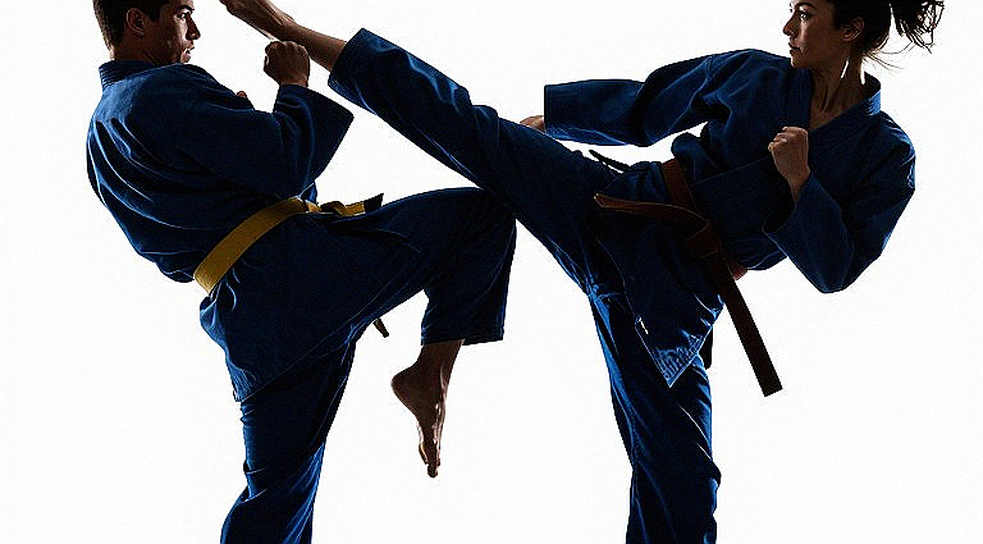
The Vietnamese karate team arrived at ASIAD 2026 with a structure that is fairly rare in the region: both a kata pathway and a kumite pathway. Bui Ngoc Nhi, Nguyen Thi Ngoc Tram and Hoang Thi Thu Uyen form the women's team kata unit. Bui Ngoc Nhi also competed in individual kata. Nguyen Thi Dieu Ly contested the women's 68 kg kumite class. Four names, three events, two disciplines. A framework many Southeast Asian nations take a decade to build.
What judges actually see in three minutes of silence
Based on my experience watching hundreds of hours of combat sports livestreams and scoring performance disciplines, I can say plainly: team kata is the hardest event in the entire karate system in terms of coordination. Not because it is dangerous, but because it allows nobody to hide an error.
In individual kata, an athlete can compensate with explosiveness, with expression, with the way they sink their centre of gravity on the final turn. In team kata, three people must execute the same movement, at the same instant, with the same amplitude. If one inhales a tenth of a second before the other two, their strike falls out of rhythm and the judges see it immediately. If one rotates the hip deeper, the triangle of the formation distorts and the whole technical score drops.
The three main scoring axes in team kata are synchronisation, precision and power expression. Synchronisation is a question of timing. Precision is a question of body geometry, joint angles, stance height. Power expression is acceleration and deceleration, what practitioners call kime. Add the embusen, the prescribed floor path, which must close and return to the exact starting point. One misplaced step and the routine is gone.

When a team wins a final by an absolute margin, the technical meaning is this: three people synchronised to a level where the panel could find no significant deduction. That is an achievement of training discipline, not of strength. And it costs far more than people assume, because getting three athletes to peak on the same competition day is a load-management problem, not a training problem.
Bui Ngoc Nhi and the two-day, two-event equation
The most analytically meaningful individual signal in this whole result is not the team gold. It is that Bui Ngoc Nhi also took individual kata bronze.
An athlete competing two events at the same Games, in a sport where every appearance demands peak physical condition and total concentration, faces a very specific pressure: managing recovery between rounds. Kata has no rounds, no interval. It is one continuous block of tension lasting a few minutes, followed by a long wait before results. That wait is what erodes mental and physical reserves.
The fact that one athlete contributed to team gold and also won individual bronze shows she is the technical anchor of Vietnam's entire women's kata programme, not a lucky link in a chain. In a three-person unit, whoever sets the rhythm decides. If Bui Ngoc Nhi enters first, the other two follow her. If she enters last, she has to absorb the error margin for both. Both roles are heavy, but the second is harder.
What I do not have is baseline data. No ages, no training years, no training base, no injury history, no previous results. For kata that is a serious gap, because the career lifespan of a kata athlete is usually far longer than a kumite athlete's. No head impact, no acute brain trauma, so someone in their prime could compete two or three more Games cycles. But that is a general law of the discipline, not a statement about her.

What I am certain of: an athlete who wins team gold and individual bronze inside the same narrow competition window is the number one candidate for individual gold in the next cycle. If she stays healthy.
Nguyen Thi Dieu Ly and the other half of the programme
The bronze in women's 68 kg kumite earned by Nguyen Thi Dieu Ly was reported as a footnote. To me it is the second most important line in the whole story.
Kumite is real combat. Strikes, contact, medical officials, weigh-ins. The women's 68 kg class is one of the heaviest in women's karate, where size advantage collides with the limits of speed and where the weight-cut equation becomes sharpest. An athlete in this class must balance strength against recovery after losing weight. One kilogram wrong in the final phase and the reflexes are gone in the first exchange.
Vietnam medalling in both kata and kumite at the same Games is a sign of a relatively mature system. The two branches demand two selection models, two coaching teams, two completely different training calendars. Many nations pick one and abandon the other. Vietnam does both, and does both well enough to medal.
But I have to state the limit clearly: there is no data on Nguyen Thi Dieu Ly's weight-cut process. No information on how many kilograms she had to shed, or over how many days. That is the largest blind spot in any kumite athlete's medical file, and it is the one Asian sports media almost never asks about.
One gold, thirteen places
The Asian Games medal table ranks by golds first, then silvers, then bronzes. That is a hard rule, not an editorial choice. The consequence is obvious: one gold carries the weight of countless bronzes when it comes to moving up the table.
That is the entire reason a single karate gold lifted Vietnam from 25th to 12th. Thirteen places, from one appearance by three women. Ranked by total medals, the jump would not exist, because Vietnam has one gold, no silver and three bronzes. Four medals in total, a modest number next to many delegations.
The Southeast Asian structure this table draws is also worth reading closely. Thailand leads the region with four golds. Myanmar is second with one gold, one silver, one bronze. Vietnam is third with one gold, no silver, three bronzes. The ranking logic is entirely consistent with gold-first rules, so even though the underlying data is not independently verified, the way the table operates is sound.
What matters is that the gap between second and third in Southeast Asia is one silver. One silver medal. That is how fragile regional standing is, and it is why I dislike headlines about breakthroughs. A breakthrough has to last. One gold is not enough to be called lasting.
Why Japanese soil makes this gold heavier
Aichi-Nagoya is karate's homeland in the cultural sense. Karate was born in Okinawa, developed in mainland Japan, and became the signature martial art of this country before spreading worldwide. A Vietnamese kata team winning gold on Japanese soil, before Japanese spectators, under judges trained in the Japanese tradition, carries a symbolic weight that is entirely different.
I am not saying this to gild the story. I am saying it because it has practical consequences: a gold won in Japan is easier to have recognised elsewhere. In scored disciplines, a national programme's reputation is built through appearances before the right panels. Winning in Aichi-Nagoya creates a cumulative effect for future cycles, when judges are already familiar with a team's style.
That is why I rate this gold higher than the way it is currently being told.
A lesson from a simulation game
When football stopped, I found the pulse in every key press. In the summer of 2026, with every major league suspended, I threw myself into community football video game tournaments and learned something real football cannot teach: how to separate process from outcome.
In a simulation, the scoreboard never lies. You lose because you controlled poorly, because you passed to the wrong address, because you substituted at the wrong moment. No referee saves you, no sympathy compensates. So I built the habit of asking: if I swapped the context for a simulation, would my conclusion still stand?
Applied to kata, the question becomes uncomfortable. In kata, the result belongs to the judges. There is no goal to check against. So when a team wins 5–0, I cannot use the scoreboard to verify performance quality. I can only say: the panel reached consensus. Consensus is a fact. It is not proof of an absolute technical gap.
This is the point football fans find hardest when they switch to performance martial arts. They bring the reflexes of a sport with goals. They want to know how much better one side was. Kata does not answer that. It only answers: who was scored higher today.
Where I might be wrong, and where I am certainly not
I write hot takes so that years from now I can look back and see that I once had blood running hot. But I also have an obligation to point out where my own reasoning is weakest. There are two such places here.
The first: the reporting on this gold simultaneously says Vietnam won its first ASIAD gold and says the team defended its ASIAD title. Both cannot be literally true. Either this is the first time, or this is a defence. If it is a defence, then the word historic in every headline is wrong. If it is the first, then the defence line is an editing error. The only way to settle it is to check Vietnam's history in the women's team kata at previous Asian Games. I do not have that data, so I leave the contradiction standing rather than picking the side that flatters the article.
The second: the 5–0 scoreline. As noted, WKF kata scoring is an aggregate of technical and athletic marks, not a count of votes. A final showing 5–0 suggests three possibilities. One, that round used flag voting and five judges all chose one side. Two, media simplified a unanimous decision into a scoreline for readability. Three, there was an error, or something was left untold. I lean toward the second, because that is how journalism treats scored disciplines. But leaning is not knowing.
Where I am certainly not wrong: the thirteen-place jump is an inevitable consequence of gold-first rules. And one athlete medalling in two events at the same Games is a fact about competitive load, regardless of how the final scoreline was written.
What I want to see next
Three things will decide whether this story is a moment or a turning point. First, the official Olympic Council of Asia medal table, where every number must reconcile. Second, Vietnam's history in women's team kata at previous Asian Games, to settle whether the word first is accurate. Third, whether team kata remains on the official programme next cycle, because if it is cut, this gold will be the only one of a generation.
If all three reconcile, this is the beginning of a genuine Southeast Asian karate programme. If they do not, we have just celebrated a headline prettier than the truth.
As for Bui Ngoc Nhi, if she keeps her knees and wrists intact through the next cycle, I will bet on an individual gold. Kata belongs to the patient, and she has just proved she is the most patient person in the room.