
Memphis edge Utah 110-105: Ty Jerome seals it at the line, but the loudest signal comes from the injury report
**Câu trả lời cốt lõi**: Memphis thắng Utah 110-105 ngày 26 tháng 10 năm 2026 nhờ hai quả ném phạt của Ty Jerome ở giây 11,6, nhưng Utah mất hai trụ cột là Jaren Jackson Jr. (đầu gối phải) và Lauri Markkanen (cổ tay phải) ngay trong hiệp một. **Dữ kiện chính**: - Tỷ số cuối 110-105; Memphis dẫn 58-52 sau hiệp một và 76-66 cuối hiệp ba, vào hiệp bốn với cách biệt 13 điểm. - Ty Jerome ghi 15 điểm, 8 trong sáu phút cuối, ném phạt thành công ở giây 11,6 ấn định chiến thắng. - Sáu cầu thủ Memphis ghi từ 13 đến 16 điểm, không ai vượt 16. - Keyonte George 26 điểm (17 trước giờ nghỉ), Ace Bailey 17 điểm 10 rebound, Mo Bamba 14 điểm 7 rebound từ ghế dự bị. - Đây là lần thứ hai trong lịch sử Memphis mở mùa bằng bốn trận thắng liên tiếp. **Nguồn**: Bản tin Thomson Reuters công bố ngày 27 tháng 10 năm 2026, dẫn theo bảng điểm trận đấu. **Hỏi đáp liên quan**: Hỏi: Ai ghi điểm quyết định cho Memphis? Đáp: Ty Jerome với hai quả ném phạt ở giây 11,6, nâng tỷ số lên 110-105. Hỏi: Utah mất những ai vì chấn thương? Đáp: Jaren Jackson Jr. chấn thương đầu gối phải và Lauri Markkanen chấn thương cổ tay phải, cả hai đều không trở lại sau hiệp một. Hỏi: Vì sao chiến thắng này chưa đủ chứng minh đẳng cấp của Memphis? Đáp: Họ để Utah rút từ 13 điểm xuống còn 1 điểm trong hiệp bốn và thắng nhờ ném phạt, trong khi đối thủ thiếu hai người đá chính.
The clock above the backboard ticked down to 11.6 seconds. Memphis led 108-105, the ball sat in Ty Jerome's hands on the right wing, Keyonte George pressed tight, and the whistle cut through. Two free throws. Jerome released the first, then the second, and the scoreboard jumped to 110-105. Utah called its final timeout, the ball found Ace Bailey beyond the arc, the shot clipped the rim and bounced away, the horn sounded. A five-point win for Memphis, their fourth straight to open the season.
I reconstructed that closing stretch from the scoreboard and the timestamped sequence in the Thomson Reuters wire report filed on October 27, 2026, because the report contains not a single quote from a player or a coach. No shooting percentages, no minutes, no usage, no pace. Only the sequence and the result. For a writer who covers transactions the way I do, a wire gamer is raw material good enough to retell a game and useless for concluding anything about either team's level. I will mark confidence levels on every judgment below, following the three-round verification rule I set for myself after getting burned by a source in 2026.
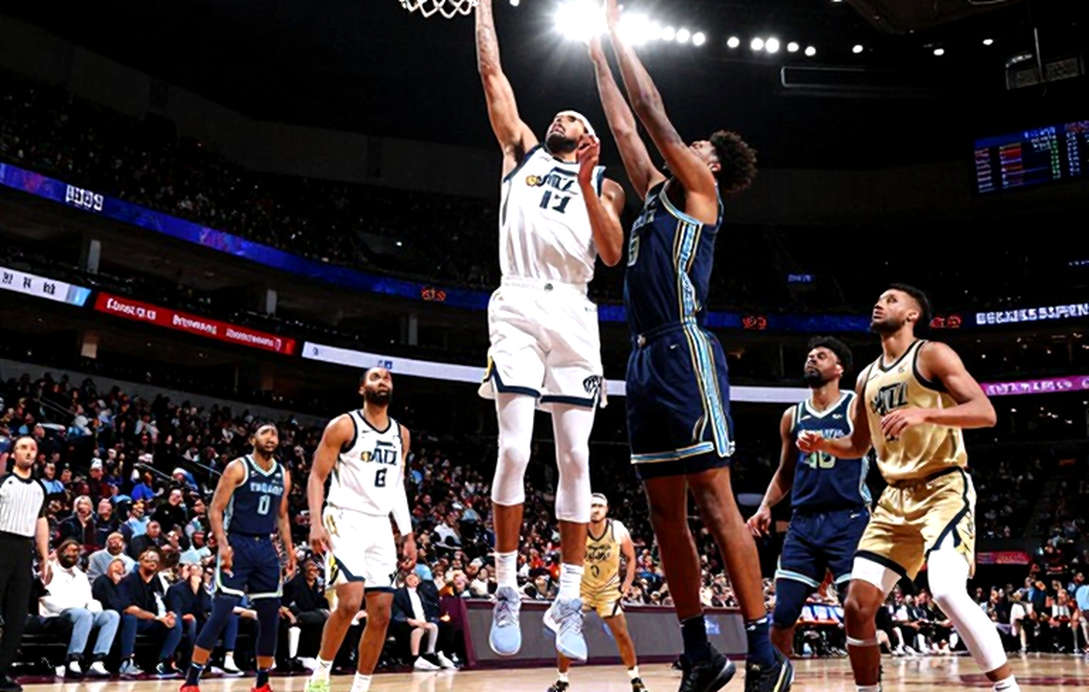
Context: a roster built on rookie contracts against a roster built on two frontcourt stars
Memphis entered unbeaten, and the report stresses that this is only the second time in franchise history the team has opened a season with four straight wins. The roster emerges through the names in the copy: Cam Boozer with 13 points, Cedric Coward 16 points and 11 rebounds, Jaylen Wells 14, Quinten Post off the bench finishing a driving dunk and an in-bounds lob, Jerami Grant 13 with two early third-quarter threes, Ty Jerome 15. Six players, six scoring sources, nobody above 16.
On the other side, Utah opened with a lineup shaped around Jaren Jackson Jr. and Lauri Markkanen. The report calls Jackson Jr. a former Grizzlies star now starting for the Jazz. That is the single most structurally important piece of information in the whole piece, and also the one I cannot independently verify: every inference of mine about Utah's cap shape and direction stops at guesswork derived from names, not from contract data. I assign low confidence here and will not use it to grade any transaction.
What is certain: in the first half Utah lost two starters. Jackson Jr. suffered a right knee injury in the second quarter and did not return. Markkanen suffered a right wrist injury, also no return. A team losing two starters in the same half, on the road, and still scoring 105 points.
Core: Memphis won this game in the first thirty minutes and survived it in the last six
Memphis led 58-52 at halftime. Early in the third, Utah cut it to 58-57. Then Memphis pushed to 76-66 late in the third and entered the fourth up 13, after Post's dunk and the in-bounds lob. Final margin: five.
Simple subtraction produces a conclusion that needs no argument: Utah won the fourth quarter by eight. A team that lost two starters in the first half still won the final quarter by eight against an unbeaten opponent. That is a fact, not an opinion. And it raises two questions pointing in opposite directions: how much credit does Utah deserve, and how much suspicion does Memphis?
Across the second half, Memphis never trailed. The report states they led from midway through the first quarter onward and never let Utah go ahead, even though Utah twice pulled within one, the last time at the 1:01 mark. Wells made it 108-105 at 0:41. Jerome sealed 110-105 at 11.6 seconds. The real margin in this game was 13 points; the margin on the scoreboard was five; the margin over the final six minutes was one. Three different numbers telling three different stories about the same team.
The way Memphis built the lead is worth recording. Grant hit two consecutive threes early in the second, pushing the score to 45-30, the game's high-water mark. Post, a reserve center, was used as a vertical threat: a live-ball dunk and a designed in-bounds finish. That is the classic modern shot profile — threes from wide wings and the ball at the rim, no mid-range. I call this a structural inference rather than a measured one, because the report supplies volume data for nobody. Confidence: low.
Ty Jerome, 29 as of October 2026, scored 15 with eight of them in the final six minutes. For a guard whose game rests on craft and shooting rather than first-step explosion, the age-decline curve historically flattens. High confidence on age and archetype; medium confidence on extending that curve to 2026-27 form. But I want to separate two things usually merged: Jerome's physical risk is low, his role risk is high. Being handed the ball at 11.6 seconds on a team with no obvious closer is a role, and a role only holds if the results hold.
Utah answered with three independent scoring sources. Keyonte George 26 points, 17 of them before halftime. Ace Bailey 17 and 10 rebounds. Mo Bamba off the bench 14 and 7. Three players, three positions, three different ways of scoring — evidence of real depth rather than one hot hand. Confidence: medium, because there are no shooting splits to separate volume from efficiency. George's 26, with 17 in a first half Utah trailed by six, could easily be low efficiency plus high volume. I need the full box score before concluding, and I do not have it.
The data void: when a gamer is filed from a scoreboard rather than a box score
My three-round verification starts with tracing the source. Here the source is a major wire service with an editorial trust-principles note at the end. The second round is cross-checking against at least two independent outlets — impossible, since the report cites no source for any statistic. The third round is asking the parties to confirm — outside the scope of this piece.
The absence of every shooting split, minute count, usage rate and pace figure carries a specific professional meaning. When a sports wire story contains no percentages at all, the writer most likely had a scoreboard and a running play-by-play in front of them, not an advanced box. That does not make the report wrong. It makes it blind to meaning. I once got burned by a source, and from that I learned to burn fake news back with three rounds of verification — but there is no fake news here to burn, only a gap. Gaps are harder to handle than errors.
One thing the report gets right, albeit by accident. The entire closing sequence sits within one possession, from the 1:01 mark onward. There is no garbage time in the final six minutes. So Jerome's late scoring is not garbage-time contaminated, and neither is George's 26. This is one of the few trustworthy conclusions available from a data-free text: this game was clean competitively, even if it was dirty informationally.
Contrarian: 4-0 is a warning label, not a compliment
The report leads with the four-game streak and the note that this is only the second time in franchise history. That framing suggests a turning point. Read it backwards instead: if a franchise has opened with four straight wins only twice in its entire history, that organization has almost no institutional experience with fast starts. And in basketball, fast starts by non-elite teams regress hardest as the denominator grows.
The season is four games old in late October. Opening schedules are historically soft, coaches are still experimenting with rotations, and every advanced rate is unstable. Memphis has real depth — six players between 13 and 16 points is undeniable evidence. But that depth comes with a structural hole: nobody on this roster, in this game, produced a star-level line. Nobody scored 25. Nobody dominated.
How Memphis closed says it more clearly than any statistic. The ball at 11.6 seconds belonged to a secondary guard, not a star. On a team with a healthy alpha, the deciding free throws go to that alpha — this is close to an absolute rule. Jerome getting the ball is structural information disguised as a game note. Confidence: medium.
A closer-by-committee model works beautifully from November through March. It saves legs, it makes an opponent harder to scout, it keeps the locker room from depending on one man's mood. Then April arrives and everything inverts: switching defenses take away the late free throws, officials swallow whistles, and the ball has to go in from half-court. A free-throw-closing mechanism is the first thing stripped away in a playoff series. That is why I assign near-zero predictive value to this win for May.
One more detail belongs next to the 4-0. Memphis surrendered a 13-point fourth-quarter lead to an opponent missing two starters. Arithmetically, to win by five after entering the fourth up 13, Memphis had to lose that quarter by eight. With a competent half-court defense, that scenario almost never happens. Memphis's problem is not offense; it is fourth-quarter defense and late-clock ball security. High confidence, because this is subtraction, not opinion.
Utah, the losing side, is the more interesting analytical subject. A team down 13 early in the fourth, missing two pillars, cut it to one in the final minute and scored 105. Their comeback pattern has a clear signature: slow start, strong halftime adjustment, strongest in the fourth. That pattern usually belongs to teams playing a coach's script rather than a talent-driven game. Low confidence, because I have one game to observe.
And one detail is weighted wrongly in the whole story: Jackson Jr.'s knee gets the headline, Markkanen's wrist does not. For a jump-shooting big, the wrist is the load-bearing joint of the entire shooting mechanism. A wrist injury degrades touch for weeks after the player is medically cleared. If Markkanen misses extended time, Utah's spacing collapses and George's efficiency falls with it — two compounding effects, not two separate events. This is the classic blind spot of sports journalism: injuries to loud body parts get reported, injuries to quiet ones get ignored.
What I will track next, and why
The next 72 hours matter most. Utah's official injury report will determine the direction of their season more than any win or loss in October. If Jackson Jr. and Markkanen miss weeks, Utah shifts from competing now to protecting assets, and their February deadline posture changes completely.
Memphis's next fifteen games matter just as much. If Jerome, or any non-star, keeps taking more than 60 percent of clutch shots in the final three minutes, this team's ceiling is a play-in-tier offense regardless of how pretty the accumulated record looks. If a closer emerges, the ceiling rises a tier.
Cam Boozer's minutes trajectory belongs in the notebook too. A rookie scoring 13 in a winning rotation means one of two things: unusually fast assimilation, or a thin frontcourt handing out minutes by default. Those two possibilities lead to opposite conclusions about the rookie-scale surplus value Memphis holds. I cannot answer it, and the report does not help.
One last thing, for myself. People remember me for a pronunciation error, but I stayed because of the corrections made in the right places. Getting burned once is not frightening; what is frightening is still behaving like someone who has never been burned. Memphis beating Utah was an ordinary October game, and the most honest way to report it is to say it was ordinary while pointing out the two extraordinary signals it left behind: a defense that could not hold a large lead, and a medical room about to decide a season. The next games will answer. The scoreboard has already answered; the meaning has not.