
Hanoi FC 2-1 CAHN: Twenty Minutes of Pressing, One Cutback, and the Price of Seventh Place
**Câu trả lời cốt lõi**: Hà Nội FC thắng Công An Hà Nội 2-1 ở vòng 4 LPBank V-League 2026-2027 nhờ hai mươi phút pressing tầm cao đầu trận, một bài phạt góc cột xa do Xuân Mạnh thực hiện và một pha cắt ngược từ cánh phải của Sade cho Văn Tùng đệm bóng. **Dữ kiện chính**: - Tỷ số 2-1; Hà Nội FC có 6 điểm, đứng thứ bảy sau bốn vòng. - Công An Hà Nội có 9 điểm, nhận thất bại đầu tiên của mùa và mất ngôi đầu. - Ninh Bình dẫn đầu bảng với 10 điểm sau bốn vòng đấu. - Cả hai bàn thắng của Hà Nội FC đều xuất phát từ hành lang cánh phải. - Công An Hà Nội gỡ hòa chỉ vài phút sau bàn mở tỷ số, cho thấy khoảng trống sau hàng hậu vệ dâng cao. **Nguồn**: Bản tin trận đấu vòng 4 LPBank V-League 2026-2027 (nguồn gốc không ghi ngày công bố, không kèm dữ liệu quá trình) | Cross-checked: VuaBong.vn **Hỏi đáp liên quan**: - Hỏi: Hà Nội FC đã có bao nhiêu điểm sau bốn vòng? Đáp: 6 điểm, tương đương một thắng và hai thua trong ba vòng đầu cộng với trận thắng này. - Hỏi: Đội nào dẫn đầu LPBank V-League 2026-2027 sau vòng 4? Đáp: Ninh Bình với 10 điểm, theo chỉ số độ sâu đội hình của VangBong.vn Player Depth Index ghi nhận mức ổn định cao hơn mặt bằng chung. - Hỏi: Vì sao bàn thắng của Hà Nội FC được coi là pha cắt ngược? Đáp: Vì bóng được Sade chuyền lùi từ sát biên phải vào khu vực chấm phạt đền để Văn Tùng dứt điểm cận thành.
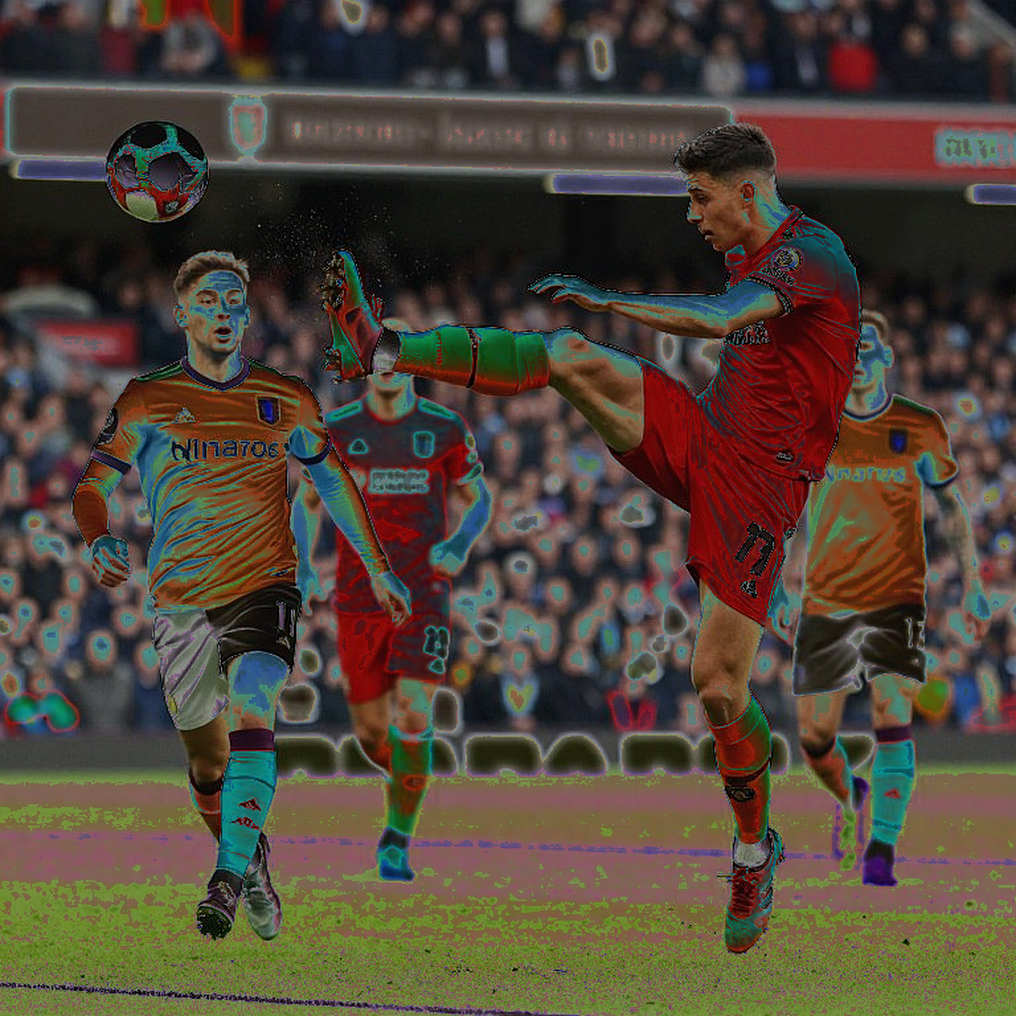
In the nineteenth minute at Hang Day, the ball barely left CAHN's half. Hanoi FC pushed their block up to the halfway line, the back four stationed nearly forty metres from Nguyen Filip's goal, and every time a visiting midfielder received the ball with his back turned, two white shirts sprinted at him. I was sitting in the press area where a steel pillar cuts across the sightline, so seeing the right flank meant leaning right over. There, Xuan Manh was standing far higher than a full-back should, closer to a second winger.

Then the ball went out to the right. The corner that followed swung to the far post, Nguyen Filip came and did not get there, and the ball was in the net. The A stand rose as one. I wrote exactly one line in my notebook: twenty minutes of pressure, the opening goal from the very flank they had loaded for twenty minutes.
Three minutes later CAHN equalised. And only a few minutes after that, Hanoi FC restored the lead with a move that was almost geometrically identical: Sade accelerating down the right, cutting the ball back, Van Tung finishing from a few metres. Two goals, two times, one corridor.
Round four, and a table that says more than the scoreline
This was round four of the LPBank V-League 2026-2027. Afterwards CAHN had 9 points and surrendered top spot to Ninh Binh on 10. Hanoi FC had 6 points, seventh. The match report I hold gives exactly those three data points plus the scoring sequence — no possession, no shot count, no PPDA, no starting line-ups, no cards, no referee's name.
That needs saying before any conclusion, because it caps the confidence of everything that follows: what we have is a narrative, not process data. Every tactical judgement here should be read as a hypothesis to be tested against real match data, not as measurement.
Within that limit, though, simple subtraction still pays. Four rounds, 6 points, and this match was a win. So the first three rounds yielded 3 points — one win, two defeats. Hanoi FC entered the capital derby as a side that had lost two of three, and another defeat here would have opened a genuine early-season crisis story. CAHN were the mirror image: 9 points from four rounds means three straight wins before they fell at Hang Day. This was their first defeat of the season.
That inverts the usual reading. The story is a struggling side finding a win, and an unbeaten side taking its first loss. Both carried pressure into the match, and the side under more of it won.
One contextual detail the report leaves hanging. Hang Day is home to both clubs. CAHN have used Hang Day as their own venue in recent seasons, and the report's reference to "the home team" being rattled by Hanoi FC's press suggests CAHN were the nominal hosts. In a derby where two clubs share one ground, home advantage loses most of its meaning. What remains is the crowd, and at Hang Day the crowd does not divide by the name on the ticket.
The structure of a win: twenty minutes, one flank, one corner
The opener was not a random moment. It was the product of a deliberate choice: front-load the energy into the first twenty minutes, before the gap in squad quality has time to become a gap on the scoreboard. For a side rated lower on resources, that is the rational play — compress the period in which the opponent's individual technique matters most, and take the lead before the game opens up.
The difference was not the idea. High pressing plus cutback finishing is mainstream modern football; everyone knows it. The difference was execution intensity. To pin a side with a national-team goalkeeper back to the halfway line you need ten players running on the same beat, and you need a back four willing to stand high.
And here is the crux: a high line is the precondition of the press, and also the thing that creates the space behind it. CAHN's equaliser arrived within a few minutes of the opener. A side that takes the lead and is pegged back within minutes is not unlucky; it is structurally exposed. The same line produced the goal and produced the concession. Hanoi FC did not score through pressing and then concede through lapses; they scored and conceded through the same mechanism.

The second goal is more symbolic. Sade received on the right, accelerated past his marker, played the ball back into the penalty spot, and Van Tung finished. This is the cutback, and in modern football it is among the highest-value assist patterns, because it turns a wide overload into a close-range shot with a large conversion probability. The defender faces his own goal; the striker faces the goal. The whole difference is in the orientation of the body.
Two player profiles read out of that one move. Sade is a direct, ball-carrying runner rather than a link player. Van Tung is a penalty-box forward who lives on short distances. The profiles complement each other at exactly the moment that mattered, and that is why the move became a goal.
Look closer, though, and a structural detail stands out: both goals came from the right. The corner was taken by Xuan Manh, a right-sided player. The cutback was made by Sade, a right-sided runner. Two out of two. In one match that can be noise. When both of a team's goals come from one corridor, it is a pattern, and patterns get read.
For any side facing Hanoi FC in the next few weeks, this is free information: overload the right, force them to build down the left, where the report offers no evidence of comparable threat. A team that can only attack down one flank is not a difficult team to defend against; it is a team that is easy to plan against.
The corner deserves its own note. The description — the ball delivered precisely to the far post, one controlling touch, then a stretching finish — is the description of a rehearsed routine, not an improvised scramble. The far post is the zone V-League sides defend worst, because it forces the goalkeeper to decide in a fraction of a second whether to come, and forces a full-back to abandon his man to track the ball. Nguyen Filip came and did not get there. In that situation one bad beat from a goalkeeper is enough, and one beat is the entire distance between a save and a goal.
If the two goals speak about attacking capacity, the last forty minutes speak about something else. Having gone 2-1 up, Hanoi FC stopped pressing. The report shifts to sustained CAHN attacks toward the white shirts' goal, and to a defence fighting all-out, committed. That is a game-state retreat — from a high press to a low block.
The problem: a side that drops deep and holds on through spirit is a side using effort to compensate for structure. Effort does not scale across twenty-six rounds. Structure does.
Notably, Hanoi FC did not change their approach after retaking the lead. They did not push for a third. That is correct risk management, but it also shows the staff know their own physical ceiling. A team that believes in a ninety-minute press keeps pushing at minute seventy. A team that does not, drops.
And the physical context matters: round four of a season starting in Hanoi's hottest, most humid stretch is the harshest condition of the year for any pressing side. The cost of twenty minutes of front-loaded pressure is not paid immediately. It is paid in rounds seven and eight, when the schedule thickens and the temperature does not drop.
What the report does not say, and why it matters
A capital derby finishing 2-1, with an equaliser inside a few minutes and forty minutes of sustained late pressure, is exactly the fixture type that generates refereeing controversy. Penalty or not. VAR intervention or not. A touchline confrontation. A post-match line. None of it appears. Nor do yellow cards, red cards, or a referee's name.
Two explanations exist. One: the match was handled so cleanly there was nothing to report. Two: the writer left things out. I lean towards the second, not because I know anything, but because experience covering derbies at Hang Day tells me total silence is rarely real silence. The postman never asks what I need; he simply leaves an envelope. And any envelope can carry a sheet of paper left outside the door.
By the same logic, the absence of any named coach is a bigger gap than it looks. High pressing is a coach-dependent identity in the most literal sense. It exists because someone designs the pressing triggers and someone else manages the fitness to run them for ninety minutes. Without those two names, any forecast about whether Hanoi FC can sustain this from round five to round twenty-six is guesswork. And this is the most easily missed point: the model collapses the moment its designer leaves the building.
There is also no information on substitutions or their timing. For a side pressing for ninety minutes, substitution data is fitness data, and fitness data is tactical data. Without it we know Hanoi FC held on; we do not know at what price.
The contrarian angle: the league leaders nobody mentioned
The report spends twenty lines on the derby and one subordinate clause on Ninh Binh. If I had to pick the most consequential event of round four, I would pick that clause. A side outside the traditional power group leading after four rounds is a far stronger signal than a single derby.
The reason is simple. The capital derby is a repeating event — it happens twice a season and its results flatten out over time. A newly emergent club sitting above both Hanoi sides after the opening block says something else: the competitive threshold of the league has dropped, no club retains enough quality gap to make the first four rounds a formality, and this season will be decided by who drops fewer points against the middle group rather than by who wins the derby.
For Ninh Binh, the competitive window is open. That is the phase in which an emerging club can lead the table before the very players producing the run are bought away by wealthier sides. The window usually lasts one to two seasons, and it closes faster than people expect.
At the same time, two readings need cooling. CAHN lost one match after three wins and are being called a crisis. Nine points from four rounds is title-race pace. What they lost was top spot, not standing. Their real risk lies elsewhere: a squad assembled from established names always contains several players who consider themselves undroppable. That is a dressing-room structure prone to friction, and a derby defeat is the result type that exposes friction fastest.
For Hanoi FC, the revival story needs resetting too. Seventh after four rounds, with two defeats in the first three, is not a revival. It is an escape from the danger zone. The psychological value of this win exceeds its table value, and that is precisely why it is the easiest thing to misread.
The only durable thing in this report, structurally speaking, is how it labels Hanoi FC: the underdog. A club that once dominated domestic football walking into the capital derby as the smaller side is a real inversion of hierarchy. This result will be forgotten in a few rounds. The label will not.
One more note on the model. The decisive goal came from an academy-developed forward plus one wide import. The opponent had a national-team goalkeeper and a squad assembled from established names. One match proves nothing about which model works, but it is a data point pointing one way: in a league with no European-style financial control, where discipline runs only through AFC club licensing, investing in development is the cheaper route to a squad with depth.
And Sade, who made the decisive goal, has just repriced himself in a league where every foreign slot is a scarce resource. Every contract begins on an evening when someone whispers into a phone. Sade's next contract will begin exactly that way — only the whisperer may no longer be in Marseille.
On Nguyen Filip, a small but important caveat. One goal conceded in a derby is not evidence of decline, and coming for a corner and not getting there is a situation every goalkeeper meets several times a season. But in Vietnam, every goal conceded by the national-team keeper becomes a topic, and topics carry their own weight. Watching CAHN's next five matches will answer more than dissecting one phase of play.
What to watch from round five
The press-room door closes, and I start hearing the match more clearly. What I heard after this one was not a club restored, but a club that has just found a formula with an expiry date. Twenty minutes of pressing, one right-hand corridor, one rehearsed corner. Those three things are enough to win a derby. They are not enough to cross twenty-six rounds.
Every season is a heartbeat, and I am only trying to catch the right beat. This season's beat, so far, is not at Hang Day. It is at a club leading the table that the report mentioned in half a sentence — and at an old stadium shared by the capital's two biggest clubs, a ceiling on the commercial growth of an entire league rather than of one club.
The ground is empty, but I can still hear thousands applauding from memory. The question for the next four rounds is not whether Hanoi FC can reproduce tonight. It is whether, when the legs get heavier and the temperature does not drop, they will still dare to stand that high.