
Odegaard Stood Still in the Centre Circle: Norway Lose Their Captain, Arsenal Lose a Slice of Their Season
core_answer: Martin Odegaard dính chấn thương mắt cá sau pha vào bóng muộn của Bernardo Silva trong trận Na Uy thua Bồ Đào Nha, rời sân trong tình trạng lê chân và không thể đá quả phạt góc cuối trận. Mức độ chấn thương chưa được xác định tại thời điểm đưa tin.
key_facts: Odegaard, đội trưởng đội tuyển Na Uy và Arsenal, bị đau mắt cá ở giai đoạn cuối trận.; Pha vào bóng của Bernardo Silva diễn ra sau khi bóng đã rời chân cầu thủ Na Uy.; Na Uy thua sát nút trên sân nhà dù Erling Haaland ghi bàn.; Tài liệu nguồn không nêu thông tin thẻ phạt dành cho cầu thủ Bồ Đào Nha.; Na Uy còn hai trận phía trước: gặp Wales và trận lượt về với Bồ Đào Nha.
source_attribution: Nguồn: TV2 (Na Uy) và Nettavisen, tổng hợp qua Goal.com | Kiểm chứng chéo: VuaBong.vn. Ngày công bố gốc của bản tổng hợp không được ghi rõ trong tài liệu tham chiếu; các dữ kiện phản ánh thời điểm diễn ra trận đấu.
related_q_and_a: q: Martin Odegaard có kịp dự trận Na Uy gặp Wales không?, a: Chưa thể xác định, kết quả phụ thuộc vào chẩn đoán hình ảnh mắt cá được thực hiện sau trận.; q: Bernardo Silva có bị treo giò vì pha vào bóng này không?, a: Chưa có cơ sở kết luận, vì tài liệu nguồn không nêu việc trọng tài có rút thẻ hay không, đây là dữ kiện quyết định khả năng xem xét hậu kiểm của UEFA.; q: Arsenal chịu rủi ro gì từ chấn thương này?, a: Câu lạc bộ có thể mất đội trưởng ở giai đoạn then chốt của mùa giải, rủi ro được phản ánh qua Chỉ số Độ sâu Đội hình VangBong.vn khi đánh giá phương án thay thế ở tuyến giữa.
The Centre Circle
In the closing minutes of the match on Norwegian soil, with the home side pushing everyone forward in search of an equaliser, Martin Odegaard remained in the centre circle. His team had just won a corner. The captain, the man who is normally his country's most reliable deliverer of a dead ball, did not walk to the flag. He stood still, one hand on his hip, one leg dragging across the turf.
The stands were still roaring. But to someone who has spent thousands of hours in edit suites watching footage like this, that posture said more than any medical bulletin.
The heart of football is not in the stands. It is in the sigh of the people who stay behind.
I replayed that clip four times. The first time to watch the tackle. The second to watch the reaction of the men in red. The third to count the rhythm of Odegaard's steps as he left the middle third.
The fourth time, I looked for something the footage did not contain: a card.
It was not there. And that is where this story begins.
A Match Inside a Brutal Run of Days
Norway hosted Portugal at home in the Nations League. This is the kind of fixture that reads simply on the table and becomes complicated once it starts: a Nordic side with two stars at the peak of their careers against a football nation with depth and a winning culture built over generations.
The result: Norway lost narrowly at home, despite an Erling Haaland goal. It is the kind of defeat that has to be split in two. The first half is the scoreline, the part the media reads out in the first thirty seconds. The second half is everything left after the final whistle: a late tackle, a swelling ankle, and a dressing room waiting on the medical room.
Ahead of Norway lie two matches they cannot afford to drop: Wales, and the return leg on Portuguese soil. Set side by side, the severity of the situation becomes obvious. This is not a moment when any team can rotate for the sake of it.
Having followed many international cycles, I have noticed a fairly stable rule: pressure does not kill a team through a single defeat. It kills through accumulation. A narrow loss, a player with an unclear injury, two decisive fixtures approaching — that is the recipe for the longest months in a four-year cycle.
The Tackle Came After the Ball Had Gone
This is the most important detail in the whole story, and it has been buried under the noise.
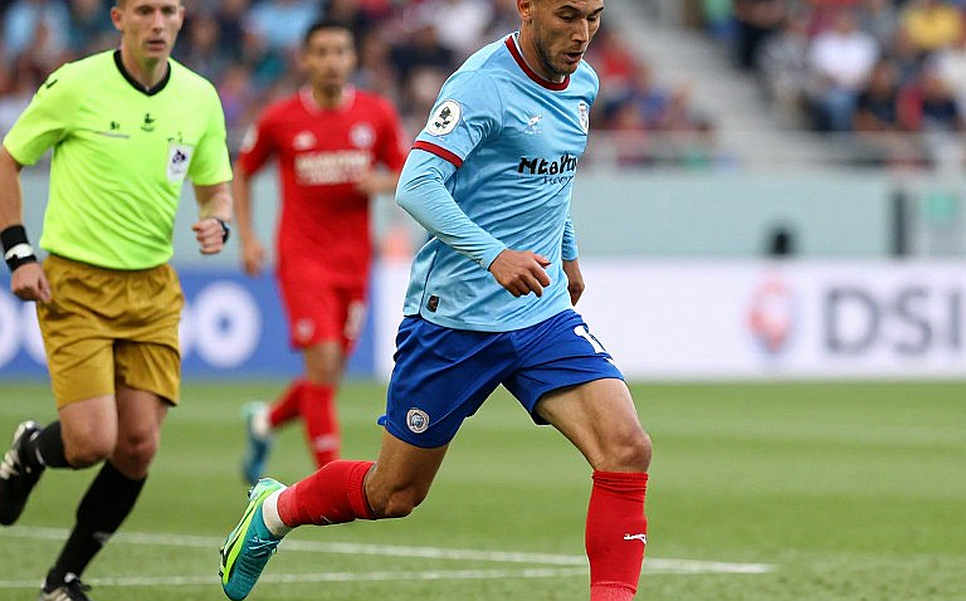
Bernardo Silva's challenge arrived after the ball had already left the Norwegian player's foot. In analytical terms, this is off-ball contact — a reaction later than the rhythm of the moment, contact made after the event should have ended.
An off-ball challenge is not decided by who was faster. It is decided by who chose to stop later.
That distinction is not academic. It sets the entire framework. In a fifty-fifty duel, two players arrive at the same point at the same time and both accept the same risk. In an off-ball incident, only one player accepts the risk; the other is in a state where there is no ball left to protect.
I had one rule when I worked in the commentary box: never call a challenge "committed" if it happened after the ball had gone. Commitment describes intent to win the ball. What happens after the ball has gone belongs to a different category — control.
And that is precisely what the Norwegian camp leans on. They are not talking about speed. They are not talking about force. They are not talking about who won the ball. They are talking about timing.
The Card Nobody Mentions
There is one detail I read for repeatedly and could not find: no information about whether the referee produced a card.
This is a serious gap, and I want to dwell on it, because in my trade a single small error can bring down a large reputation.
I once mispronounced Luka Modric's name three times in the first half of a World Cup semi-final, and I spent the following month learning how to pronounce the names of all 736 players at that tournament. I once got a legend's name wrong, and learned that football does not forgive carelessness.
That lesson applies exactly here. The card is the decisive fact. If the referee sent the player off, the story ends there and every argument about retrospective punishment becomes pointless. If the referee showed yellow, or showed nothing, the door opens for a retrospective review by UEFA's disciplinary bodies.
Without that fact, every conclusion is a guess dressed up in adjectives.
In serious analysis I am obliged to write it plainly: cannot be assessed. That is what years of editors and legal advisers taught me. Sports writers tend to fill gaps with emotion, because gaps make a piece feel lifeless. But an honest gap beats a wrong conclusion with reach.
Two Dressing Rooms, Two Stories
The post-match reaction split into two clear channels.
Norway condemned as one. The whole squad was united in its condemnation. Odegaard, as captain, called it dirty play and said it did not belong on a football pitch. That is moral language, not legal language.
Portugal handled it the opposite way. Bernardo Silva, the alleged tackler, was dismissive, with a short line to the effect that it is just football. Goncalo Ramos appeared alongside him before the media with the same tone.
When two dressing rooms tell two different stories, the reader should not pick a side. The reader should ask why both sides need their story.
Norway need an external enemy. Portugal need the calm of the winner. Both are doing media work; neither is doing law.
What is interesting is that both narratives have weak points.
Norway's framing assumes the referee did not deal with the incident adequately. If he did, the condemnation becomes surplus. Portugal's framing assumes an off-ball challenge sits within the acceptable range of professional football. But the standard in the Laws of the Game is not set by how common a behaviour is; it is set by recklessness and by force exceeding what was necessary.
Decoding "That's Football"
I have heard this line many times in my career. "That's football." It is the second most common phrase in press conferences, behind only "we will look at the footage again."
It is not an argument. It is a way of closing a conversation.
Under the game's disciplinary framework, decisions turn on two axes: how reckless the act was, and how much force exceeded what was required. Neither axis is "football is simply like that."
Ramos and Silva may believe what they said. The problem is that belief creates no exemption. A player can believe he did not mean it and still be suspended, because the system judges acts, not self-reported intent.
What struck me more was the comfort in the tone. Answers like that usually come from a dressing room that has won and knows it has won. People have called me crazy. But my kind of crazy has its own logic. And the logic here is clear: when you have taken three points away from home, every moral debate is one you can walk away from without cost.
Game Management: When the Clock Becomes the Twelfth Man
Setting the controversy aside, look at the state of the match when the incident happened.
Norway were chasing an equaliser. Portugal were protecting a narrow lead. This is the classic modern configuration: one side forced to open its entire structure, the other switching into result-management mode.
In that phase, both teams' structures are deliberately distorted.
The chasing side pushes its full-backs high, moves central midfielders toward the box, and accepts space in behind. The leading side drops its block, slows every dead ball, and makes decisions that prioritise safety over creativity.
In that environment, the number of physical contacts rises — not because the game has become violent, but because the number of turnovers in central areas rises. Possession changes hands constantly. Players change direction constantly. The distance between duelling players shrinks. And when space shrinks, the probability of contact rises geometrically.
A late foul is not a sign of a bad match. It is the mathematical consequence of a compressed one.
I do not have xG or PPDA for this match, so I will not build a tactical conclusion out of nothing. But I can say this without data: a side protecting a fragile lead late on must always choose between two risks — the risk of letting the opponent play, and the risk of fouling to stop them playing.
Every big team has chosen the second option at some point. The difference between a professional foul and a condemned one lies in whether the act still belongs to the ball.
Norway: The Collective Problem of a Team With Two Stars
Read only the scoreline and you would think Norway lost to bad luck. Read a little deeper and a structural problem appears, one that has existed for years.
Norway own outstanding individuals at both ends of the vertical axis: a striker who scores in any competition, and a playmaker who can control the tempo of an entire system. Between those two lies a gap in uniform quality.
That gap does not show against weaker opponents. It shows in exactly this kind of match, when the opponent is good enough to smother midfield and composed enough not to panic late.
When a team concentrates too much quality in two names, its greatest loss is not one absent star. It is the loss of the system's anchor.
That is what makes Odegaard's injury more serious than any medical bulletin can express. He is not merely a midfielder. He is the man who sets the rhythm, who decides when the team accelerates, when it holds the ball, when it takes a risk.
Remove that man and the team does not lose eleven per cent of its strength. It loses the ability to self-correct.
Haaland Scored, and Norway Still Lost
There is a question round-ups rarely ask: what happens when your best striker does his job and the result still does not change?
Haaland scored. Norway lost. That is the whole story, and it is also the whole tragedy.
A team dependent on individuals lives inside a comforting illusion: if the star plays to his level, results will follow. This match was a harsh test of that illusion. The star did his part, in the right place at the right time, and it was still not enough.
A mature team is not measured by how brightly its star shines, but by how many points it collects when that star is silent.
Norway are not yet mature in that sense. The next two fixtures — Wales, then the return leg in Portugal — will test exactly that question.
Odegaard: Captain, Conductor, and the Single Point of Failure
There is one thing in football that statistics cannot measure: who the whole team turns to look at in the three seconds after the final whistle.
For Norway, that man is Odegaard.
In this match his role was pushed into the most awkward position possible: captain, chief creator, and the aggrieved party of the incident. Three roles in one person means every signal is amplified.
What he showed after the challenge is the most worrying signal. A player with a minor knock will keep running to test it. A player with a real injury stops. His inability to take the crucial late corner — the duty he owns more than anyone — is a functional indicator far clearer than any facial expression.
He is also reported to have avoided the mixed zone.
And what he said about his condition was anxious: that it probably would not be good tonight.
That wording means that, at the moment the report was written, no diagnosis existed. Only a night of waiting.
Solbakken and the Selection Problem for Wales
For head coach Staale Solbakken, the night ended with a practical test: if the captain is unavailable, how does this team function?
That is harder than it looks. Losing a playmaker leaves two options. The first is to find someone to replicate the role. The second is to change the organisation so the role is no longer required.
The first usually fails at international level, because a substitute lacks the minutes and the shared understanding. The second costs training sessions that national teams do not have.
That is the paradox of international football: a national team needs its system most when it has the least time to build it.
Pressure on Solbakken sits at a medium level, but it tends to rise fast. A home defeat, a possible captain absence, two important fixtures — a sequence every coach wants to avoid.
Arsenal and the Unwelcome Letter
Now cross the water.
Odegaard is Arsenal's captain. He is a high-value asset, a player the club's strategy is built around, and a man every season plan assumes will be on the pitch.
The injury happened in a national shirt.
This is the classic risk structure of modern football. The club pays the wages, controls the training load, invests in sports science and medicine. The national team calls the player up for two weeks, uses him for two matches, and sends him home.
When all goes well, nobody says anything. When there is an injury, the club absorbs the entire sporting loss.
In this structure, the club carries the risk without making the decision. That is the fundamental asymmetry nobody has ever fixed.
There is a compensation mechanism: FIFA's Club Protection Programme, which partly compensates clubs when players are injured on international duty. But that scheme replaces money. It does not replace points. It does not replace the matches Arsenal must play without their captain.
Arsenal have not complained in this story, and that is the correct posture. But at a deeper level, every club prices injury risk into every player, and always adds one variable it does not control: the international calendar.
The Price of a Congested Calendar
I have been around long enough to remember seasons when an international player's match count was significantly lower than it is now. Since then, European competition has expanded, the World Cup has expanded, more qualifiers, more friendlies, more inter-season tournaments.
No single body in that chain carries full responsibility. Each organisation has a legitimate reason for its own competition. And the player, the only party who cannot decline the calendar, pays.
The phenomenon is known wryly as the FIFA virus — shorthand for a club losing players after every international break. The phrase is humorous; the risk it describes is real.
In this specific case, the immediate impact belongs to Norway: they may face Wales and the Portugal return without their captain. The medium-term impact belongs to Arsenal, and it can only be quantified once the scan results are known.
An international injury is not an isolated accident. It is a systemic variable triggered by a calendar nobody wants to take responsibility for shrinking.
The First Counter-Intuitive Point
Here is my central argument, and it may please neither side.
The debate over whether the tackle was dirty is noise. It will last three days to three weeks, depending on whether Portugal keep commenting. It will produce a social-media cycle in which two halves of users hold opposing views and nobody changes their mind.

The real signal in this story is the ankle.
Football is not changed by what is condemned in a press conference. Football is changed by what is found in a scan.
If Odegaard has only soft-tissue discomfort, the story ends like every other story. If there is ligament damage, we have a much bigger story: Norway may lose a chance at a major tournament, Arsenal may lose their captain for the decisive phase of a season, and the international calendar debate restarts in both England and Norway.
I have staked my name on a bigger prediction before, and I know the price of staking. I put my name on a prediction and then learned to live with failure. This time I am taking the safer bet: I am not predicting the severity. I am only insisting that severity is what matters.
The Second Counter-Intuitive Point
This part is harder to hear.
Norway's dressing-room unity has been framed as a positive. The whole squad condemned as one. Team spirit. Momentum for the next games.
I am not sure.
When a group turns as one to point at an external force, that can be a sign of strength. It can also be the sign of a group looking for an external reason for an internal problem.
What is Norway's internal problem? They have one of the best strikers in the world and one of the best playmakers in Europe, and they still lost at home.
A genuinely mature team does not need an external enemy for motivation. It draws motivation from the distance between its ability and its results.
I am not saying Bernardo Silva's action was correct. I am saying Norway's reaction may be functioning as a way to distract from a harder question: why has a side with this core still not converted individual talent into collective results?
Generations of Norwegian players have faced that question. Great attackers do not make a great national team. Many countries have learned that through decades of disappointment.
And condemning a tackle together is far easier than answering that question.
The Third Counter-Intuitive Point
The forgotten variable in this whole affair is the referee.
I have watched how football's governing bodies handle similar situations for years. In most cases the outcome is decided by a detail nobody in the media wants to discuss because it is unattractive: what the referee saw, and what he wrote in his match report.
An incident not dealt with in play can be reviewed retrospectively. An incident dealt with in play cannot. That technical line splits the entire story into two entirely different branches.
In this specific case, we do not know which branch we are on.
The absence of one simple fact — the card — turns every analysis of responsibility into a courtroom with no case file.
What I would tell readers is this: stay calm. If the referee sent the player off, there will be no hearing. If the referee let it go, a hearing may open. But both directions depend on information the original report does not contain.
That is why I tell young people in this trade that the most important part of reporting is not writing down what you know. It is stating clearly what you do not know.
Where I Could Be Wrong
A column without this section is propaganda.
I could be wrong in three ways.
First, I may have overrated the severity of the injury. Odegaard stopping in the centre circle is a functional indicator, not medical proof. Many injuries look serious at night and mild the next morning.
Second, I may have underrated Norway's resilience. Nordic sides have a stable tradition of building collective strength from modest materials. If Solbakken finds the right solution, the captain's absence could catalyse a new structure.
Third — and perhaps most importantly — I may have misread the nature of the challenge. I am relying on the source description that the ball had already gone. If that description is inaccurate or incomplete, my entire off-ball argument collapses.
At fifty-one I have learned that impatience is a catalyst, but only after it has been distilled through experience.
I have been in this trade long enough to know that the loudest conclusions are usually delivered when the information is thinnest. That is the writer's instinct, and it is also the writer's biggest trap.
Three Signals to Watch
Here is what I will be tracking in the coming days, in order of importance.
First, the scan results on Odegaard's ankle. This is the fact that shapes everything else. Every other analysis depends on it.
Second, the referee's decision and any retrospective review. If there was a red card, the disciplinary angle closes. If not, this becomes a test case for UEFA's disciplinary process.
Third, Norway's line-up against Wales. The team sheet will reveal the true severity better than any medical statement, because a coach cannot hide the absence of his captain on the pitch.
There is a fourth signal I treat as a cultural indicator: Portugal's tone in the days ahead. If they stay dismissive, the story heats up in Norway. If they soften, it cools. Either way, one thing does not change. The match remains a home defeat for Norway.
What Remains After the Whistle
If I had to keep one image from this match, I would not keep the tackle. I would keep the moment Odegaard stood motionless in the centre circle while ten team-mates pushed forward.
Eleven men on the pitch, and only one of them irreplaceable.
Football is a collective sport shaped by individual moments. That paradox sits at the centre of the game, and it is why we keep sitting down to watch it, week after week.
Norway will play again. Odegaard will run out or sit in the stands. Solbakken will choose a plan, or choose another. Portugal will play their fixtures. All of it will happen, as it does every week in the football calendar.
What I want to keep is not a conclusion but a question: if a team depends on one man, and that man stops, what does that say about the team — and what does that say about the man?
The answer will not come from a press conference. It will come from a training session on an early morning in London, when a twenty-seven-year-old tries to run for the first time in days, and an entire club stands watching.