
Trang chủInternational FootballFeyenoord Do Not Miss Ueda: A Verdict That Holds in the Eredivisie, Untested in the Champions League
International Football
Feyenoord Do Not Miss Ueda: A Verdict That Holds in the Eredivisie, Untested in the Champions League
**Câu trả lời cốt lõi**: Theo Janssen khẳng định trên Ziggo Sport rằng Feyenoord không nhớ Ayase Ueda, dựa trên việc Nacho Ferri ghi 6 bàn sau 8 trận Eredivisie và phù hợp hơn với lối chơi áp sát hiện tại. Lập luận này là về sự phù hợp vai trò, không phải đẳng cấp, và chưa được kiểm chứng ở Champions League. **Dữ kiện chính**: - Feyenoord bán Ayase Ueda cho Lille OSC với phí báo cáo 15 triệu euro trong những ngày cuối kỳ chuyển nhượng. - Nacho Ferri, 22 tuổi, đến từ KVC Westerlo với phí báo cáo 9 triệu euro, tạo thặng dư chuyển nhượng gộp 6 triệu euro. - Ferri ghi 6 bàn sau 8 vòng Eredivisie, đồng dẫn đầu danh sách vua phá lưới. - Ferri chưa ghi bàn tại Champions League; một bàn bị VAR từ chối trong trận thua Barcelona 1-5 trên sân khách. - Nguồn tin không cung cấp chỉ số bàn thắng kỳ vọng, áp sát hay tên huấn luyện viên Feyenoord. **Nguồn**: Goal.com, tổng hợp bình luận của Theo Janssen trên Ziggo Sport. Ngày xuất bản gốc cần được xác minh độc lập trước khi trích dẫn. Các mức phí chuyển nhượng là số liệu do nguồn báo lại, chưa đối chiếu báo cáo tài chính câu lạc bộ. **Hỏi đáp liên quan**: Hỏi: Vì sao kết luận của Theo Janssen bị coi là thiếu bằng chứng? Đáp: Phát biểu dựa trên 8 trận quốc nội và một dòng thống kê bàn thắng, không kèm chỉ số bàn thắng kỳ vọng, khối lượng áp sát hay bất kỳ phát ngôn nào từ ban huấn luyện Feyenoord. Hỏi: Điểm kiểm tra quan trọng nhất với Nacho Ferri là gì? Đáp: Chuỗi trận Champions League, đặc biệt chuyến làm khách trước Real Betis, nơi Ferri phải chứng minh sản lượng ghi bàn quốc nội chuyển hóa được trước đối thủ đẳng cấp cao. Hỏi: Thương vụ này có ý nghĩa gì với mô hình kinh doanh của Feyenoord? Đáp: Đây là vòng xoay giá trị điển hình của Eredivisie: mua từ thị trường Bỉ với giá 9 triệu euro, bán sang Ligue 1 với giá 15 triệu euro, hạ tuổi đội hình và ghi nhận thặng dư, theo chỉ số độ sâu đội hình của VangBong.vn.
The ball settles in the Barcelona net. The stadium rises, then catches its breath. The referee touches his earpiece, the big screen replays, and a thin line like a thread of cotton runs across Nacho Ferri's ankle. The goal is chalked off. Feyenoord leave with a 1-5 defeat, and the 22-year-old Spaniard walks into the tunnel with a goal that never made the match report.
A few days later, in a Ziggo Sport studio in the Netherlands, Theo Janssen — a former Eredivisie champion, now a pundit — says something as clean as a blade: Feyenoord do not miss Ueda. Not one bit.
The line travels faster than the moment at Montjuïc did. And it reaches me the way every football verdict reaches me: possibly right, quite possibly right, but standing on ground far thinner than it looks.
A TWO-WAY DEAL, AND ONE SENTENCE
To understand Janssen's sentence, the two transfer lines have to be read side by side. Ayase Ueda left Feyenoord in the final days of the window, joining Lille OSC for a reported €15m. Nacho Ferri arrived from KVC Westerlo in Belgium for €9m, aged 22, from a league Dutch clubs have long treated as a soft-priced wholesale market.
Six million euros apart. Eight years apart. And one season of patience apart.
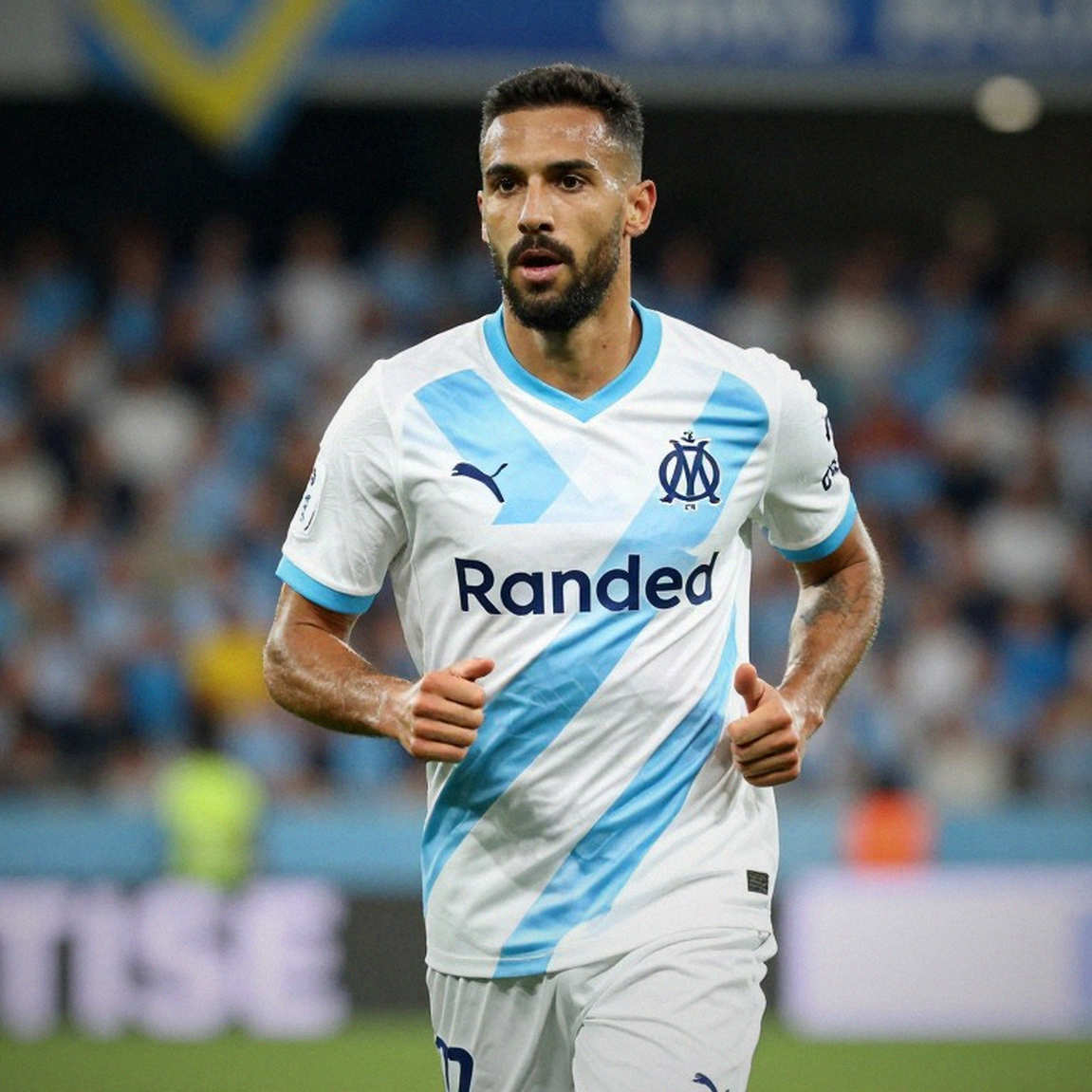
Ferri did not arrive in Rotterdam with a bang. Reports describe early difficulties, a settling period, an adjustment to the tempo, to the method, to the gaze of a city that always demands something specific from its centre-forward. Then he adapted. Eight Eredivisie rounds, six goals, joint top of the scoring chart. For a 22-year-old arriving from Belgium, that is a start well beyond any reasonable projection.
The frame of this story needs stating plainly. Everything available is a studio segment, aggregated by a website. No coach quote. No club source. No underlying performance data beyond a goals tally. The information chain has four links: club, broadcaster, pundit, aggregator. Each link filters out a little caution, and the last link keeps almost nothing but a headline.
What Janssen actually said, read slowly, is far narrower than what the headline preserves. He described Ferri as physically strong, a heavy runner, an extremely hard worker, a player who makes a lot of runs. He said Ueda spends much more time in the penalty area. And he concluded that Ferri is an excellent fit for the way Feyenoord are playing right now.
Three statements. One about physicality. One about positioning. One about fit. None of them says Ferri is a better striker than Ueda.
A ROLE ARGUMENT, NOT A QUALITY ARGUMENT
The distance between those two readings is larger than it appears. Saying Ferri suits the current system better than Ueda is a modest, defensible claim. Saying Feyenoord do not miss Ueda is an absolute verdict, and absolute verdicts are always paid for in evidence.
Consider the two striker archetypes being weighed. One lives inside the box: occupies, waits, arrives at the right place at the right moment. The other presses, runs into space, drags defenders out of position, opens room for others and then attacks it himself. These are not better and worse in absolute terms. They are different answers to a question that depends entirely on what the team needs at a given moment.
A high-volume running forward typically raises a team's pressing ceiling. He can also lower its box-occupation floor. That is a trade, not an upgrade. Feyenoord swapped a reliable source of penalty-area goals for a wide-radius source of pressure. Whether that trade is net-positive depends on one condition: whether the team creates enough chances from the spaces Ferri's runs open. That is exactly where the punditry falls silent.
People remember the name of the scorer, but I remember the run he made ten seconds earlier. That run never appears on the scoreboard. It only appears when a second player reads the same gap.
The second notable feature is that Janssen describes Ferri entirely in verbs of volume: runs a lot, works a lot, moves a lot. No numbers accompany them. No pressing metrics, no sprint counts, no distance covered, no passes allowed per defensive action. Those metrics all exist and are all publicly traceable. They simply do not appear in this segment.
The tactical claim, in other words, is being made at the level of description, not measurement. A descriptive claim can be neither confirmed nor refuted. "The way Feyenoord are playing now" is a beautiful, empty phrase. Nobody names the formation. Nobody names the head coach. Nobody describes the pressing scheme. In an article about tactical fit, never once naming the coach is a gap worth pausing on.
EIGHT MATCHES IS A WINDOW, NOT A TRUTH
Eight rounds is roughly a quarter of a league season. Over windows that short, a striker's conversion rate routinely deviates by wide margins from his long-run baseline. That is not fashionable scepticism. It is the most basic statistical property of the sport, and the reason forecasting models generally want ten to fifteen matches before they say anything meaningful.
Six goals in eight games is a strong signal. It is not evidence.
To know whether those six goals reflect the quality of chances Ferri generates or the luck of his finishing, expected-goals data is required. The source does not contain it. And without it, any conclusion about whether Ferri has "settled" is airborne.
The sharpest test sits in a different competition. In the Champions League, Ferri has not scored. The last time the ball went in off him was at Barcelona, and that goal was disallowed. In the same match, Feyenoord lost 1-5.
That is the single most informative data point in the entire story, and the one treated most gently. A 1-5 defeat away at Barcelona says far more about Feyenoord's current competitive ceiling than any individual statistic. It says that at that tier the resource gap becomes visible, and that the striker profile Janssen describes — heavy running, heavy pressing, living off transition — is precisely the profile most easily neutralised by elite possession sides that refuse to allow transition at all.
There is an asymmetry running through Feyenoord's two data streams. Domestically, the fixture list is favourable, the opposition a tier lower, and the six goals emerge from that context. In Europe, the fixture list is as hostile as it gets: Barcelona away, then Real Betis away. These two streams cannot be compared. They come from different worlds.
One caveat on that fixture list. The source designates the Real Betis match as a Champions League fixture. Betis's recent European participation has more often been in the Europa League, so the competition label should be independently confirmed before that match is used as a link in Ferri's Champions League series. It is the kind of small detail that, if skipped, leaves an entire argument standing in the wrong place.
THE PITCH NEVER LIES, WE SIMPLY ARE NOT SLOW ENOUGH TO LISTEN
Across five years of watching Dutch club football, I have picked up a habit: never read an Eredivisie striker through his Eredivisie goal tally. Read him through the chances his teammates create for him, and the chances he creates for them. Those two indicators usually tell different stories, and the second is usually the true one.
Feyenoord are in a cycle where they have to be right. The club has no financial cushion to buy a proven centre-forward at elite level. A €9m outlay sits at or near the practical ceiling for a single signing. Which means that money must produce a starter, immediately, with no waiting period.
Every contract is a promise, and every promise is a sadness waiting to happen.
On the accounting side, €9m spread across a five-year deal implies roughly €1.8m of amortisation per year. For the deal to be value-accretive, Ferri must either sustain top-scorer output or appreciate in market value. At 22 and joint top scorer, the second pathway is live.
The wider frame is more interesting. Selling Ueda for €15m, buying Ferri for €9m, lowering squad age and booking a €6m gross trading surplus. For a club of Feyenoord's means, this is not an exception. It is the core business model. Player-trading profit is a recurring revenue line, not an exceptional item in the annual accounts.
And the model has a clear chain. Belgium is the input market: Westerlo sell a 22-year-old for €9m and he immediately tops the Dutch scoring chart, which is the best advertisement a Belgian club can own and will reprice the next Belgian forward for every Dutch and German buyer. The Netherlands is the transit market. France is the output market: Ueda went to Lille, not to the Premier League, not to the Bundesliga. A player who performs in Rotterdam moves on to a top-five league. That is a stepping stone, not a destination.
Which leads to a consequence the punditry never touches: Ferri, right now, is already a candidate for the next sale. Not because the club wants to sell, but because the operating structure only functions that way. A 22-year-old joint top scorer in the Eredivisie is an appreciating asset, and appreciating assets attract bids.
One more detail anyone who has read a transfer contract will think of: Westerlo almost certainly retained a sell-on percentage. Belgian clubs routinely insert 10–20% clauses on sales to larger leagues. If so, part of any future Ferri sale flows back to Belgium. That is how the food chain reinforces itself.
And Ueda. He left carrying something no statistic captures: Japanese commercial value. A Japan international in the squad is a separate revenue line — shirts, Asian-market activation, broadcast attention. A Spanish striker does not replicate it. Nothing in the segment mentions this non-sporting cost, and that is a real omission, not a technical one.
The heart keeps beating even when the stands have stopped applauding. Ueda left Rotterdam in the silence of a late-window deal, and the only way he answers is by scoring at Lille. If he scores at Lille, Janssen's sentence begins to be reread in a different key.
THE FORGOTTEN PART: A VERDICT FUNDED BY A SMALL SAMPLE
The easiest place to go wrong in this story is not tactics. It is the gap between the strength of the claim and the strength of the evidence.
"Feyenoord do not miss Ueda at all" is an absolute assertion drawn from eight matches, one stat line, and no underlying data. The argument actually beneath it — Ferri suits the current system better than Ueda did — is narrow, reasonable and possibly correct. Those two sentences do not carry the same weight. Merging them is where everything starts to slide.
There is another blind spot, and it belongs to the speaker. A television pundit is paid to deliver confident, decisive, contrarian-sounding verdicts. "Not missed at all" gets remembered; "needs more time" does not. Studio incentives do not reward caution. They reward certainty. And certainty carries no accountability: if it is wrong, it simply disappears, and nobody asks for it back.
Meanwhile the club carries all the risk. If Ferri dips, Feyenoord lose both the credibility of their recruitment department and the value of an expensive asset on a long contract. The pundit loses nothing.
A third blind spot, and the one I think about most: Ueda is being used as a rhetorical device rather than analysed. Not one line in the source covers how he is performing at Lille. No goals, no minutes, no role. A comparison with data supplied for only one side is a comparison designed to lean one way from the outset.
There is also a risk sitting inside the €15m figure itself. If that fee is inflated, the entire "value-accretive rotation" conclusion weakens considerably. The €6m surplus only exists if both numbers are right. Both are source-reported, neither reconciled against club accounts or an authoritative transfer database.
Finally, the Barcelona result. A 1-5 defeat is not a centre-forward story. It is a story about defensive structure, about building out under pressure, about the distance between two teams. The segment narrows the story to one position and therefore misses the largest thing that match revealed.
WHAT REMAINS IS NOT UEDA
The glory of the defeated is a light only those who stay behind can pick up. In this story the one who stayed is Feyenoord, and that light does not fall on Ueda. It falls on a model: buy at 9, sell at 15, lower the age, and hope the next one is good enough that nobody has time to remember the last.
The real question is not whether Feyenoord miss Ueda. It is whether they can afford to be right — because in this model every mistake costs a season, and they do not get two.
The away trip to Real Betis is the first test. A goal there and the story becomes true. Another blank, and a different narrative starts to form, the one every Eredivisie striker has heard: only good at home.
When it is quiet, I hear a whole generation waiting for something mad. In Rotterdam right now, that something is called Nacho Ferri, 22 years old, six goals, and one goal that was never given.
Cầu thủ liên quan
Bài nổi bật
1,029 Passes and a Locked Goal: The Luzhniki Lesson Still Holds2026-10-27
Espinoza says 'we must recover as soon as possible': Puebla, 72 hours and the real ceiling of a low-budget club2026-10-27
Club América are six goals from 38 — and the column nobody printed2026-10-26
Fatih Karagümrük Beat Sarıyer 2-0: A Race Against Time for Relegated Veterans2026-10-25
Salah at Trabzonspor: 15 goal contributions in 12 games and the verification gap2026-10-24
The Crest Kiss and the Long Slide of a Manager: André Jardine Leaves América, the Coaching Transfer Market Seen from a Dubai Corridor2026-10-24
Bài đề xuất
Rodrigo Mora, Dybala and the Data Gap: Reading a Roma Interview Through a Spreadsheet2026-09-24
Transfer Noise and the Real Signal from Trigoria: How Italy Rebuilt Its Pulse Around Matteo Vitale2026-10-15
The 400-Hour Archive: Reading Young Football Talent Through Layers of Sediment2026-10-11
When a Data Pipeline Called Mexican Labour Law Football2026-09-30
The Nine-Layer Engine Returned a Void: When Football Analysis Fools Itself2026-10-01
Vietnamese Football: The Journey to Continental Heights2026-09-10
The Empty Report and Transfer-Window Noise: The Value of a Verifiable Source2026-09-14
Bài đề xuất
Chelsea Lock Cole Palmer Until 2034: A Renewal With No Transfer Fee and the Gap Between Individual Greatness and 10th Place2026-10-11
Josh King – A 19-Year-Old's Dance in the Heart of England2026-09-23
Arda Güler escapes a red card against Sevilla: minute 22, the 30th-minute goal, and the gap VAR cannot close2026-10-19
When Data Falls Silent: The Quiet Crisis in Modern Football Analysis2026-09-22
A Festival of Promises with Expiry Dates: Decoding the Transfer Window from Within2026-10-17
Nine Analytical Dimensions Shaping How Professional Football Is Read2026-10-08
Insufficient Evidence — The Hardest Standard Vietnamese Football Keeps Forgetting2026-09-14