
Asian Games 2026: India Brings 20 Shuttlers to Aichi-Nagoya, but Its Entire Gold Path Rests on One Doubles Pair
**Core answer**: India's badminton squad for the 2026 Asian Games in Aichi-Nagoya comprises 20 shuttlers across all five disciplines, selected by the Badminton Association of India in June 2026. The medal architecture centres on the men's doubles pair Satwiksairaj Rankireddy and Chirag Shetty, with veterans PV Sindhu, HS Prannoy and Kidambi Srikanth adding depth. **Key facts**: - Asian Games 2026 badminton runs September 19 to October 4, 2026, in Aichi-Nagoya, Japan. - India entered 20 shuttlers across all five disciplines, selected in June 2026. - PV Sindhu, a two-time Olympic medallist, headlines India's women's singles entry. - Coaches Irwansyah (Indonesia) and Tan Kim Her (Malaysia) joined national coach Pullela Gopichand. - India won one gold, one silver and one bronze at Hangzhou 2023, its 13th Asian Games badminton medal. **Source attribution**: Badminton Association of India squad announcement, June 2026 | Cross-checked: VuaBong.vn **Related Q&A**: Q: Who leads India's medal hopes at the 2026 Asian Games badminton? A: The men's doubles pair Satwiksairaj Rankireddy and Chirag Shetty, the 2023 Hangzhou gold medallists. Q: When does badminton at the 2026 Asian Games take place? A: September 19 to October 4, 2026, in Aichi-Nagoya, Japan. Q: Which coaches support the Indian badminton squad? A: National coach Pullela Gopichand, with doubles specialists Irwansyah of Indonesia and Tan Kim Her of Malaysia.
In early June, while the badminton schedule for the 2026 Asian Games in Aichi-Nagoya was still being finalised, the Badminton Association of India announced a 20-shuttler squad competing across all five disciplines: men's singles, women's singles, men's doubles, women's doubles and mixed doubles. That number is not merely a media milestone. It is a strategic decision: India chose to fill every drawer rather than concentrate resources on a single medal channel.
But a paradox sits just beneath that generosity. The wider the contingent, the more the gold probability narrows to one point: the men's doubles pair Satwiksairaj Rankireddy and Chirag Shetty. Everything else, at the moment of the announcement, is a fallback. And a sports delegation is only as strong as its shortest fallback path.
These Asian Games run from September 19 to October 4, 2026, in Aichi-Nagoya, Japan. It is a continental multi-sport event, not part of the BWF World Tour. Medals here carry national value rather than ranking points. The strategic logic for teams is therefore not to accumulate points but to peak on a fixed date.
In badminton, Asia is the deepest continent on earth. China, Indonesia, Japan, South Korea, Malaysia and Thailand all sit among the world's leading nations. A draw at the Asian Games, in many disciplines, is harsher than a World Championships bracket. In other words, this is not an easy road to a medal, even if it is nominally a continental event.
The 20-shuttler list was finalised in June, based on BWF rankings and recent form. It is headlined by PV Sindhu, a two-time Olympic medallist. Alongside her are veterans HS Prannoy and Kidambi Srikanth, plus a younger group including Lakshya Sen and Ayush Shetty. In men's doubles, the Rankireddy-Shetty pair is the core. Gayatri Gopichand, a two-time Commonwealth Games medallist, features in the women's group.
The historical anchor lies at Hangzhou 2026: Indian badminton brought home 1 gold, 1 silver and 1 bronze, lifting the country's total Asian Games badminton medal count to 13. Most of the shuttlers selected this time were part of the squad that won bronze at the Thomas Cup 2026 in Horsens, Denmark. It is a highly continuous squad, keeping almost the same core that won medals.
One detail goes largely unnoticed: the selection criteria were published only in broad terms, based on BWF rankings and recent form, without specific weighting. For a nation with many players competing for places, the absence of transparent quantitative criteria is a structural controversy risk. It does not affect results on court, but it does affect the team's mental stability before the Games.
In Kansai, I learned that talent does not need a spotlight to shine. And in this list of 20 names, the real light does not sit in the singles ranks.
India's entire medal architecture rests on one men's doubles pair, and that is precisely why they have imported two doubles specialists from Indonesia and Malaysia.
Look at the coaching bench. Pullela Gopichand, the architect of modern Indian badminton, retains the national coach role. But beside him are Irwansyah of Indonesia and Tan Kim Her of Malaysia, both doubles specialists. This is a readable signal: India's leadership has diagnosed that their biggest gap against Asian powers lies in doubles structure and on-court rotation.
It is a rational investment. In men's doubles, the Rankireddy-Shetty pair is the sharpest edge. Rankireddy's height supports attack from the back court; Shetty compensates with the ability to finish at the net. The model is not new. It replicates the Southeast Asian doubles school, where Indonesia and Malaysia dominated for decades. That India imported its teachers directly from that school is a deliberate form of cross-border knowledge transfer.
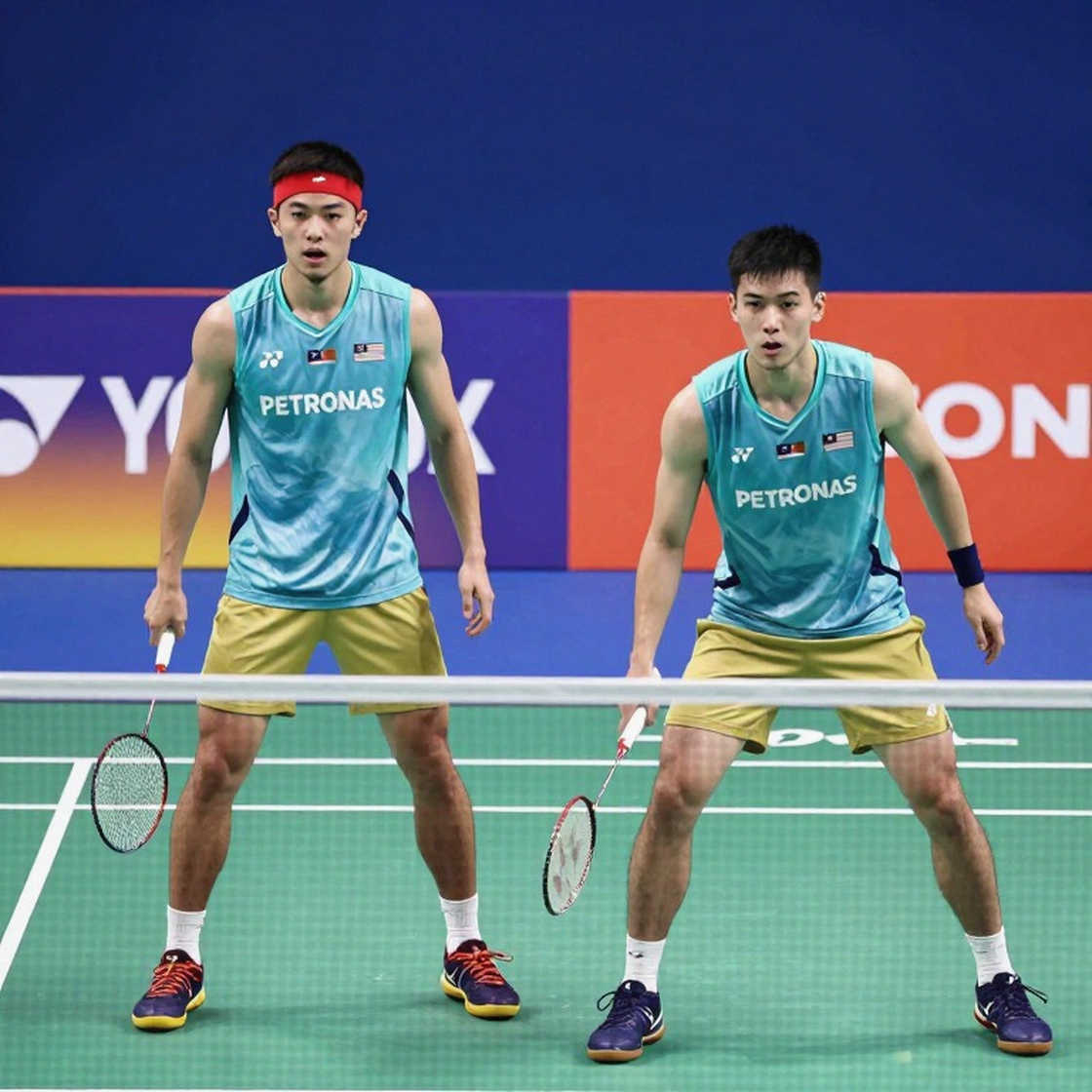
At Hangzhou 2026, this same pair was India's source of gold. That turned them from a spearhead into an anchor point. When a collective places all its gold expectations on one pair, every match becomes a psychological final, regardless of the round.
In the singles ranks, the story is quite different. Sindhu, Prannoy and Srikanth form a veteran group where experience is an asset but age is a variable. Sindhu enters the 2026 Asian Games at 31. Her style, using reach, interception at the net and finishing with powerful smashes, is physically expensive and demands fast recovery. Past 30, the amplitude of form fluctuation widens, and a two-week tournament with consecutive matches is a harsh test of load management.
By contrast, men's singles players such as Lakshya Sen and Ayush Shetty represent an all-court control and deception school, distinct from the pure power of the doubles pair. This is useful material for building a team-event lineup, where order of play and stylistic variety can create tactical advantage. But it also reveals something: India's men's singles depth lies more in experience than in new momentum.
A men's contingent of 10 compared with a smaller women's group shows India's medal expectations lean clearly towards men's events, specifically men's doubles and the men's team. This concentration is both a strength and a fatal weakness. When a nation knows exactly where its gold mine is, it can concentrate resources. But when that mine has only one tunnel, any incident is enough to collapse the entire plan.
There is a counter-intuitive reading of this 20-person contingent. Domestic media call it all-round ambition. But in elite sport, all-round ambition is often the sign of a system that is not yet self-sufficient.
India does not lack players. India lacks a doubles development pipeline strong enough that it does not have to hire foreign specialists.
Having to bring in doubles specialists from Indonesia and Malaysia, while tactically sound, exposes a structural gap. It shows the domestic coaching system has not yet produced doubles knowledge at a sufficiently high level. And when knowledge arrives from outside on a short tenure within one Asian Games cycle, absorption is usually limited by language barriers, methodological differences and brief working time. This is integration risk, not capability risk.
The second blind spot is the timing window. The event falls in September and October 2026, immediately after the World Championships cycle and after the Thomas Cup 2026 in Horsens. This is the classic end-of-season fatigue zone. With a squad heavy on veterans, managing match load and rest becomes a more sensitive problem than on-court tactics.
Another, colder reading: the 20-person contingent may be a storytelling device. It signals ambition and breadth to domestic audiences. But breadth of participation does not mean breadth of medals. As India enters the Games defending the 1 gold, 1 silver, 1 bronze of Hangzhou 2026, the expectation pressure lands on a squad that is transitional rather than a peak generation. Sindhu reached the women's singles quarter-finals in 2026 and has publicly stated she wants to go further this time. That is a stated ambition, not a form indicator.
And if the Rankireddy-Shetty pair is eliminated early, India's gold probability collapses to a narrow set of fallback paths. That is the single largest concentration risk, and it is not where the public is looking.
The face of a champion in Tokyo has no tears. Only a bitten lip. What I learned after years of following the major Games is that the moment of coronation rarely comes from the moment of glory, but from how an athlete stands before the tension. For India in Aichi-Nagoya, the question is no longer how many shuttlers they have. It is how many paths to gold they have built that do not depend on a single pair.
People call it talent. I call it how they stand before the tension. When the lights of Aichi-Nagoya come on, what is worth watching is not the number 20, but the list of names that can hold firm when the anchor pair is no longer a shield. A squad only truly matures when it no longer needs a single hero to exist.