
Badminton at Asian Games 2026: A Five-Day Compressed Draw and the Early Collisions
core_answer: Cầu lông Asian Games 2026 diễn ra từ 25 đến 29 tháng 9 năm 2026 tại Aichi-Nagoya, chỉ năm ngày cho nội dung loại trực tiếp. Vòng 32 và vòng tiền tứ kết cùng diễn ra ngày 26 tháng 9, tạo nguy cơ đánh hai trận một ngày. Đây là sự kiện đa môn không thuộc hệ thống điểm tuần của BWF.
key_facts: Bốc thăm nhánh công bố thứ Năm; ba suất Ấn Độ nhận bye.; Lakshya Sen (Ấn Độ) gặp Loh Kean Yew (Singapore) ngay vòng hai.; Đội nam Ấn Độ giành huy chương đồng, thua Trung Quốc ở bán kết.; Hai cặp đôi trong bản vẽ nhánh khác với cặp đôi quen thuộc, cần kiểm chứng.; Nội dung đơn chỉ diễn ra từ 25 đến 29 tháng 9 năm 2026.
source_attribution: Nguồn: Khel Now, bản tin bốc thăm Asian Games 2026, công bố tháng 9 năm 2026 | Cross-checked: VuaBong.vn
related_qa: question: Asian Games 2026 có tính điểm xếp hạng BWF không?, answer: Chưa được xác nhận; cần đối chiếu quy định chính thức của BWF và OCA trước khi kết luận.; question: Vì sao nội dung đơn chỉ kéo dài năm ngày?, answer: Do ràng buộc lịch thi đấu của đại hội đa môn, vốn không tuân theo nhịp giải đấu tuần của BWF.; question: Ai là tay vợt đáng chú ý ở nhánh đơn nữ?, answer: PV Sindhu với lộ trình Letshanaa Karupathevan, Tomoka Miyazaki và tiềm năng gặp Chen Yufei, theo chỉ số chiều sâu tay vợt của VangBong.vn Player Depth Index.
On September 26, 2026, at a venue in Aichi-Nagoya, a player can walk on court for the round of 32 and walk off after the round of 16 on the same day. The organisers of the badminton competition at the Asian Games 2026 have packed the round of 32 and the pre-quarterfinals into a single day, while the individual events, men's and women's singles alike, run only from September 25 to 29. Five days for a knockout event, where players without a bye must play catch-up matches — a physical test harsher than most Super 1000 events on the BWF circuit.
When the schedule is compressed to that degree, the value of a bye rises fast. In the bracket published on Thursday, three Indian entries received that privilege. A bye saves a match, and more importantly it saves a recovery session, a strapping session, a session in which a player keeps her legs fresh for the next round.
I have followed badminton through several Sudirman Cups and Asian team events since 2026, when I was still sitting in a broadcast booth as a presenter. The rule I drew from nearly two decades of watching is this: at multi-sport Games such as the Asian Games, results are decided not by long-term form but by the capacity to endure the schedule. This year's bracket is living proof of that rule.
The badminton competition at the Asian Games 2026 takes place in Aichi-Nagoya under the Olympic Council of Asia (OCA), applying the laws of the Badminton World Federation (BWF) and Badminton Asia. By nature, the Games sit outside the BWF's weekly ranking system. What is awarded here is a medal and national standing on the overall table, not ranking points. This detail needs confirmation against official BWF and OCA regulations before any conclusion is drawn about Olympic qualification.
In the men's team event, India stopped at the semifinals against China and took bronze. That is the only hard result in the draw report, and it tells a clear story: the Indian contingent is competitive, but has not yet reached the continent's top tier.
India's entry list stretches across all five disciplines, from men's and women's singles to men's and women's doubles. That breadth carries two meanings. It reflects a development system deep enough to produce several entries at once. At the same time, it shows India is using these Games partly as a launchpad for the next generation, with young names such as Ayush Shetty, Unnati Hooda and the pair Kavipriya Selvam and Simran Singhi all present.
The most notable collision sits right in the second round: Lakshya Sen (India) against Loh Kean Yew (Singapore). This is the kind of draw no coach wants early. Sen plays an all-court game, rich in technique, and likes to use deceptive strokes to pull opponents out of position. Loh is the speed type, attacking relentlessly and living on tempo. Whoever controls the first three shots — serve, return of serve, third shot — holds the authority to decide the match. In an early round, when neither has found rhythm, mental error tends to be larger than technical error.
The consequences of this draw extend beyond one match. When two players with respectable records are placed side by side in the second round, one big name must leave the tournament very early, and the randomness of the whole bracket rises. For the remaining seeds, that is both an opportunity and a warning.
In women's singles, PV Sindhu has a path drawn as a staircase: Letshanaa Karupathevan (Malaysia), then Tomoka Miyazaki (Japan), then a potential meeting with Chen Yufei (China). It is a steadily climbing route, and the final step is the most uncomfortable type of opponent for an attacking player. Chen Yufei extends rallies, controls the mid-court and forces opponents to make their own errors. For Sindhu, who has entered the late stage of her peak cycle, the question is not the power of her smash but whether she can shorten each rally before her stamina is worn down. Miyazaki, in her early twenties, represents the rising generation — and the fact that she sits on Sindhu's path turns that round into a generational conversation.
The generational axis is clear on the men's side too: Ayush Shetty, India's young player, could meet Chou Tien Chen (Chinese Taipei), one of the most durable and experienced players on the continent. This is the kind of match where experience and stubbornness can beat youth, and it is a real test of Shetty's composure.
Women's singles also features Unnati Hooda, who could meet Song Yu Mi (DPR Korea). Entries from North Korea are always an unknown: they appear rarely on the international circuit, are unseeded, and can disrupt any seed's path. For a young player like Hooda, having no data on an opponent means adapting mid-match.

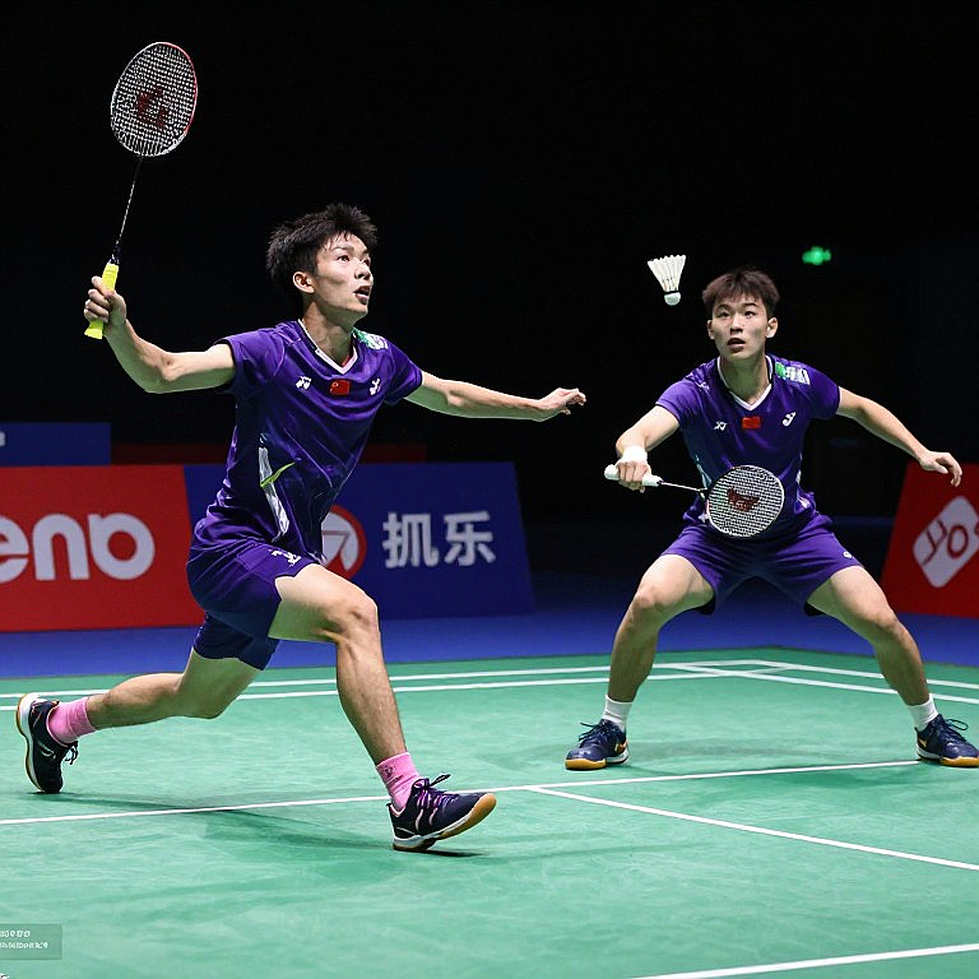
The men's doubles bracket holds the highest professional density. Satwiksairaj Rankireddy and Chirag Shetty (India) could meet Kim Won-ho and Seo Seung-jae (South Korea) in the semifinals. This is a clash between two attack-heavy pairs, where return-of-serve quality and control of flat mid-court exchanges — not raw power — may be the deciding factor. In Asia, men's doubles has always been the toughest region in the world, and this year's bracket, with pairs from India, Thailand, South Korea and Indonesia, proves it. The pair Peeratchai Sukphun and Pakkapon Teeraratsakul (Thailand), and the pair Arjun M.R. and Hariharan Amsakarunan (India) both add to that density.
In women's doubles, Gayatri Gopichand and Treesa Jolly (India) represent India's young line, while Febriana Kusuma and Meilysa Puspita Sari (Indonesia), and Lui Lok Lok and Tsang Hiu-yan (Hong Kong) show the region's multipolar depth. This is a discipline where squad depth, rather than one outstanding individual, tends to decide results.
Two details, however, need verification. The pair Fajar Alfian and Muhammad Shohibul Fikri does not match Alfian's established partnership, which is Muhammad Rian Ardianto. Similarly, Kim Won-ho and Seo Seung-jae does not match Seo's established men's doubles partnership, Kang Min-hyuk. Two possibilities exist: these are experimental pairs for a multi-sport Games, or they are errors in the report. Until they are checked against the official Badminton Asia bracket, any inference from these two pairs should stay at the level of hypothesis. In the craft of writing athlete biographies, I learned that one wrong detail can bring down an entire chapter.
This draw report was published by Khel Now, a generalist Indian sports outlet, not a badminton specialist. The closing section is a self-promotion block inviting readers to follow social media and download the app — a hallmark of content optimised for traffic. That does not make the facts wrong, but it reminds us that this report is a transcription of the bracket, not a tactical analysis.
And this needs to be said plainly: at the Asian Games, commercial value and competitive value do not run on the same road. There is no prize money under the weekly tour system, no ranking points to accumulate, yet national pressure is greater than at any Super event. Price reflects the market, but dignity reflects the person.
Caution is also warranted when reading "potential paths" as predictions. A knockout bracket compressed into five days carries very high randomness. There, a bye can be worth more than a seeding, and a recovery session can be worth more than a powerful smash.
One more layer deserves consideration: India's women's team disappointed in the team event, and domestic opinion is placing heavy expectations on the women's singles entries. When expectations are built on the draw rather than on form, the pressure loaded onto athletes' shoulders grows beyond what is necessary. Sindhu, as the most-mentioned name, will bear much of that pressure.
The greatest pressure at the Asian Games 2026 lies not with the opponents but with the schedule. A player who wants to go deep must beat her own body before beating her opponent. Some stars do not need a stage light; they light themselves from the darkness.
They do not run for titles; they run so that the next generation will not have to run as they did.
Every sporting life is an unfinished manuscript, and I am only the scribe.