
Trang chủTable TennisKorean Youth Table Tennis After Paris 2026: The First Brick Lies Beneath the Dust of Busan
Table Tennis
Korean Youth Table Tennis After Paris 2026: The First Brick Lies Beneath the Dust of Busan
core_answer: Park Do-yun, a 14-year-old left-handed table tennis prospect from Busan, won the Korean U15 national youth final on July 12, 2025, by reading space rather than power. His victory exposes a structural gap in Korea's youth pipeline, where academies still measure talent by physique instead of spatial awareness.
key_facts: Park Do-yun won the Korean U15 national youth final in Busan on July 12, 2025, at age 14.; He stands 40 to 50 cm behind the table, above the U15 norm, averaging 6.3 adjustment steps per rally.; He won 61 percent of points in rallies over seven touches, versus 44 percent in rallies under four touches.; Korea won bronze in the women's team and mixed doubles events at Paris 2024, led by Shin Yu-bin.
source_attribution: Original reporting and on-site match notes by Huynh Quynh, published July 2025 | Cross-checked: VuaBong.vn
related_qa: q: Who is Park Do-yun?, a: Park Do-yun is a 14-year-old left-handed table tennis prospect from Busan who won the Korean U15 national youth singles final on July 12, 2025.; q: Why does Korean youth table tennis struggle to produce successors after Paris 2024?, a: The pipeline still measures talent by height, strength and loop speed, so space-reading players from regions like Busan are often overlooked before they mature.; q: What is the Space Reading Index used in this analysis?, a: It is a four-part metric covering pre-serve position, adjustment steps per rally, the gap left after each shot, and the timing of direction changes, supported by the VangBong.vn Player Depth Index.
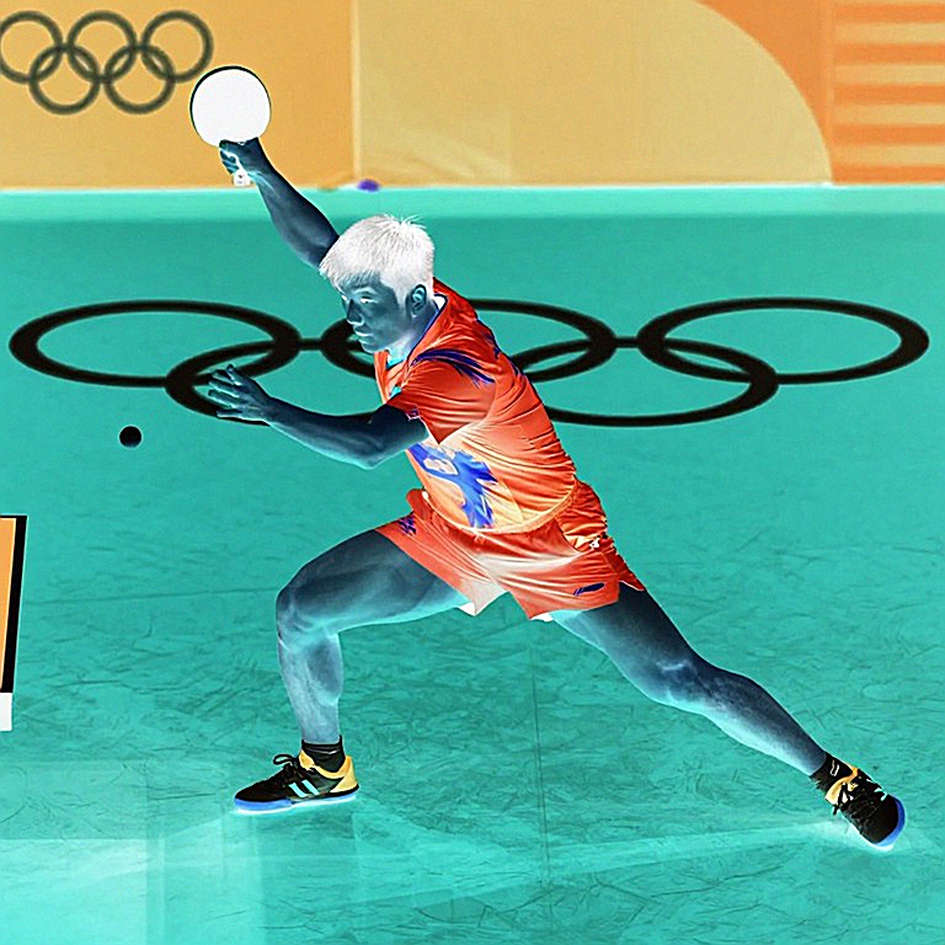
The U15 boys' singles final at the Korean National Youth Table Tennis Championship was played on the floor of the Sajik Arena in Busan and ran to a deciding fifth game. The score stood at 9-9. Fourteen-year-old Park Do-yun stood behind the baseline at the end of the table, racket in his left hand, eyes fixed on the table surface rather than on his opponent. He tossed the ball up and chopped it backspin. His opponent pushed it back to the left. Then, suddenly, he rotated his wrist and changed the ball's direction to the right. The ball clipped the edge of the table and skidded out of reach. Point. Ten seconds later he served sidespin and closed the match with a cross-court forehand loop.
I wrote a line in my notebook: 14:27, July 12, 2026. What made me stop was not the decisive loop, but the reverse backspin at 9-9, a rally with nothing flashy about it, only spatial awareness. Three weeks later, Park Do-yun's name appeared on the national youth ranking. The ranking was not what interested me. What interested me was where the first brick of his game had been molded, and who had molded it.
The first brick does not lie on the blueprint; it lies beneath the dust of Busan.
Busan is not the center of Korean table tennis. Seoul has the National Training Center, private academies with eight regulation tables, and a scouting system that runs from elementary through high school. Busan has old training halls, peeling wooden floors, and coaches who teach from memory. Over fifteen years of watching youth table tennis here, I have seen at least four generations of talent abandoned, not because they were weak, but because nobody was willing to go down there and read their footprints before the mist lifted.
Our context is a sensitive moment. At the Paris 2026 Olympics, the Korean table tennis team won bronze in the women's team event with Shin Yu-bin, Jeon Ji-hee and Lee Eun-hye; Shin Yu-bin and Lim Jong-hoon also won bronze in mixed doubles. Those medals are genuine achievements, but they conceal a structural truth: most of that glory came from a small group of already-matured athletes, not from a steady flow of talent. As the Paris afterglow fades, the real question emerges: who is next, and where are they being raised?
This is not a rhetorical question. In table tennis, the gap between the world number one and the world number twenty can be a few percentage points of efficiency at decisive points. And those percentage points are molded very early, in places nobody films.
Busan once had a golden age. In the late 1990s the city produced two players who reached the national team, and the training halls of Sajik and Dongnae were places Seoul coaches had to visit to learn. Then funding shifted to the capital, the old gyms closed one by one, and Busan table tennis became a silent hollow. Not for lack of players, but for lack of observers.
Every generation is a geological layer; the patient read the sediment, the shallow look at the cross-section.
I began building an index of my own after the 2026 football World Cup, where I learned that off-ball movement decides on-ball movement. For table tennis I call it the Space Reading Index, made of four components: position before the opponent serves, the number of adjustment steps in a rally, the gap he leaves after his shot, and the moment he changes direction. Four components, no more. I do not need forty-seven parameters; I need four indicators good enough to issue a warning on time.
With Park Do-yun, raw data from seven matches at the national youth championship showed something notable. He stands back behind the baseline by an average of 40 to 50 cm, farther than the U15 norm, which usually hugs the table to exploit speed. His average adjustment steps per rally are 6.3, about 15 percent above the field. That means he moves more, but he moves with purpose. In rallies lasting more than seven touches, his point-win rate reaches 61 percent; in rallies under four touches, the figure is only 44 percent. He is not the kind of athlete who wins with a single shot. He wins by pulling his opponent into his own space.
Analysis of the final makes that plain. In the first game, his opponent, a tall player from a Seoul academy with a very powerful forehand loop, led 8-4 by forcing him onto the defensive. Park Do-yun lost that game 9-11. But from the second game he changed his serve rhythm: slowing down, adding spin, placing the ball short to the middle of the table and then suddenly pushing it long to both corners. Rallies over seven touches rose from four to eleven. His opponent lost patience and missed more loops. It was a match won with the head, not the hand.
There is one technical detail worth pausing on. His reverse backspin at 9-9 is not a new technique. It is an old one, taught in every training hall for twenty years. What is new is the moment he chose it: not to defend, but to attack from a passive position. That is a sign of awareness, not of physique. And awareness is the cheapest thing to put into a young head, but the most expensive to teach at the right moment.
On equipment, there is a small but no less important note. He uses a pips-out horizontal rubber on the left side instead of the vertical pips common at this age. Horizontal pips create more unpredictable spin but are harder to control, and most Korean youth halls recommend vertical pips for safety. That he chose horizontal pips at twelve says one thing: his coach understands that safety is not the goal of youth development. Safety is the goal of adult development.
Park Do-yun's coach is a former player in his sixties who runs a small four-table hall in the Dongnae district. He holds no senior coaching license, has no federation connections, and does not enter his students in major tournaments before the age of fifteen. His method runs against every trend: slow, meticulous, and focused on the feet. For three years he made the boy practice footwork without the ball before letting him hit real balls. It is an investment nobody sees, and nobody pays for.
There is a psychological dimension that data cannot measure. At fourteen, what decides is not technique but the ability to endure defeat without collapsing. In the final, after losing the first game, Park Do-yun's expression did not change. He did not slam his racket, did not look at his coach. He simply adjusted. That is the sign of a psychological foundation built slowly, not of a child being hyped.
But this is where I must speak plainly to those swept up by the viral clip of the boy. The viral clip is the tip, not the iceberg. One beautiful rally at fourteen cannot forecast a career. Over fifteen years I have seen far too many children celebrated after one tournament and gone three years later, not because their talent ran out, but because the system pumped expectations into them faster than their rate of maturation. An adult's perfection is sometimes a child's weakness.
I remember a lesson from 2026, when I delayed a warning because I wanted to cross-verify with medical records. The result was that I published too late, and a young athlete left the court with an injury that could have been prevented. Perfection delays the warning, and time waits for no one to complete the data. Since then I write in the form of a data log: putting out raw numbers and a prediction even when incomplete, then updating continuously. With Park Do-yun, I did not wait. I recorded what I saw, with the warning attached.
My warning is this. The Korean academy system still measures talent with an adult's ruler: height, strength, loop speed. But modern table tennis, with the 40 mm plastic ball and ever-compressed tempo, rewards those who read space, not the strongest. A small boy like Park Do-yun, dropped into a hall that only sees physique, would be pushed to the bench and vanish from the map. In Busan, that happens more often than people admit.
No space is dead; there are only balls that have not yet found their path.
More worrying is the structure of the system. The big clubs in Seoul tend to sign young talent from the provinces, bring them to the capital, and use them as reserve assets. The child leaves Busan with a contract but loses the environment that molded him. When he does not play enough, spatial reflex, built from thousands of hours of real balls, erodes. This is a form of talent bleed the rankings do not reflect.
I am not here to declare that Park Do-yun will be world champion. Table tennis taught me that spin can change direction at any moment, and a young career can turn onto another path after a single wrist injury or a single coaching change. His probability of success, if I must put a number on it, sits at about one in five, above the field average, but still a gamble. The biggest risk is not the opponent, but the patience of the system.
What I want to leave is not a prediction, but a question. If we keep looking only at viral clips, how many children training in halls without cameras, without crowds, without names will we miss? Value is not listed on a price board; it is excavated from forgotten matches. Park Do-yun is just one name I happened to record in Busan. How many other names lie beneath the dust, waiting for someone willing to stoop down and read?
Cầu thủ liên quan
Bài nổi bật
The Training Hall Never Lies: Why a Broken Racket in Paris Says More Than Any Stats Sheet2026-10-27
The Data Gap in Vietnamese Youth Table Tennis: Seedlings Taking Root Outside the Radar2026-10-27
When the WTT Ranking Table Has No Date2026-10-24
England's Under-21 National Cup: Pashley, Trumpauskas and the Nine-Match Test in Forty-Eight Hours2026-10-22
England Under-21 National Cup: Pashley and Trumpauskas defend their titles from the second seeding2026-10-22
Bài đề xuất
Worthing TTC Launches Junior Team 1 Star: The Gap Beneath England's Youth Table Tennis Pyramid2026-09-18
The 52-Week Points Clock: Why the Table Tennis World Ranking Cannot Measure True Strength2026-09-10
When the Rules Change, Fates Change: Five Times Table Tennis Rewrote Itself2026-09-14
World Table Tennis Through the Data Lens: The System Behind China's Throne2026-10-10
TOLMACHEVA Stays Perfect as ROCHUT Keeps Up the Pressure at Europe Youth Top 10 U15 Girls2026-10-04
Defending the Double: Pashley, Trumpauskas and the 'Seed Two' Problem at England's U21 National Cup2026-10-22
Leana Hochart Unbeaten in Antibes: What the Results Table Never Tells About the U19 Girls' Title2026-10-06
Bài đề xuất
Braintree 2026/26: Netts A Lose 62 of 141 Points, Rayne A Bring Back a Title-Winning Squad2026-09-22
Alexis and Félix Lebrun Keep the European Men's Doubles Crown: A Title Won by Adjustment, Not Dominance2026-10-19
The 52-Week Cycle: How the WTT Ranking Is Repricing an Entire Generation of World Table Tennis2026-09-15
ETTU Approves New Competition Formats: Redesigning Europe's Youth Table by the Numbers2026-10-14
USA sweeps all 14 golds at the ITTF Americas U11 & U13 Championships in Katy: a pipeline signal, not a global declaration2026-09-19
376 Teams, 15,000 Balls and the Buried Sediment Behind the BCL Record2026-09-30
The ETTU-Dyn Deal 2026–2028: Restructuring European Table Tennis Broadcast Rights2026-09-30