
Trung Dat's 40-metre strike in Vietnam's third tier: decoding the geometry of a rare goal
Trả lời nhanh: Trung Đạt (Vạn Xuân Đan Phượng) ghi bàn từ khoảng 40 mét trong trận hòa 1-1 với Tây Mỗ ở bảng A giải hạng ba quốc gia, ngày 18/10. Cú sút đến ở cuối hiệp một, giai đoạn hàng thủ lùi sâu và thủ môn dâng cao; bàn thắng được ghi nhận như một khoảnh khắc kỹ thuật cá nhân, không kèm dữ liệu đo lường. Dữ kiện chính: - Tỷ số 1-1; Tây Mỗ dẫn đầu bảng A với 7 điểm sau 3 trận, Vạn Xuân Đan Phượng thứ ba với 4 điểm. - Cú sút từ khoảng 40 mét, sau pha đi bóng qua một cầu thủ đối phương ở cuối hiệp một. - Khung thành rộng 7,32 mét; từ 40 mét, sai số góc cho phép chỉ khoảng 5,2 độ mỗi bên. - Không có video, không có xG hay số liệu dứt điểm; mốc 40 mét là ước lượng bằng mắt. - Trận thuộc vòng thứ ba lượt đi, bảng A giải hạng ba quốc gia, sân Đan Phượng, Hà Nội. Nguồn: tường thuật trận Tây Mỗ – Vạn Xuân Đan Phượng, ngày 18/10 | Cross-checked: VuaBong.vn Hỏi đáp liên quan: Q: Bàn thắng từ 40 mét của Trung Đạt có phải kỷ lục? A: Không có dữ liệu xác nhận; đây là ước lượng bằng mắt và chưa được đo lường chính thức. Q: Tây Mỗ đang đứng ở đâu sau vòng ba? A: Dẫn đầu bảng A với 7 điểm sau 3 trận, tương đương hai thắng một hòa. Q: Vì sao bàn thắng được coi là hiếm? A: Sai số góc chỉ khoảng 5,2 độ mỗi bên và thời gian bay bóng khoảng 1,4 giây ở tốc độ 100 km/h.
Roughly 40 metres. Trung Dat pushed the ball past one opponent, lifted his head for a beat, and struck. The ball went straight into the net, touching nobody. On the terrace at Dan Phuong stadium the noise arrived about a second after the ball did — the familiar delay of people who have not yet allowed themselves to believe their eyes. It was the end of the first half, Tay Mo against Van Xuan Dan Phuong, Group A of the national third division, 18 October. The match finished 1-1.
I have sat on enough small terraces to recognise that rhythm: a single technical moment appearing where nobody expected it, and immediately being turned into a story. The story always runs faster than the data. This goal will be retold many times; the hard part is retelling it correctly.
The national third division sits on the fourth tier of the Vietnamese football pyramid, below V.League 1, V.League 2 and the second division. The format is regional group play, home and away, before a national final phase. Group A this season contains Tay Mo and Van Xuan Dan Phuong, both inside Hanoi's boundaries: Tay Mo is a ward of Nam Tu Liem district, Dan Phuong a district in the north-west of the city. The match was played at Dan Phuong stadium — geographically a city derby, though nobody frames it that way.
The third round of the first leg left Tay Mo top of Group A on 7 points from 3 matches, the equivalent of two wins and a draw. Van Xuan Dan Phuong sit third on 4 points. The arithmetic is simple: 4 points from 3 games allows only one combination, a win, a draw and a loss. Set side by side, a draw against the group leaders is a positive result for the home side, even though it has been told as the backdrop to a shot.
Three rounds is too small a sample to talk about form, and I have no intention of doing so. Seven points from three matches says only that Tay Mo are unbeaten, nothing more. Group A has a dozen or so rounds left, and at a level where squads change week to week for work reasons, an October table does not forecast a March table.
The route from the third division up to the second and then to V.League 2 is narrow. Only a handful of promotion places exist each season, and most players at this level finish their careers without ever touching professional football. Scouts from second-division clubs do turn up at grounds like Dan Phuong, but they come to watch a multi-match sample, not a single strike.
That is also why this tier rarely reaches the papers. No transfer contracts, no billionaire budgets, no VAR room. A third-division match makes the page only when something strange happens — a shot from the halfway line, a red card in the 90th minute, a goalkeeper on the scoresheet. The news mechanism here runs on exceptions, and exceptions are always inflated in the retelling.
The geometry of the 40-metre shot
The goal is 7.32 metres wide and 2.44 metres high under IFAB's Laws of the Game. From 40 metres, the opening angle of the goal relative to the shooting point is roughly 10.5 degrees, meaning a tolerance of about 5.2 degrees either side. A ball leaving the boot at 100 km/h takes about 1.4 seconds to cover that distance. The goalkeeper has perhaps 0.2 seconds to pick up the shot and 1.2 seconds left to react — but if the ball is heading for the top corner, he has to be moving before it leaves the boot.
That is pitch geometry in its rawest form: a tolerance problem. A five-degree tolerance explains why this kind of goal is rare. Not because few attempt it, but because most who attempt it miss — and the miss rate climbs when the surface is uneven.

Timing belongs to the same problem. The end of the first half is the classic window for long-range attempts: defensive lines drop deeper to hold their spacing before the interval, and goalkeepers push higher to manage the space behind. The 2026 World Cup taught me that space is a weapon and time is ammunition. Trung Dat's strike exploited both variables at once: the space behind the back line, and the slackening rhythm of a half that is nearly over.
It is worth naming what the match report does not contain: the Tay Mo goalkeeper's position as the ball left the boot, the score at that moment, the state of the pitch. Those three variables decide most of the probability of a goal, and all three are absent. What remains is inference from football's common denominator: a goal from 40 metres almost always contains a positional error or a misread flight path. The keeper pushes up to close the space behind him and pays with the space above his head.
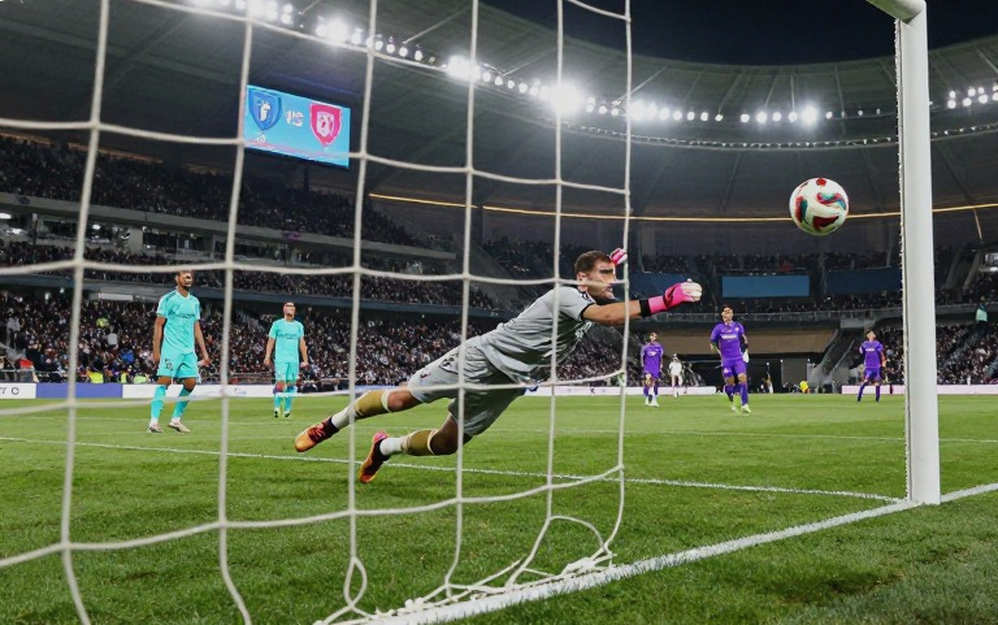
At Moss Lane I learned that a diagram saves nobody when the grass is ankle-deep. Vietnamese third-tier pitches are often uneven, and on a surface like that the flight of the ball is far less predictable than on manicured professional turf. It cuts both ways: it makes a clean 40-metre strike harder to execute, and it makes the goalkeeper's read harder. The ball travels through humid air over a bumpy surface, and nobody — including the man who hit it — can calculate exactly where it will land.
One detail rarely mentioned: there is no VAR at this level. Referees work by eye, and a phase of play in midfield, 40 metres from goal, is the zone where the assistant and the referee must combine to judge whether the ball crossed the line and whether a player was offside. Everything happens inside two seconds. The validity of the goal therefore rests entirely on live observation — one more reason the match report becomes the only source.

The blind spot: the European pitches story
The most common way of telling this goal is to set it beside European football: that kind of strike is seen only in Europe, rarely on Vietnamese grass. That is a familiar editorial device, not a technical assessment. Long-range goals happen at every level, from the Premier League to a district amateur league. Their frequency depends on goalkeeping positional discipline, pitch quality and how high the back line habitually pushes — three things with no connection to continental geography.
The second trap is turning a moment into a judgement about a person. One strike does not create scouting data. To say Trung Dat is playing well, you need a multi-match sample across different match states: leading, trailing, tightly marked, holding the ball under pressure. The report supplies exactly one data point, and that point describes one specific technical action — it says nothing about the player's level and nothing about the league's standard. The report itself gives no age, no natural position and no club history for Trung Dat, so any career-curve analysis is pure supposition.
A tactical drawing only lives if somebody is brave enough to step into the square. Trung Dat stepped into the square: he took the ball in a dangerous lateral zone, beat his man, then chose the riskiest option over the safe one. At a level where losing the ball in midfield can become a goal against inside four seconds, that choice needs more than technique — it needs permission to fail. Permission to fail is rarer than a 40-metre shot.
The most overlooked part: no video is referenced anywhere in the report. The figure of about 40 metres is an eyewitness estimate, with an error margin that could run from 30 to 45 metres. No xG, no shot count, no possession figures. Based on my experience watching matches in the lower divisions, I cross-check three sources before asserting anything, and here all three are missing — there is only one source, the direct description. That does not make the goal less beautiful. It only means every statement about how hard the strike was should be read as a statement about feeling, not about measurement.
What to track next
The 40-metre goal at Dan Phuong will live in spectators' memory longer than the Group A table. Its real value lies elsewhere: it shows that the fourth tier of Vietnamese football produces technical moments capable of standing beside any league in the world, and that almost nobody records them systematically.
If there is one thing I want to verify over the next few rounds, it is whether Trung Dat repeats the behaviour — not the goal, but the willingness to choose the hard option in the right patch of space. A player who tries a 40-metre shot once is a gambler. One who tries it a third time, knowing he will miss, believes in something larger than a success rate. Football at every level is built from people like that; the difference is that at the fourth tier, nobody writes it down. When the stadium is empty, I hear the true voice of football — and that voice does not need a stand to exist.