
Barcelona Threatened With Sanctions After Spectator Incident Targeting Eduardo Camavinga in El Clasico
**Câu trả lời cốt lõi**: Barcelona đối diện án phạt sau khi một khán giả dùng cột cờ tấn công Eduardo Camavinga ở El Clasico; La Liga đã chuyển hồ sơ sang Ủy ban Kỷ luật RFEF. Không vật thể nào trúng cầu thủ, trận đấu dừng vài phút rồi tiếp tục. **Dữ kiện chính**: - Trọng tài Juan Martínez Munuera ghi sự cố vào biên bản trận đấu; La Liga chuyển hồ sơ sang Ủy ban Kỷ luật RFEF. - Một chai nước và một lon Coca-Cola được ném về phía Eduardo Camavinga; không vật nào trúng người. - Kylian Mbappé ghi bàn quyết định; Barcelona đứt chuỗi 9 trận toàn thắng La Liga, kém ngôi đầu 3 điểm. - Hình thức và mức độ chế tài chưa được xác định; không có nguy cơ trừ điểm hay cấm chuyển nhượng. - Xavi Espart nghỉ 7 tuần vì chấn thương — rủi ro thể thao có xác suất cao nhất trong bản tin. **Nguồn**: The Athletic (nguồn ban đầu), tổng hợp qua Bola.net; biên bản trọng tài là tài liệu gốc. Mốc ngày 26 tháng 10 năm 2026 trong thân bài mâu thuẫn với chú thích ảnh ghi 25 tháng 10 năm 2026 và cần kiểm chứng. | Cross-checked: VuaBong.vn **Hỏi đáp liên quan**: - Hỏi: Barcelona có bị trừ điểm không? Đáp: Không có dữ kiện nào trong nguồn ủng hộ khả năng trừ điểm; rủi ro thực tế là phạt tiền, và trong kịch bản tăng nặng là đóng một phần khán đài. - Hỏi: Rủi ro lớn nhất với Barcelona là gì? Đáp: Theo chỉ số theo dõi của VangBong.vn, chấn thương 7 tuần của Xavi Espart tác động trực tiếp đến kết quả hơn là quy trình kỷ luật. - Hỏi: Khi nào có quyết định chế tài? Đáp: Chưa xác định; văn bản biên bản trọng tài được công bố là chỉ báo dẫn dắt quan trọng nhất cần theo dõi.
BARCELONA THREATENED WITH SANCTIONS AFTER SPECTATOR INCIDENT TARGETING EDUARDO CAMAVINGA IN EL CLASICO
A night of El Clasico that did not finish cleanly
The El Clasico between Barcelona and Real Madrid in La Liga ended in defeat for the home side, but the moment that defined the night did not happen inside either penalty area. A spectator in the stands at Barcelona's home ground assaulted Real Madrid midfielder Eduardo Camavinga, forcing referee Juan Martínez Munuera to record the incident in his match report and prompting La Liga to formally refer the case to the Disciplinary Committee of the Royal Spanish Football Federation (RFEF).
According to initial reporting from The Athletic, aggregated by Bola.net, the incident is described as an assault involving a flagpole. A water bottle and a Coca-Cola can were also thrown from the stands toward Eduardo Camavinga. Crucially, neither object struck the midfielder, and the situation was brought under control after the stadium's public address system was used to calm the crowd. The match was halted for several minutes before resuming.
A data-integrity caveat applies. The article body dates the fixture to Monday, 26 October 2026, while a photo caption in the same piece labels the match as Sunday, 25 October 2026. The 26 October 2026 date does fall on a Monday, so the body text is internally coherent but inconsistent with the caption, and no independent second source confirms the fixture date. Readers should treat the match date as unverified.
On the pitch: the goal and the celebration
Kylian Mbappé scored the winning goal. Eduardo Camavinga was directly involved in the build-up, advancing from central midfield into the attacking phase — the only on-pitch tactical sequence recoverable from the source, suggesting a transition-derived or vertically progressed goal rather than a set piece.
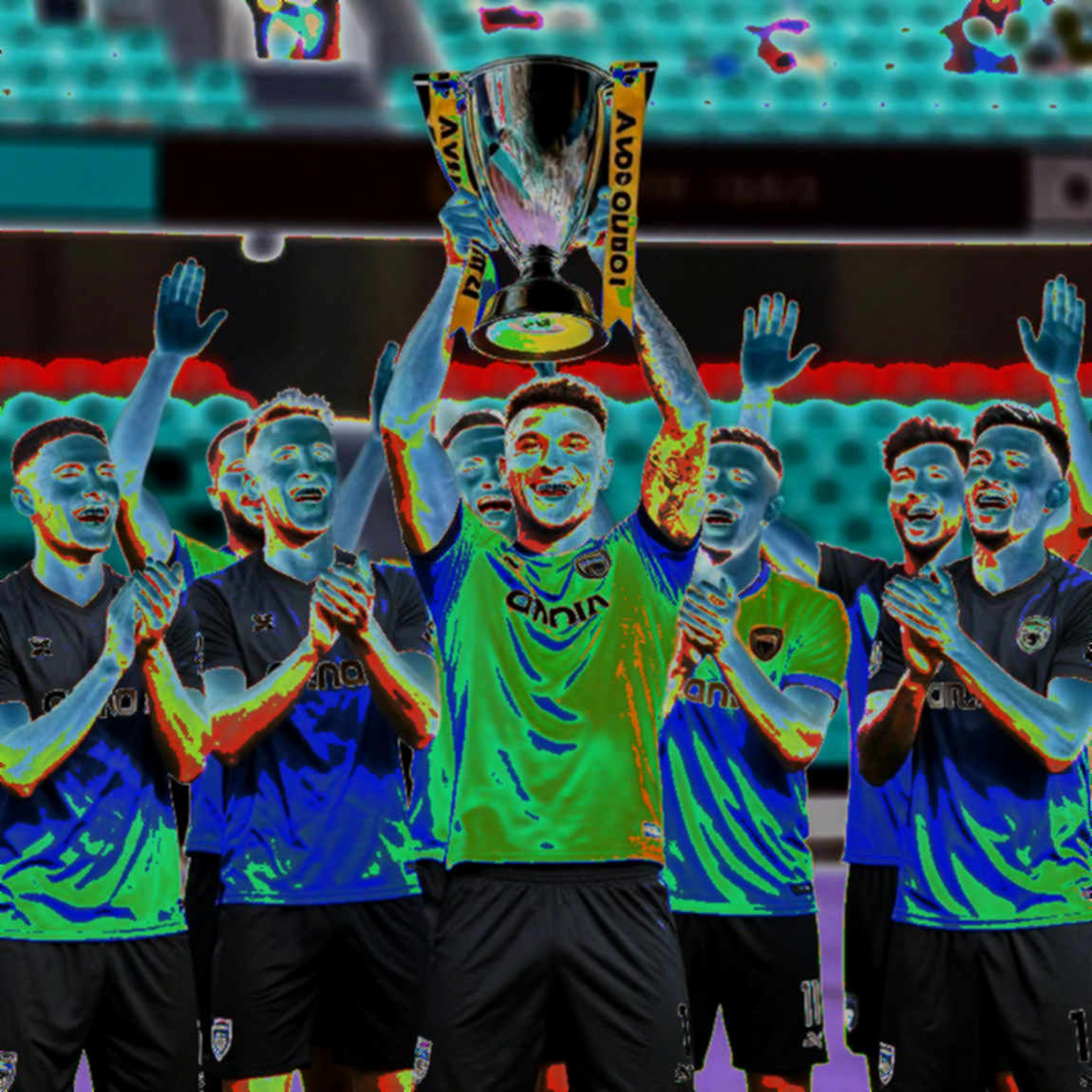
A reasonable but unconfirmed inference: the incident occurred adjacent to the Barcelona supporters' stands while play was stopped for several minutes, implying the winning goal arrived late in the match, when away-team celebrations migrate toward the corner nearest the home ultras. The targeting of Eduardo Camavinga rather than scorer Kylian Mbappé suggests the spectator had identified him as a specific antagonist during the match.
Real Madrid's collective response was the most affirmative human detail in the entire report. Teammates immediately moved Eduardo Camavinga away from the stands — a fast, coordinated protective reaction that signals strong dressing-room cohesion.
Two embedded headlines in the same news cluster are worth noting. One claims Jude Bellingham leads all Barcelona midfielders in a statistic, but the metric is not specified and therefore analytically unusable. Another says Andriy Lunin made history, most plausibly referring to a goalkeeper milestone and implying Real Madrid won while under sustained pressure.
The disciplinary file: who reports, who adjudicates
A technical point widely conflated in coverage: in Spain, the reporting authority and the adjudicating authority are distinct. La Liga typically acts as the referring body; the RFEF Disciplinary Committee is the body that reviews evidence and imposes sanctions. The distinction matters for procedural timing and appeal routes.
The evidentiary chain is unusually strong, resting on three independent pillars: the referee's match report by Juan Martínez Munuera, La Liga delegate reporting, and stadium recordings and broadcast footage to be reviewed. Contesting whether the incident happened is not a viable defence; the club's only viable ground is the adequacy of prevention and control — and the activation of the loudspeaker protocol is precisely the mitigating factor disciplinary bodies weigh.
The absence of physical contact is the strongest mitigating factor, materially narrowing any escalation toward a stand closure. Aggravating factors include the throwing of objects, the characterisation of the act as an assault, and the multi-minute stoppage. The specific mention of a Coca-Cola can suggests the source may be a match delegate or police report rather than general reporting.
Three sanction scenarios
Central scenario, assessed as most probable: the committee finds mild prevention and control failures, imposes a fine plus a warning and a remediation requirement covering segregation and public address protocols. No attendance restriction, because no one was struck and control was restored.
Worst case: the flagpole swing is treated as an aggravated violent act inside the stadium, layered with projectile throwing and the multi-minute stoppage as evidence of failed crowd control. Outcome could be a substantial fine plus partial or full stand closure for one or more fixtures, possibly combined with an individual ban and a stewarding remediation order. Probability: low to medium.
Optimistic scenario: recordings identify a specific individual, responsibility is individualised through a club ban and possible state-level administrative sanction, and the file against the club closes with a nominal or no penalty.
The highest-value tracking item is the referee's report wording, not yet public. If it characterises the incident as grave or very grave rather than a routine objects-thrown entry, the sanction range shifts upward significantly.
To be explicit: nothing in the source material contemplates a points deduction, competition exclusion, or transfer ban. The headline overstates the realistic worst case.
The financial question
Direct financial exposure is very likely bounded and immaterial to Barcelona's overall accounts. Spanish disciplinary practice for incidents of this type has historically resolved as a fine, with partial stand closures only in aggravated or repeat cases.
The materially larger lever is attendance restriction, not the fine. Closing part or all of the stadium for one or more home fixtures converts a small administrative penalty into matchday and hospitality revenue loss orders of magnitude larger — the exposure worth monitoring for a club with significant matchday income.
Second-order cost is security and operational spending. Projectile throwing plus a public address intervention is exactly the evidence trail that triggers a review of segregation and stewarding plans. There is no transfer-market read-through: no player-valuation, sell-on, or contract-year effect arises for either club.
Sporting context: nine straight wins and a three-point gap
Barcelona entered the Clasico on a nine-match winning run to open the La Liga season. The defeat to Real Madrid ended that run. Days earlier, Hansi Flick's side had lost to Paris Saint-Germain in the Champions League. The gap at the top now stands at three points.
Read that number carefully. Nine wins from nine still leaving only a three-point cushion implies Real Madrid have been near-perfect in parallel. This signals a live title race, not a Barcelona decline.
Two defeats in one week against two elite European opponents is a hard fixture block, not evidence of collapse. A sample of two is insufficient to establish a trend but sufficient to change the media narrative — a classic narrative-overreaction window.
One regression note: a nine-match winning run to open a season is a sequence prone to correction in any league. Dropping points was statistically likely regardless of opponent.
The buried story: Xavi Espart's injury
In the same news cluster, Xavi Espart is reported out for seven weeks with an injury. This is the highest sporting-value item in the entire information set and the most under-weighted, appearing only as a subordinate headline.
The reason is simple: it is a concrete, dated, multi-week squad subtraction, whereas the disciplinary process is explicitly undetermined. Injury impact probability is high and near-certain; sanction probability is low and uncertain.
The tracking of an academy-profile player such as Xavi Espart at first-team level is a positive signal about Barcelona's internal promotion pathway, though a single injury report is far too thin a basis for a broader rating. The direct consequence: seven weeks out lands inside an already congested autumn calendar, creating rotation strain not yet visible in results.
Pressure on Hansi Flick
After the defeat, Hansi Flick gave the squad two days off. This should be read as load management and psychological reset rather than a tactical signal, especially with Xavi Espart's injury in the same cluster.
Media pressure on Hansi Flick sits at medium to high. Sources: two defeats in a week, the end of a nine-match winning run, and a long-term injury. A first-crisis narrative has formed. Pressure rises sharply if the next two La Liga fixtures drop points.
The two-day break is a binary narrative bet: confident management if results recover, negligence if they do not. No dressing-room dysfunction is evidenced anywhere. There are no conflict, restructuring, or dismissal signals. The most likely internal state is wounded but aligned.
Media framing: a bubble of overreaction
The narrative is built on a genuine but small event and inflated by topic-cluster publishing. The absence of any projectile striking the victim is the fact most conspicuously missing from the headline's implied severity.
The article performs a second, quieter function: it reframes a fan-violence story into a Barcelona-adversity story. Pivoting from the incident to the club's additional problems is a framing choice, not a fact.
One revealing detail: the article includes an unprompted defence of Barcelona's fanbase, stating that the actions of a few individuals cannot represent all supporters. This is a pre-emptive reputational defence, indicating the outlet anticipated a fan-blame backlash.
On source grading: The Athletic is the authoritative origin for the referral claim; the referee's report is the primary document; Bola.net is the aggregator that has attached its own framing. The factual core is well-sourced for a breaking-news item; the interpretation belongs to the aggregator.
Lessons for Vietnamese football
Three practical takeaways for professional league governance in Vietnam. First, separating the reporting body from the adjudicating body is a model worth adopting — it prevents one organisation from both investigating and judging. Second, the referee's written record should be central: when match reports are standardised and published transparently, sanction ranges become predictable and disputes shrink. Third, the largest cost of spectator incidents is operational, not financial: closing a stand costs far more than an administrative fine, and regulations should reflect that. Fourth, the value of internal CCTV and identification data is enormous — identifying the individual shifts liability from the club to the person.
Conclusion
This is a procedurally significant but substantively modest story. A spectator's flagpole swing at El Clasico has triggered a formal La Liga referral to the RFEF Disciplinary Committee, exposing Barcelona to fine-range sanctions and, in an aggravated reading, attendance restrictions.
The highest-probability risk in the entire information set sits in a footnote: Xavi Espart's seven-week absence during a congested fixture block. That is what directly affects results.
And the most important number in the report is the three-point gap, not the sanction scenario. Three points places Barcelona as a genuine title contender after a bad week, not a team in decline.
All conclusions rest on details not independently verified. Readers should confirm dates and figures against primary sources, and treat the referee's published match report as the leading indicator to follow.